22 Proven Tips for High-Impact Agent-to-Agent Digital Flyer Campaigns in 2026
If you're sending digital flyers to other agents and not seeing the response you expect, you're not alone. The truth is that agent-to-agent email marketing is a completely different animal than marketing to home buyers. Agents have busy inboxes, skeptical eyes, and they're quick to delete anything that feels like a waste of their time. But when you get it right, digital flyers can be one of the most effective ways to get your listings in front of other agents and their clients. This guide breaks down 22 proven strategies to make sure your flyers actually get opened, clicked, and forwarded to potential buyers.
The difference between a flyer that lands in the trash and one that generates real leads comes down to understanding what agents actually care about and how they engage with email. Over the past few years, real estate professionals have analyzed millions of email campaigns, and the data tells a clear story about what works and what doesn't. Let's dive into the specific tactics that will improve your results in 2026.

The 3 Big Hurdles Every Agent Faces
Before we get into the 22 tips, it's important to understand that every digital flyer campaign faces three major challenges: getting delivered, getting opened, and getting action. Each of these requires a different approach, and they build on each other. You can't get someone to share your flyer if they never see it in the first place, and they won't see it if your email gets trapped by spam filters. The strategies in this guide address all three challenges systematically.
PART 1: DELIVERY
Getting Your Flyers Delivered (Tips 1-5)
Tip 1: Verify Your Email Provider Isn't on a Blacklist
This is the most fundamental step, and many agents skip it. If your email service provider has a poor reputation or appears on major blacklists like Spamhaus or Barracuda, your flyers won't reach agents no matter how good they are. Before you invest time and money in campaigns, check where your email service stands. This takes 10 minutes and could save you from months of wasted effort. Many agents don't realize their service provider has been slowly accumulating complaints that damage everyone's inbox placement.
Tip 2: Use Text Combined with Photos, Never Image-Only Flyers
An email made entirely of images without regular text is one of the easiest targets for spam filters. Beyond the technical problem, image-only emails also have much lower engagement rates and don't display well on mobile devices. Agents won't interact with them the same way. Instead, combine compelling text descriptions with professional photos. This approach works better with filters, provides more information to agents, and adapts better to the different devices they use to check email.
Tip 3: Avoid Spam-Trigger Words in Your Subject Line
Certain words are red flags for email filters, and some are especially problematic in subject lines. The word "Opportunity" is a classic example. It's a perfectly legitimate word in real estate, but using it in the subject line will cause a percentage of your emails to get flagged as spam. "Investor Opportunity" in the subject line is a common culprit. The same goes for words that create artificial urgency like "Hurry," "Act now," "Limited time," or "Won't last." Using these words in the flyer body is fine, but keep them out of the subject line. Agents trust their own judgment about how hot a listing is anyway, and hard-sell language backfires with professional audiences.
Tip 4: Skip URLs in the Subject Line and Be Careful with Link Placement
Spam filters are more likely to trap emails that put URLs directly in the subject line. If you're promoting a virtual tour or livestream, mention it in the subject line by name, but don't include the actual link. Save the clickable link for the email body where it's much safer. This small change can improve your deliverability noticeably.
Tip 5: Verify Authentication Protocols (SPF, DKIM, DMARC)
This is the technical foundation of good inbox placement. Make sure your email provider has set up proper authentication protocols (SPF, DKIM, and DMARC) on your domain. These prove to email providers that you're a legitimate sender. Without these, even great content won't reach inboxes consistently. If you don't know what these are, ask your email service provider to confirm they're configured. This is a standard feature on modern platforms and usually takes minutes to set up.
PART 2: OPEN RATES
Getting Your Flyers Opened (Tips 6-10)
Tip 6: Craft a Subject Line That Stands Out from the Crowd
The subject line is everything. It's the only thing agents see in their inbox before deciding whether to open your email or delete it. Real estate agents receive hundreds of emails, and your subject line has to be better than the noise. Keep it short (30-35 characters is ideal) so it doesn't get cut off on mobile phones. Put the most important information at the beginning since mobile screens cut off the rest.
For agent-to-agent emails, state the main feature directly instead of asking a question. Instead of "Looking for a main floor master?" write "New Listing: Main Floor Master in [Neighborhood]." Agents know the market well enough to judge properties themselves, and they want to know the news immediately. Generic subject lines like "Market Update" get ignored. Be specific.
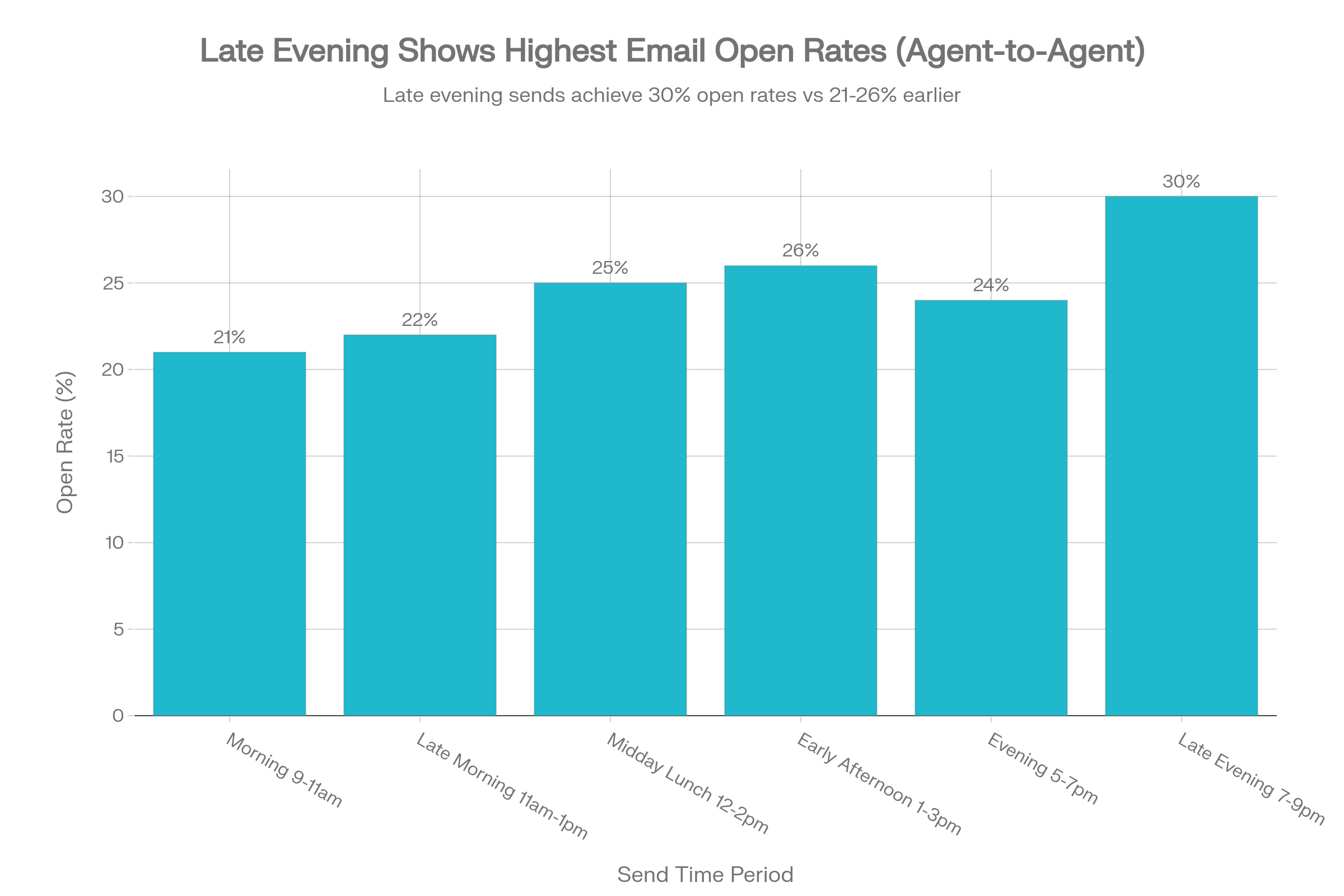
Average email open rates by send time for real estate agent-to-agent marketing campaigns
Tip 7: Use Your Personal Name as the Sender, Not Your Company
When an email comes from "John Doe" instead of "John Doe Real Estate Team" or "ABC Realty Company," agents are more likely to open it. People respond to people, not companies. A recognizable name builds a sense of personal connection and credibility. If you operate as a team, put the main agent's name first and your brokerage second. This approach dramatically improves open rates because it feels like professional correspondence rather than mass marketing.
Tip 8: Send Between 9 AM and 2 PM for Best Open Rates
The timing of your send matters more than most agents realize. Research shows that the optimal open rates for real estate emails happen between 9 AM and 2 PM in the recipient's time zone. More specifically, emails sent between 8-10 AM or 1-3 PM achieve open rates of 20-28 percent, with Tuesdays through Thursdays delivering the best results. Avoid Mondays (agents are drowning in overnight emails) and Fridays (everyone is mentally checked out for the weekend). Sundays and major holidays also see lower engagement.
The reasoning is simple: when agents first sit down on Monday morning, they have a massive backlog of spam and promotional emails from the weekend. Your flyer will get lost in the noise. By midweek, they've cleared some space and are more focused on work. By Friday afternoon, their attention is elsewhere.
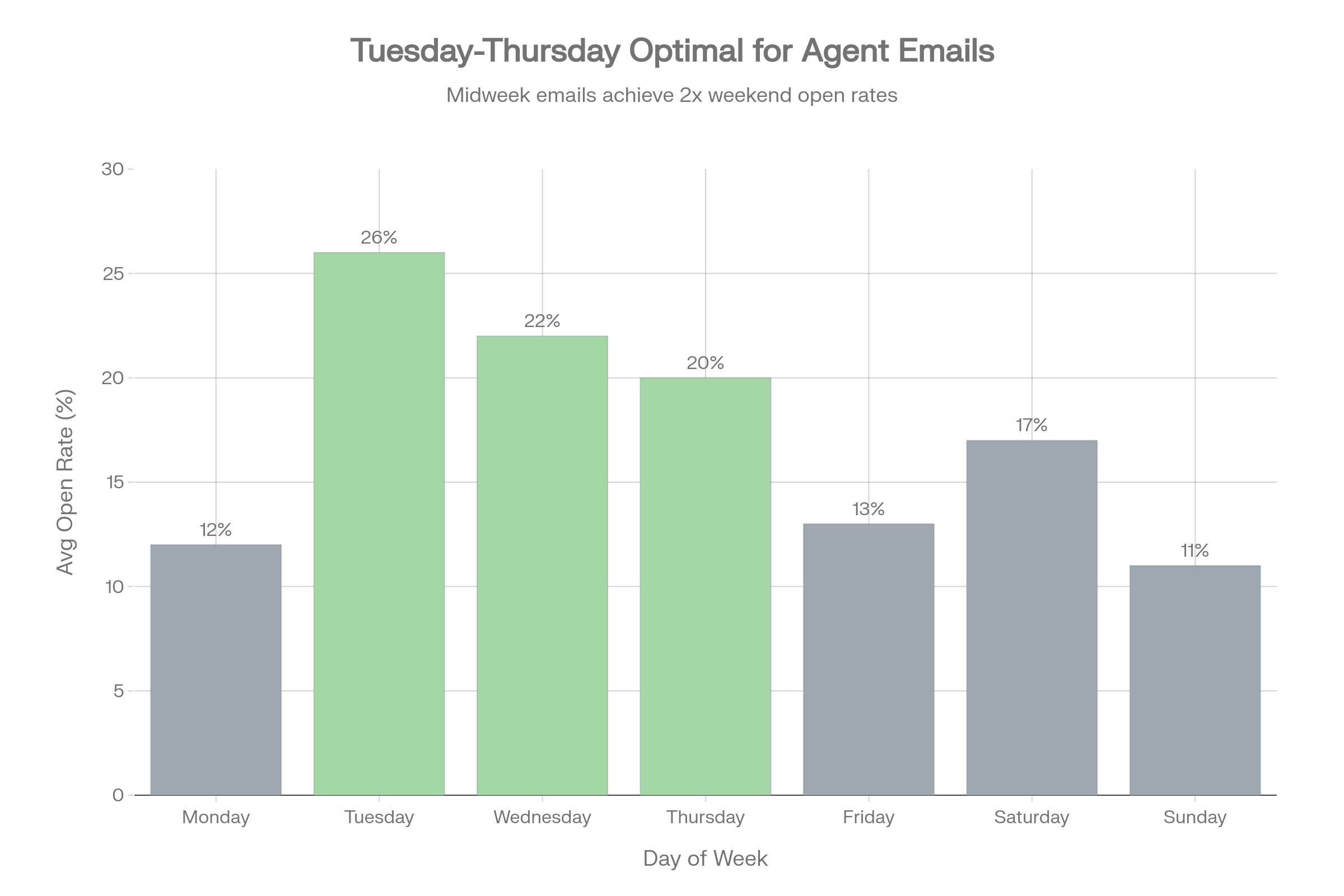
Email open rates by day of the week - Tuesday through Thursday show highest engagement
Tip 9: Avoid "Scarcity Language" That Works on Buyers But Backfires with Agents
Phrases like "Won't last," "Hurry," "Hot property," and "Don't miss out" work great when marketing to potential home buyers, but they actually hurt open rates when you're targeting agents. Most agents have seen enough listings to judge which properties are genuinely hot. Hard-sell tactics make them feel like you're trying to trick them into opening the email. Instead, lead with straightforward information: "Price Reduced $15,000," "Just Listed: 4-Bed in Downtown Area," or "New Listing with Pool and Main Floor Master." Let the property speak for itself.
Tip 10: Personalize the Subject Line When Possible
Adding the recipient's name or relevant detail to the subject line can increase opens by up to 20 percent. A subject like "Sarah, New Investment Opportunity in Midtown" performs better than "New Investment Opportunity in Midtown." If your email service allows for personalization based on location or agent history, use it. This requires a higher-quality email list, but the payoff in engagement makes it worth the effort.
PART 3: ACTION
Getting the Action You Want (Tips 11-22)
Tip 11: Always Include Both a Curb View and an Interior Photo
This is non-negotiable. If an agent opens your flyer and doesn't see a photo of the home's exterior and an interior room, they'll assume you're hiding something that would turn off their buyers. Research from analyzing millions of marketing emails shows that a red flag immediately triggers the delete button. The only exception is coming-soon listings where you're just announcing that a property is coming to the market soon.
The order matters too. Start with the curb appeal shot because it sets the buyer's first impression. A beautiful exterior makes agents more forgiving of minor interior issues (this is called the "halo effect"). If the exterior looks well-maintained, agents will assume the inside is too. After that, show the best interior spaces.
Tip 12: Write Photo Captions That Highlight Benefits, Not Just Labels
Don't caption your kitchen photo with just "Kitchen." Instead, caption it with "Updated Kitchen with New Stainless Steel Appliances and Cherry Cabinetry." Photo captions are one of the first things people scan when looking at marketing materials, so they should tell a story about why agents should care. Feature upgrades, finishes, and what makes each space special. This technique works on print ads and email equally well.
Tip 13: Respect Agents' Intelligence in Your Subject Lines
Following on the hard-sell point: agents naturally dislike feeling misled or tricked by an email subject line. If your subject line is more exciting than what's inside the flyer, they'll immediately trash it. Make sure what you promise in the subject line is what you deliver in the email. This is especially important when announcing price changes or new listings. If you're announcing a price drop, say so clearly. If you're re-marketing an old listing, make sure the news inside justifies another pitch.
Tip 14: Lead with the News (Feature It at the Top of the Flyer)
Agents are looking for actual news in their inbox, not old information they've already seen in the MLS. Don't bury your main message at the end of the flyer where few agents will read it. Feature what's new right at the top, what newspapers call "above the fold." For events, feature the date and time prominently. For price changes, feature the new price and the reduction amount immediately. For new listings, feature the listing date.
If a property has been on the market for more than six months, local agents have likely seen it many times. Emailing them again needs serious justification, like a meaningful price drop, major updates, or market conditions that have changed. Otherwise, you're just adding to their spam pile.
Tip 15: Make Sure Your Email Design Works Perfectly on Mobile Phones
More than half of agents now check email on mobile devices, and this percentage grows every year. Your email must be mobile-responsive, meaning it automatically adjusts text size and layout based on screen size. Agents shouldn't need to pinch, zoom, or scroll horizontally to read your text. If they can't easily read your flyer on their phone without these actions, they'll delete it and move on. Use responsive email templates that are specifically designed for mobile viewing.
Tip 16: Offer an Unbranded Version for Agents to Forward to Their Clients
This is one of the most important strategies, and many agents miss it completely. When agents forward your flyer to their own clients, they don't want your contact information displayed. They want their own name and contact details to appear so they get the lead. Ideally, your email platform sends a branded version (with your info) to agents and gives them a simple way to forward an unbranded version (with their info) to clients.
The impact is dramatic: research shows that when agents can't forward an unbranded version, forwarding drops by 35 percent. That's a massive loss of potential reach. Your brokerage should still be credited as the listing office even in the unbranded version, but the agent forwarding it should be able to put their name front and center. This single feature can nearly double the number of agents who actually forward your flyers.
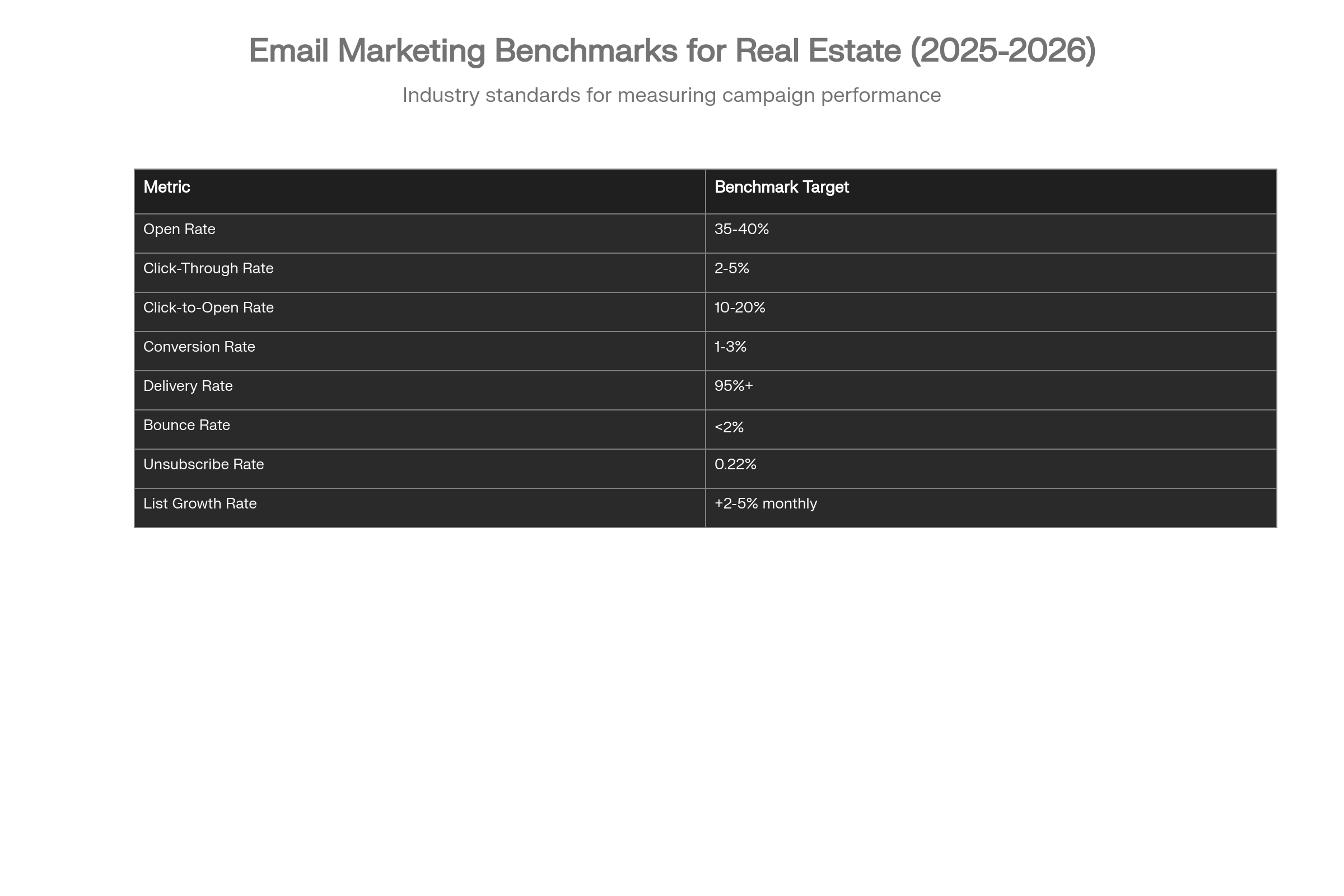
2026 Real Estate Email Marketing Benchmarks and Target Performance Metrics
Tip 17: Target Agents Within 10-20 Miles of the Property for Best Results
Geography matters hugely for agent-to-agent campaigns. The sweet spot for distribution is 10 to 20 miles from the property. You can go up to 35 to 40 miles in some cases, but beyond that, you're spending money on agents who have almost no chance of helping and likely don't care about out-of-market properties. Agents especially resent out-of-state flyers, and the spam complaint rate from distant agents is pronounced. Overly broad distribution damages your email reputation and wastes your budget. Be hyper-local with your distribution.
The only exceptions are vacation and resort properties where buyers might travel from farther away, or luxury properties with a wider appeal. But for regular residential properties, geographic focus pays off.
Tip 18: For Pocket Listings, Explicitly State the Buyer Agent Commission Percentage
Pocket listings (off-market properties not listed on the MLS) are excellent performers in email campaigns. They automatically feel like news because agents haven't seen them on the MLS yet. But there's a catch: if you don't explicitly state what buyer agent commission you're offering, agent forwarding drops by nearly 50 percent. Agents need assurance that the commission meets reasonable expectations before they'll bring their clients to the property.
Include a clear statement in the flyer like "Buyer Agent Commission: 2.5%" prominently displayed. This simple transparency makes a huge difference in how many agents will promote your pocket listing to their buyers.
Tip 19: Use Interactive Features Like Clickable Polls to Highlight Key Features
If your email platform supports it, add a clickable poll question that highlights your property's best features. A question like "Is your buyer looking for a pool and main floor master?" might not get many poll clicks, but it prominently restates your listing's value proposition right in the email. It serves double duty: it gives agents a way to engage, and it reinforces your listing's benefits in their minds.
For broker open houses, use poll questions to collect RSVPs with language like "Might you join us Thursday for light snacks?" This soft phrasing is much more effective with agents than demanding a firm commitment.
Tip 20: Make Virtual Tours and Digital Features Clickable, Not Retyped
The vast majority of agents won't manually retype a URL to view your virtual tour, even if they're interested. But if they can click a link directly in the email, many will take a quick look. This is the difference between engagement and no engagement. Make sure any digital feature you're promoting (virtual tour, video walkthrough, interactive floor plan) has a clickable link prominently placed in the flyer. Skip the "Visit our website for more details" approach. Link directly to what you want agents to see.
If your email platform supports interactive maps showing neighborhood amenities, school districts, or market data, include those. Maps that agents can actually click and explore boost engagement from both agents and clients significantly.
Tip 21: Post Your Flyer to Facebook and Share on Your Business Page
Most flyers are designed for email, but they also work great on Facebook. Your email platform likely provides a web link suitable for social media sharing. Post this link to your Facebook wall, your local Facebook groups, and your Facebook business page. You're not asking for more money by doing this; you're just getting free extra reach. Agents who follow you on Facebook see the flyer there and may engage differently than they do in email. Some will message you directly from Facebook, and others will be reminded to check their email. It's a simple way to amplify your campaign.
Use an AI-Powered Platform That Handles Design, Email Optimization, and Smart Targeting Automatically
In 2026, you don’t need to be a designer or marketing expert to create high-performing flyers and email campaigns. AI-powered platforms like Blastrow handle everything for you - from professional design and automated email optimization to smart audience targeting. With just a few clicks, you can generate polished flyers, launch targeted email campaigns, and track real-time performance through built-in analytics. The AI continuously learns what works best and automatically improves your results, so there’s no more guesswork, no waiting on designers, and no manual tweaking.
The Complete Checklist: Before You Hit Send
Here's a quick reference to make sure you're hitting all the high-impact elements before you send your campaign:
Email Setup
- Domain is authenticated (SPF, DKIM, DMARC configured)
- Email service provider has good deliverability reputation
- Sender name is your personal name, not company name
- Unsubscribe link is easy to find
Subject Line
- 30-35 characters maximum
- Includes specific information (not generic)
- Avoids spam words ("Opportunity," "Urgent")
- Avoids URLs
- Personalizes with agent name if possible
Content
- Includes both curb appeal and interior photos
- Photo captions highlight features and benefits
- News is featured "above the fold"
- Text plus photos (not image-only)
- Mobile-responsive design confirmed
- Clear, single call-to-action
Distribution
- Scheduled for Tuesday-Thursday
- Timed for 9 AM to 2 PM in recipient's time zone
- Targeted to agents within 10-20 miles
- For pocket listings, commission clearly stated
- Unbranded forwarding version available
Extras
- Interactive map or virtual tour linked (not typed)
- Poll question included if platform supports it
- Flyer shared on Facebook
- Campaign analytics reviewed after send
Why These 22 Tips Matter in Today's Market
Real estate agents are busier than ever. They're juggling transactions, managing teams, updating social media, and somehow still finding time to look for new leads. Your digital flyer is competing with hundreds of other messages for their attention every single day. The agents who respond to your flyers are the ones who see them as valuable, relevant, and easy to share with their own clients.
The 22 tips in this guide aren't arbitrary. They're based on analyzing millions of real emails sent by real estate professionals and tracking which ones get opened, clicked, and forwarded. Some of these strategies feel obvious once you read them. But the difference between a decent campaign and a great campaign is often the difference between hitting 5 or 6 of these points and hitting all 22 of them.
Start by implementing the foundational tips (deliverability, spam filters, sender name). Then move to engagement tactics (subject lines, timing, personalization). Finally, add the advanced strategies (unbranded versions, interactive features, mobile optimization). Each layer improves your results.
How to Measure What's Working
If you're using a service like Blastrow or any modern email platform, you should have access to detailed metrics about your campaigns. Track these key numbers:
The percentage of agents who open your flyer. For real estate, 35-40 percent is a solid benchmark. Anything above 40 percent is excellent.
The percentage of agents who click a link in your email. 2-5 percent is typical, with 3-4 percent common for well-designed flyers.
How many agents share your flyer with their clients. This is often overlooked but it's one of the most important metrics because it's directly tied to generating leads.
You'll get some of these no matter what (expect 0.22 percent or lower). If you're seeing much higher, you're sending too frequently or not to the right audience.
Look at these metrics by campaign. What subject lines got the highest open rates? What times of day worked best for your audience? Did certain neighborhoods generate more engagement? Use this data to improve your next campaign. That's where the real competitive advantage comes from.
The Bottom Line
Getting other agents to open your digital flyers, read them, and share them with clients is both an art and a science. The art is understanding what agents value and care about. The science is using data from millions of campaigns to optimize every element of your email. The 22 tips in this guide cover both.
Start with the basics: make sure your emails are being delivered, use a recognizable sender name, and lead with news. Then layer in the engagement tactics: personalize when possible, send at the right time, and use straightforward language. Finally, make it easy for agents to take action and forward to clients. That's the formula for high-impact campaigns that actually move the needle on your business.
In 2026, the tools have never been better. Platforms that were impossible to use five years ago are now accessible to any agent with a few minutes to spare. Use them. Test your campaigns. Track your metrics. Improve constantly. The agents who do this will pull significantly ahead of those who just send the same flyer to everyone at 9 AM on Mondays and wonder why engagement is low.
Your next high-performing campaign could start today.
Frequently Asked Questions

Blastrow
Listing Promotions