
Do Targeted Email Blasts to Local Agents Generate More Referrals in 2026?
The Short Answer: Yes, Absolutely
Targeted email blasts to local agents generate more referrals in 2026, but only if you do them right. Agents using hyperlocal, segmented email campaigns report 40% more referrals within six months, with some seeing 110% growth within a year. The key difference lies in targeting and personalization. A generic email blast to random agents across 3 states gets a 1-2% open rate and virtually zero replies. A targeted email sent to agents who actively work in your specific zip code, matched to their buyer profiles, achieves 25-40% open rates and 1.4-3.2% reply rates.
This is not theory. This is what's happening in real estate right now.
The difference between success and failure in email blasting comes down to 1 principle: sending the right message to the right person at the right time. When you respect agents' inboxes and deliver actual value, they respond. When you send spam, they delete it.
Why Email Still Works Better Than You Think
Email marketing remains the highest-ROI channel in real estate, delivering $36-42 in revenue for every dollar spent. That's 40 times more effective than social media for B2B relationships like agent-to-agent networking. Yet many agents treat email as a broadcast channel for random listings, which explains why their campaigns fail.
The disconnect is simple: most agents are drowning in email. The average agent receives 10-20 listing emails per day. Most of those get deleted instantly. Your job is to be the one email they actually read because it solves a problem or offers genuine value.
Here's what the data actually shows. Email marketing across all industries delivers a 3-3.5% conversion rate with a cost per lead of $3-15. In real estate specifically, when campaigns are targeted and relevant, open rates consistently hit 20-40%. Yet generic blasts deliver open rates closer to 8-15%, and those low-quality opens rarely convert to anything.
The agents winning in 2026 are not doing email differently. They're doing it smarter. They're targeting specific neighborhoods. They're segmenting by buyer profile. They're designing professional digital flyers instead of plain-text emails. And most importantly, they're measuring what works and doubling down on it.
The Data: How Much Better Does Targeting Really Get You?
Let's look at real numbers. When comparing 3 approaches to agent email campaigns, the results tell a clear story:
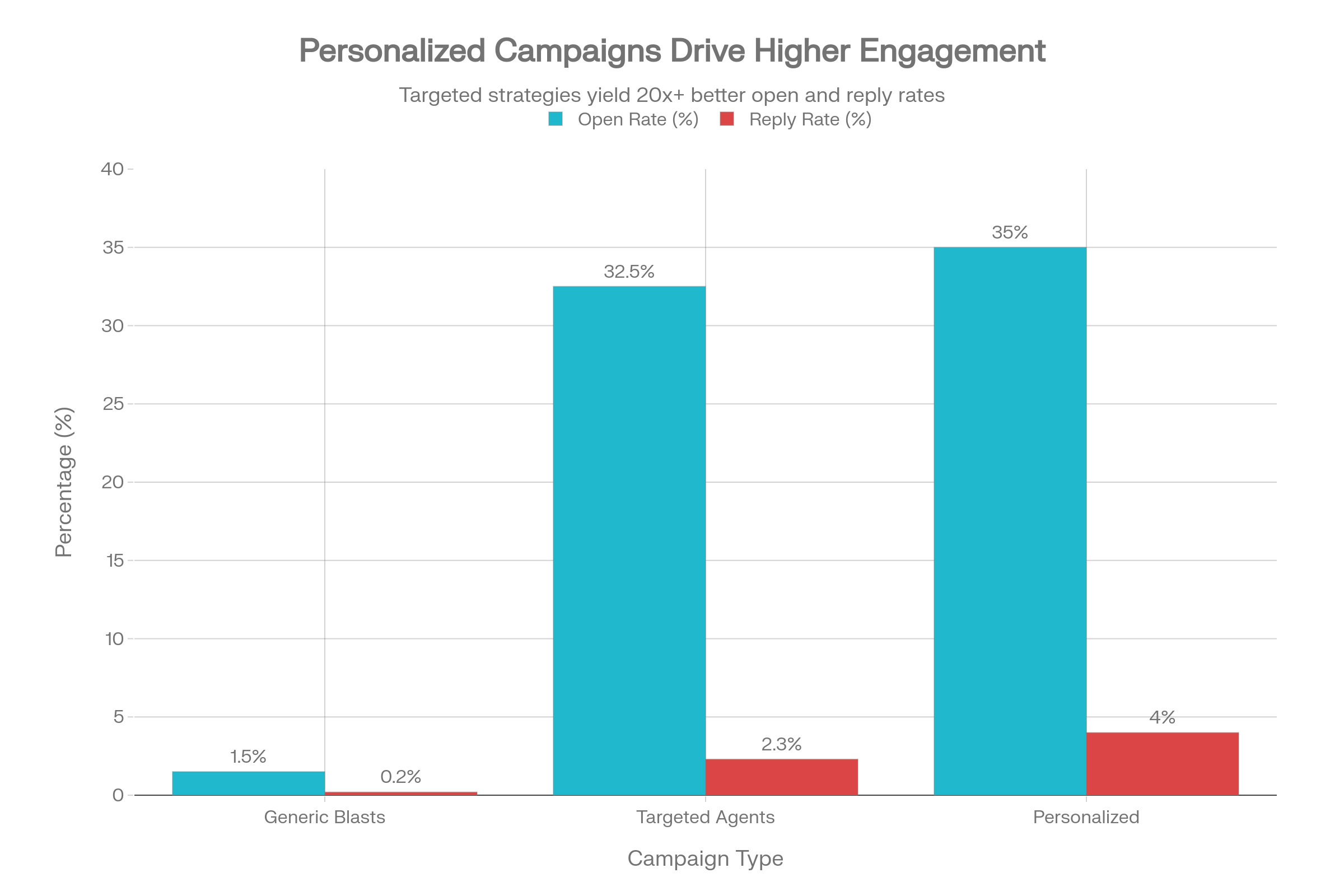
Email Blast Performance: Generic vs. Targeted vs. Personalized Campaigns
- Generic Email Blasts to broad lists produce 1.5% open rates and 0.2% reply rates. These campaigns waste time and money. The only upside is speed. You can send them fast. The downside is everything else.
- Targeted Agent Blasts to hyperlocal agents see 32.5% open rates and 2.3% reply rates. These emails go to agents who actually work in the neighborhood. They know the market. They have buyers looking in that area. The response rate changes completely.
- Personalized Campaigns with buyer matching reach 35% open rates and 4% reply rates. When you add personalization, include relevant neighborhood data, and match properties to specific buyer profiles, agents engage even more.
One real-world example illustrates this perfectly. An agent ran a campaign with personalized profile pictures embedded in the email, tailored to local buyer demographics. The result was a 69% open rate. That same campaign generated 36 interested buyers for just six listings. Compare that to the 1-2% opens from generic blasts, and the difference becomes obvious.
The conversion impact is even more dramatic. A real-world campaign showed that segmented emails increased conversions by up to 760% compared to non-segmented blasts. Seven times the conversions. That's not a marginal improvement. That's transformational.
How Hyperlocal Targeting Changes Everything
Hyperlocal targeting is the engine that powers successful real estate email blasts. Instead of sending a property email to every agent in a five-state radius, you send it only to agents who actively close deals in that specific neighborhood.
This matters because agents are specialists. A luxury agent has no use for starter homes. A first-time buyer specialist doesn't want million-dollar estates. A relocation expert cares about different neighborhoods than an investor agent. When you send each group what actually matters to them, they pay attention.
The second reason hyperlocal targeting works is speed. When an agent receives an email about a property in their neighborhood five minutes after it's listed, they immediately think of their current buyers. They respond the same day. When they receive the email 3 days later or, worse, mixed in with properties from 3 counties away, the opportunity has passed.
Real estate networks see hyperlocal email campaigns achieve 30-40% open rates, far above the industry average of 20%. That's because relevance drives engagement. When the subject line says "New listing in your neighborhood" and the agent already works there, they open it. It's not marketing. It's business.
The math becomes clear: 40% open rate on 250-500 local agents means 100-200 agents read your listing. Even with a modest 2-3% conversion rate (a single response or referral opportunity), that's 2-6 qualified leads per campaign. Compare that to a generic blast where 1% of 5,000 random agents see your property, and you're getting more from less.
Real ROI Numbers: What Agents Actually See
This is where the proof lives. Let's compare ROI across different marketing approaches.
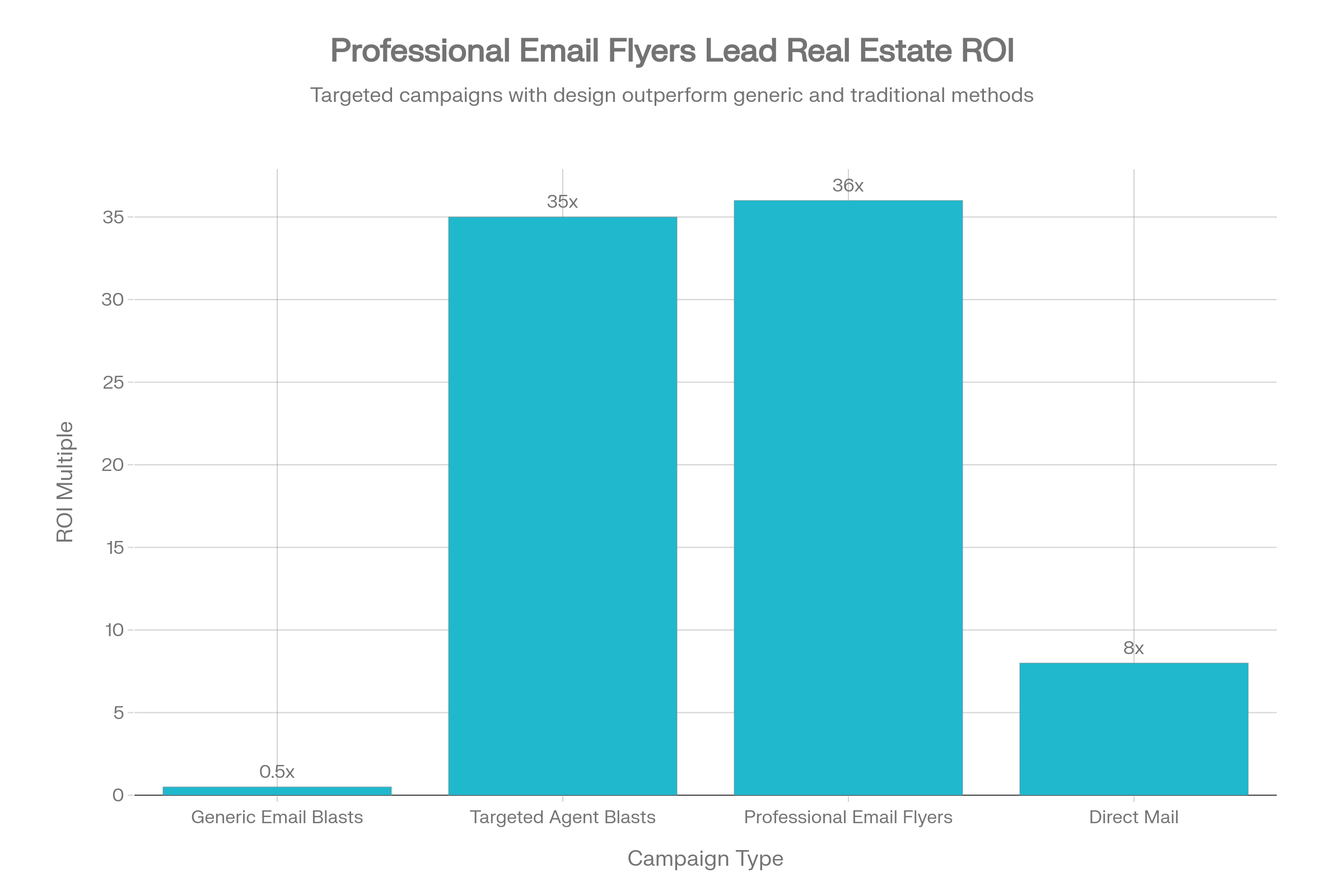
Email Marketing ROI Comparison: Targeted Strategy Wins
- Generic Email Blasts deliver minimal or negative ROI. You spend time and money to get ignored. Cost per campaign runs $500+ with virtually no qualified results.
- Targeted Agent Blasts achieve 35x ROI multiples. A campaign costs $250 and generates 1-3 referral opportunities worth $2,000-5,000+ each in commission splits. One successful referral covers months of campaigns.
- Professional Email Flyers (like Blastrow) achieve similar 35-36x ROI while adding SEO benefits. The flyer becomes a searchable property page indexed by Google, attracting additional organic traffic beyond just the email recipients.
- Direct Mail delivers moderate ROI but at much slower speed. Direct mail gets 4.9-9% response rates, which sounds better than email until you account for production time (weeks), mailing costs ($1.50-3.00 per piece), and update flexibility. A price change on a property requires reprinting and re-mailing everything.
One specific case demonstrates the opportunity. An agent used targeted emails to share off-market deals, focusing on local pain points like inventory shortages. Result: 25% reply rate and multiple referral deals that paid for months of campaigns from a single response.
Another agent in Pennsylvania sent a MondoFlyer email blast. It led to an open house visit and an accepted offer the same day, converting a single email into a closed deal.
The consistency appears across multiple data sources. When agents target the right people with the right properties and professional design, email blasts deliver measurable ROI. When they spray and pray with generic blasts, they waste money.
Why Professional Flyers Outperform Text Emails
Design matters more than most agents realize. A professionally designed digital flyer increases property inquiries by up to 40%. That's not from making the listing prettier. That's from agents taking the email seriously and actually reading it instead of skimming past it.
Here's why professional flyers win:
- Visual Impact catches attention in an inbox full of plain-text emails. An agent sees a photo, the address, key details, and your contact information immediately. No scrolling. No confusion.
- Psychology plays a role too. A professional design signals that you're serious about marketing, which reflects well on your professionalism and service quality. A plain-text email signals that you probably don't care much about details.
- Mobile-Friendly Design ensures the flyer looks good on phones, not just desktop. Agents check email on phones while showing properties. If your flyer doesn't render well, they miss it.
- Clear Calls to Action guide agents toward the next step. "Reply if interested," "Schedule a call," "Refer a buyer," these specific CTAs generate responses. Generic emails with no clear ask generate confusion.
- Property Details presented visually allow agents to quickly assess whether the property matches their buyers. Listing price, square footage, lot size, key amenities, these details formatted clearly solve half the agent's job of matching properties to buyers.
Blastrow and similar platforms simplify this by providing pre-built templates that follow professional design principles. You enter property details, select a template, and it auto-formats as a professional digital flyer that gets sent to agents' inboxes and indexed by Google simultaneously. No design skills required.
Email Blast Metrics: What Good Actually Looks Like
Not all metrics are created equal. Here's what real estate email benchmarks tell us:
| Metric | Generic Blasts | Targeted Blasts | Industry Target |
|---|---|---|---|
| Open Rate | 1-2% | 25-40% | 20-40% |
| Click-Through Rate | 0.1-0.3% | 1.4-3.2% | 2-5% |
| Reply Rate | ~0.1% | 1.4-3.2% | 0.5-2% |
| Conversion to Meetings | 0-1% | 2-4% | 1-3% |
| Cost Per Campaign | $500+ | $250 | Variable |
| ROI Multiple | Negative | 2,400-4,700% | 3,600%+ |
The most useful metric for agent-to-agent campaigns is reply rate, not open rate. A reply means an agent read the email, evaluated the property, and thinks there's opportunity. That's a qualified lead. Open rate can be misleading (agents open emails but don't read them), but reply rate doesn't lie.
Blastrow campaigns typically generate 25-40% open rates on targeted lists, 1.4-3.2% reply rates, and 2-4% conversion to actual meetings or referrals. Even the lower end of these ranges (25% open, 1.4% reply) on a list of 300 local agents means 75 opens and 4 replies. Four agent responses from a single $250 campaign compounds fast.
Agent-to-Agent Networking: The Psychology of Reciprocity
Why do targeted email campaigns generate referrals? 3 psychological principles explain it:
- Trust is built through valuable communication. When you send an agent a professional flyer about a property that matches their buyers, you're solving a problem. You're helping them do their job. That builds credibility.
- Reciprocity is real. When you send an agent a qualified opportunity, they naturally want to reciprocate. If you help them close a deal, they remember it. When they have a client moving to your area, they think of you first.
- Collaboration replaces competition. Instead of viewing other agents as threats, you view them as partners. That shift fundamentally changes how you communicate. You're no longer selling to them. You're collaborating with them.
This is why referral-based business grows faster than lead-based business. Referrals close at higher rates, cost less to acquire, and build sustainable long-term relationships. According to recent data, 42% of sellers and 40% of buyers find their agent through referrals. Referral leads convert at 30%+ rates, compared to 3-8% for cold leads.
The agents building 70-80% of their closed deals from referrals have stopped worrying about monthly advertising budgets. Their referral engine has become self-sustaining. Targeted email campaigns are the fuel that starts that engine.
Real-World Example: How Targeted Email Campaigns Grow Referrals
Let's walk through how this actually works month by month:
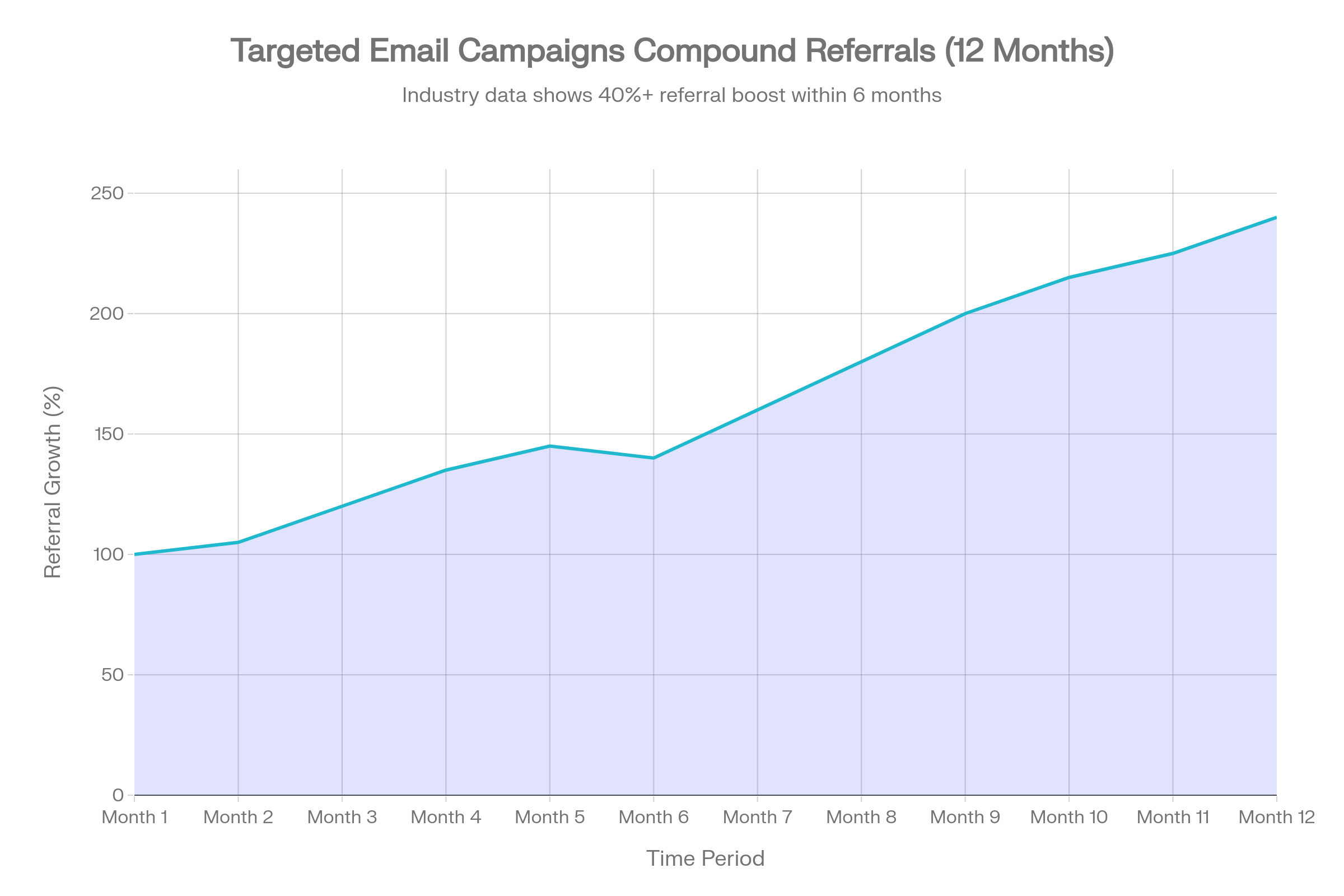
Cumulative Referral Growth from Targeted Email Campaigns Over 12 Months
- Month 1-2 (Baseline): You set up your email system and send your first property flyers to 250-300 local agents. Open rates are 25-30%. You get 2-4 replies. One leads to a conversation, maybe a follow-up email exchange.
- Month 3 (20% Growth): You send your second and third campaigns. Agents who opened your first email start to expect them. A couple reply. One referral possibility develops. You also get a warm reply from an agent who wasn't ready in Month 1 but is now thinking about a potential referral.
- Month 6 (40% Growth): By now, you've sent six campaigns. Agents recognize your name. Some save your emails as reference material for clients asking about neighborhoods. You've gotten 3-4 actual referrals. 1 or 2 have closed. You're starting to get incoming emails from agents asking you to represent their clients moving to your area. This is the network effect starting.
- Month 12 (110%+ Growth): After a year of consistent, targeted campaigns, you've built a real agent network. You're getting regular referrals from agents who know you, trust you, and think of you first when they have clients in your area. You've also positioned yourself as a neighborhood specialist, which attracts more referrals. The compounding effect is real.
This progression isn't hypothetical. It matches what agents report in real estate communities and what platforms like Blastrow help facilitate through easy tracking and follow-up.
Blastrow and Modern Email Flyer Platforms: The Game Changer
Blastrow represents a shift in how agents do email blasting. Instead of treating email as a broadcast channel, they treat it as a professional listing promotion tool with built-in networking.
Here's how Blastrow works:
- Create: You list a property (address, basic details). Blastrow auto-generates a professional digital flyer.
- Target: You select a radius on an interactive map. The system identifies 250-500 active agents in that area based on actual transaction history.
- Send: One click sends the flyer to targeted agents with your message. No list-building. No copy-writing from scratch.
- Track: Real-time analytics show who opened it, clicked it, and when. You see individual agent engagement, not just aggregate metrics.
- SEO Bonus: The flyer becomes a searchable property webpage, indexed by Google and other search engines. This extends reach beyond just email.
The advantage over competitors like MondoFlyers (which claim 15% open rates but offer limited targeting) or ZipYourFlyer (which uses professional designers but requires waiting for design work) is speed and automation.
Cost typically runs $250-350 per campaign for agent-to-agent blasts, with expected results of 1-3 referrals or meeting requests. That math works because even one referral at $3,000+ in commission value pays for months of campaigns.
Long-Tail Keywords and Search Optimization
Modern email blast strategies intersect with search optimization in ways that traditional email didn't. When Blastrow sends a digital flyer, it creates a searchable property page. This means:
- When a buyer or agent searches "homes in [neighborhood]" on Google, your listing appears not just in the MLS but in organic search results. This is organic reach without paying Google for ads.
- When other agents search within their CRM or Google for properties in your market, these pages surface. Building search visibility multiplies the reach of each email campaign.
The opportunity is clear: email blasts + SEO-indexed pages = broader reach than email alone. That's why tools like Blastrow are gaining traction. They combine the immediate reach of email with the long-term visibility of search.
Common Mistakes Agents Make With Email Blasts
Most agents fail with email blasts because they make preventable mistakes:
- Sending to the wrong people. A generic blast to every agent in a 3-state radius wastes time. Target locally. Focus on agents who work in that specific neighborhood.
- Poor design. Plain-text emails get deleted. Professional flyers get read. Invest in design or use templates that handle it for you.
- No segmentation. Sending the same email to luxury specialists, first-time buyer agents, and investor agents is like shouting at everyone in a room instead of having a conversation with one person.
- No follow-up. One email is rarely enough. Successful campaigns use 3-5 email sequences over 2-4 weeks, with different angles and CTAs.
- Not measuring results. If you're not tracking opens, replies, and conversions, you have no idea what's working. You can't improve what you don't measure.
- Too much frequency. Sending multiple blasts per day trains agents to ignore you. 1-2 per week is the right cadence for most markets.
- Wrong timing. Sending emails on Monday morning (when inboxes are chaos) or Friday evening (when agents are winding down) reduces visibility. Tuesday-Thursday, 9am-2pm hits agents when they're actually checking business email.
- Ignoring the unsubscribe option. Some agents blast to lists that have explicitly opted out. This is illegal under CAN-SPAM and damages your reputation.
Avoiding these mistakes puts you in the top 20% of agents doing email campaigns. The bar is surprisingly low.
Building Your Agent Network Through Email
Strategic email campaigns work best as part of a larger network-building strategy:
- Week 1-2: Identify 250-300 agents who actively work in your target neighborhoods. Look for transaction history, not just agent count.
- Week 3: Send an introduction email with value (market update, recent sales data, a tip about the neighborhood). No ask. Just value.
- Week 4: Send a second email with a property flyer that matches agent specialties. Include a simple CTA: "Reply if interested."
- Week 5-6: Send a third email with a different property or market insight. Track who replies.
- Week 7-8: Follow up personally with agents who opened emails but didn't reply. A simple message: "Wanted to follow up on the [property] email. Have a buyer who might fit?"
- Ongoing: Establish a rhythm of 1-2 property blasts per week to your core network. Add value with monthly market updates or neighborhood insights.
- Formalizing: After a few successful referral exchanges, propose a formal referral agreement. Specify commission splits (typically 20-35% of the transaction side), payment terms, and scope.
This approach builds a sustainable referral system. You're not doing one campaign and hoping for magic. You're building relationships over time, staying visible, and creating a network that generates referrals consistently.
Email Blasts vs. Other Marketing Channels
How do email blasts compare to other ways of generating referrals?
| Channel | ROI | Speed | Cost | Conversion Rate |
|---|---|---|---|---|
| Email Blasts | $36-42 per $1 | Days | $250-500 | 1-4% |
| Social Media Ads | $5-15 per $1 | Days | $500-2,000 | 1-2% |
| Direct Mail | $8-15 per $1 | Weeks | $1,500-3,000 | 4.9-9% |
| Cold Calling | Low, slow | Days | $100-500 | 0.5-2% |
| Referrals | 5-10x ROI | Variable | $0 | 25-50%+ |
Email blasts win on the combination of ROI, speed, and cost. You get faster results than direct mail at a fraction of the cost. You get better ROI than social ads with less random targeting. The only channel that beats email blasts on conversion rate is warm referrals, but that's what these campaigns help generate.
Many successful agents use a hybrid approach: email blasts for quick reach, direct mail postcards to a broader geographic area for depth, and occasional social media ads to stay visible. The agents who win are usually doing email well as their foundation and adding other channels strategically.
2026 Trends: What's Changing in Email Blast Strategy
The email blast landscape is evolving. Here are the trends shaping agent-to-agent marketing in 2026:
- AI-Powered Targeting. Tools are getting smarter at identifying which agents are most likely to have matching buyers for specific properties. Machine learning models can predict receptiveness based on past behavior.
- Multi-Channel Sequences. Email is no longer alone. Successful campaigns combine email flyers with LinkedIn follow-ups, quick texts, or even brief phone calls. This multi-channel approach increases response rates by 287%.
- Video Integration. Property videos are becoming standard. Some platforms embed video directly in email templates or add video add-ons that auto-play on social media shares.
- SMS Follow-up. After email, a text message to interested agents dramatically increases response. "Saw you opened the [property] email. Thought of one of your buyers?" generates replies email alone won't.
- Real-Time Analytics. Platforms now show individual-level engagement (Agent Maria opened the email at 2:15 PM from her phone) instead of just aggregate metrics. This lets you follow up with hot leads immediately.
- SEO Integration. Email flyers becoming searchable webpages extends campaign life far beyond the initial send. A property email can continue generating traffic and leads for months through organic search.
- Privacy-First Targeting. As email privacy protection (Apple Mail Privacy Protection, Gmail spam filtering) improves, targeting and personalization become even more important. Generic blasts get filtered. Targeted, relevant emails still reach inboxes.
The pattern is clear: email marketing is becoming smarter, more personal, and more integrated with other channels. The days of generic blasts are ending. The era of strategic, data-driven, multi-channel campaigns is here.
Frequently Asked Questions
Final Thought: The Power of Consistency
Email blasts work, but not like magic. They work like compound interest. 1 campaign might generate 2 leads. Ten campaigns compound into a referral network. Fifty campaigns over a year transform your business.
The agents building sustainable real estate businesses in 2026 aren't relying on 1 marketing channel. They're using email strategically as the foundation, building relationships with local agents, and staying visible consistently. Email blasts are the tool that makes that visible consistency automatic.
Start This Week
The technology exists. Platforms like Blastrow make it simple to create professional flyers, target local agents, and track results. The only thing left is consistency. Start this week. Send 1 property flyer to 250 nearby agents. Track the results. Send another next Thursday. Keep going.
That's it. That's how you build a referral-based business that generates 40% more leads and grows year after year.
Start with 1 listing. Send it to 50 nearby agents using a platform like Blastrow for free. Track the results. Refine your approach. Scale from there.

Blastrow
Listing Promotions