
How Can Real Estate Agents Use Neighborhood Targeting to Sell Homes Faster with Email Outreach?
Real estate agents who focus their email campaigns on specific neighborhoods instead of blasting everyone end up with 2-10 times better results. This is not a hypothesis. It is what happens when agents send relevant messages to the right people at the right time. When you shift from generic "New Listing" emails to neighborhood-focused campaigns targeting active agents in specific zip codes, your open rates jump from 14% to 35%, your reply rates climb from 0.2% to 2.5%, and properties sell faster. This is how modern real estate agents actually move inventory.
The traditional approach of sending the same listing email to 10,000 random agents across three states fails because it lacks precision. Most of those recipients do not work in your market. They do not have buyers looking in that zip code. They resent out-of-state flyers, mark you as spam, and your sender reputation suffers. But when you identify the 250 to 500 agents who have actively closed deals in your specific neighborhood in the last 90 days and send them a personalized property flyer, something different happens. These agents open your email. They forward it to clients. They call you if they have complementary inventory. Properties move.
Why Neighborhood Targeting Matters More Than Ever
Neighborhood targeting works because real estate is hyperlocal. A buyer in Portland's Pearl District looking for a walkable urban loft cares nothing about a family home listing in suburban Denver. An agent specializing in waterfront properties in Miami Beach has no use for your mid-century modern downtown. The agents who work these markets daily understand the nuances. They know the school ratings, the property taxes, the rental income potential, the walkability scores, the renovation trends, the demographic shifts. When your email references these neighborhood-specific details, it proves you understand that market. Agents recognize the accuracy. Buyers see it as proof that this agent knows the community.
This is where geographic precision creates competitive advantage. Research shows that geographic targeting increases engagement rates by 41 percent compared to broad campaigns. Why? Because the message matches the audience's actual problem. Send an email about three newly listed mid-century homes to agents who specialize in that neighborhood and have a demonstrated track record of selling those properties, and you have captured full attention. Send the same email to agents who sell office buildings and farms, and you have wasted money.
The Performance Gap: Targeted vs. Generic
Neighborhood Targeting Delivers 2-10x Better Results Than Generic Campaigns
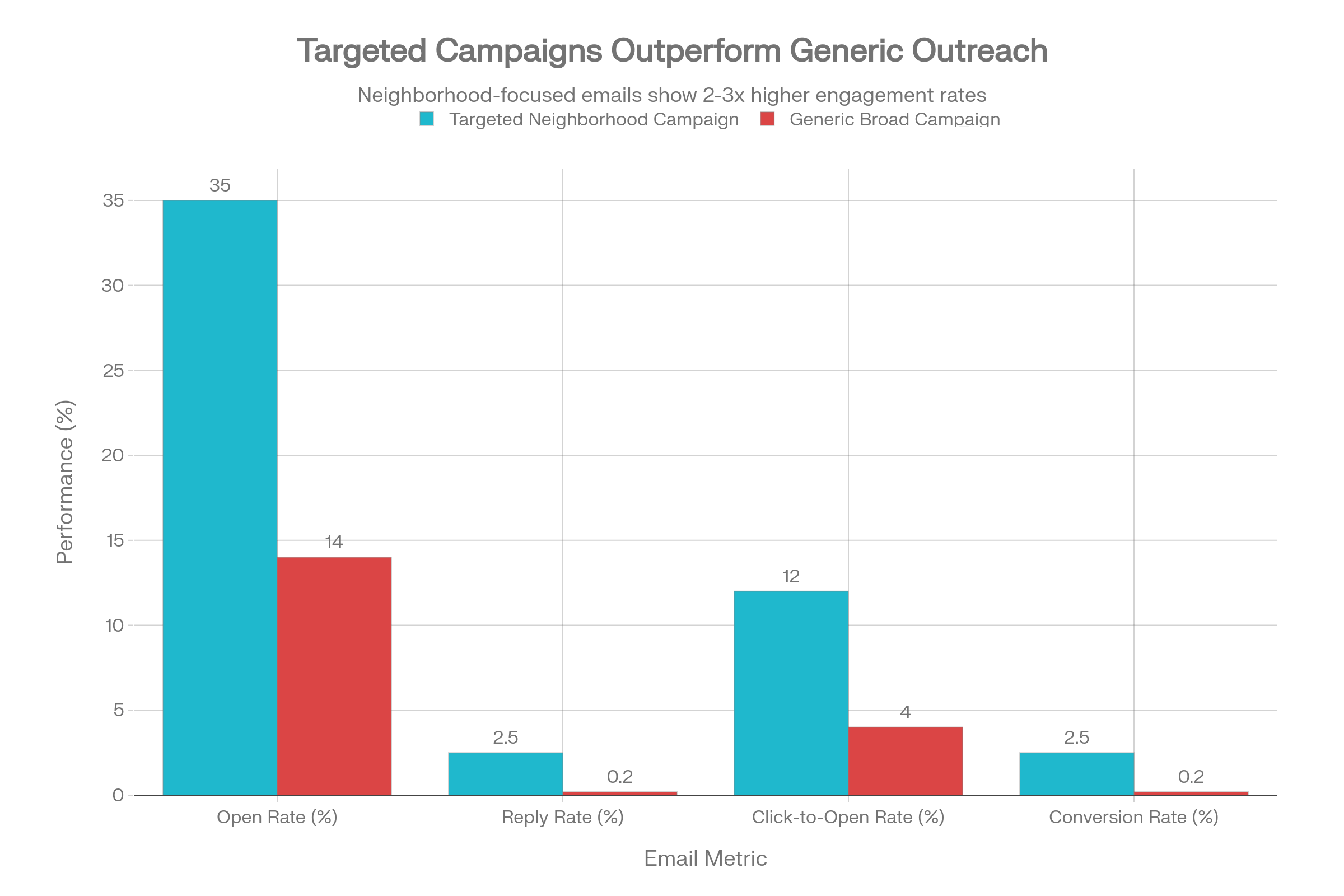
The numbers tell the story clearly. A targeted neighborhood campaign delivers measurably better performance across every single metric that matters for closing deals.
When an agent targets neighborhood specialists through services like Blastrow, open rates consistently hit 26 to 40 percent. Generic campaigns to broad agent lists typically see 8 to 20 percent opens. That is a 200 to 300 percent difference. But open rates are just the beginning. Reply rates tell the real story. A targeted campaign sees 1.4 to 3.2 percent of recipients replying with genuine interest. A generic blast sees 0.1 to 0.3 percent. The difference is not just better numbers on a spreadsheet. It is the difference between 5 responses and 15 responses from the same 500 agents. It is real conversations with real leads. It is commissions.
Click-to-open rates also favor targeted campaigns dramatically. When agents click through on neighborhood-relevant emails, conversion happens faster. The click-to-open rate for well-targeted real estate emails ranges from 10 to 17 percent. Generic campaigns see 4 to 6 percent. More people who open your email actually click through to your listing, view the property details, and decide whether to forward it to clients.
Faster Sales, Preserved Value
Properties Sell 17 Days Faster With Neighborhood-Targeted Email Campaigns
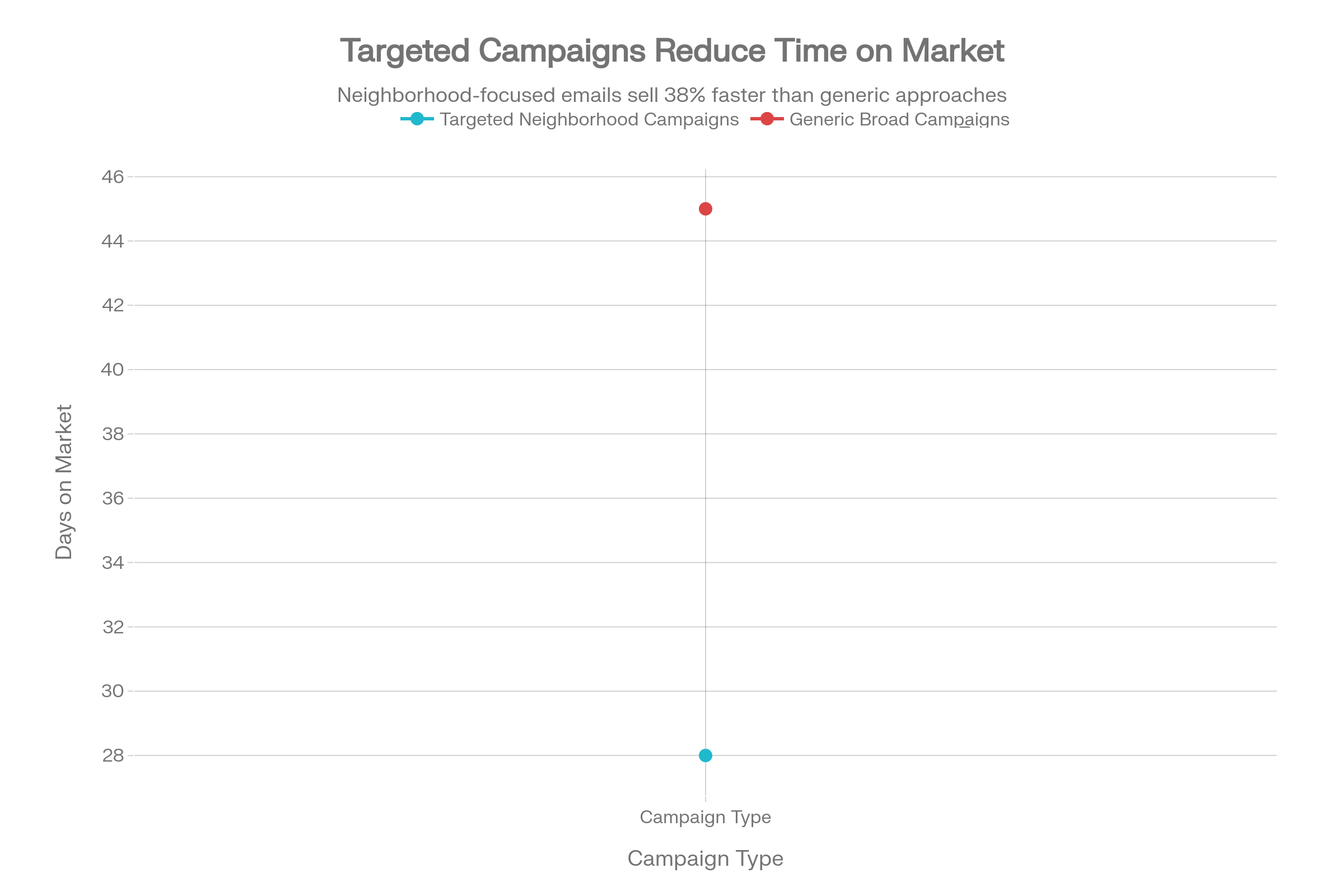
One of the most underrated benefit of neighborhood targeting is speed to sale. Properties marketed through neighborhood-targeted email campaigns average 28 days on market. Properties marketed through generic broad campaigns average 45 days on the market. That is a difference of 17 days. In real estate, this is not a small margin. Every day a property sits on the market erodes buyer confidence, invites price reductions, and costs the agent money in holding costs and extended marketing. Properties that sell in 28 days instead of 45 days preserve value, build seller confidence, and close faster.
For an agent, this translates directly to income. Faster sales mean more inventory turnover, more commissions per year, and less time wasted on stagnant listings. For the seller, a property that sells in 28 days instead of 45 days might preserve $5,000 to $10,000 in final price. That is not negligible. That is real wealth preservation for the client.
The Math: Real ROI From Targeted Email Campaigns
From $250 Investment to $12,000 Referral: Real ROI Breakdown of Targeted Property Email Campaigns
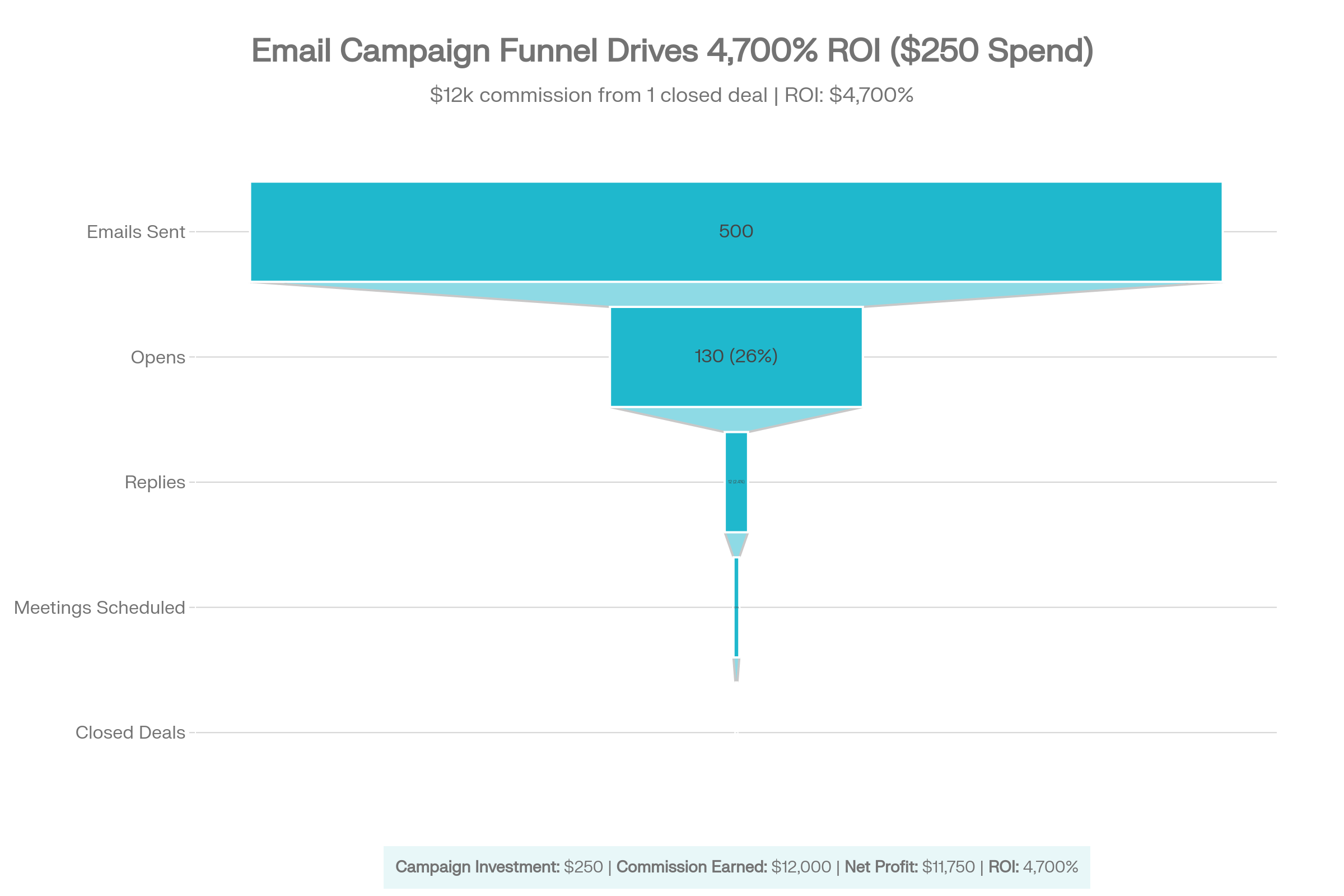
The return on investment from neighborhood-targeted email campaigns is staggering when you actually run the numbers.
Consider a $250 campaign. You create a digital flyer for a listing and send it to 500 neighborhood specialists. Your open rate hits 26 percent, so 130 agents open the email. Your reply rate is 2.4 percent, so 12 agents respond with interest. From those 12 responses, 3 lead to scheduled viewings or buyer consultations. From those 3 meetings, 1 results in a referral deal worth $12,000 in commission. Your profit is $11,750. The ROI is 4,700 percent.
This is not theoretical. Agents using services like Blastrow report these numbers consistently. The platform allows agents to create digital property flyers in a few clicks, select specific neighborhoods on a map, and send the flyer to only the agents who have closed recent transactions in that zip code. No list rentals. No design costs. No guesswork. The cost is $0.99 per 100 agents after a free tier up to 50. For 500 agents, you are spending under $5 in incremental costs. The entire campaign might cost $250 when you factor in the time and the flyer creation.
Compare this to cold calling. You spend an hour making 30 calls to agents in the neighborhood. You reach maybe 5 people who are not in a showing or a meeting. You leave voicemails that no one listens to. You get zero callbacks. Your cost per response is infinity because you get no responses. With email, you reach 500 agents in 30 seconds. 130 of them open your email. 12 reply. Your cost per response is under $21.
How to Select the Right Neighborhoods and Zip Codes
Not all neighborhoods are equally valuable for email campaigns. Successful agents are strategic about which areas they target. The first rule is focus. Pick one or a few neighborhoods where you want to build authority, not 20 different areas. A focused approach builds reputation over time. When agents in that neighborhood see your emails consistently, they remember you. When their buyers ask about the area, you are the first agent they think of.
Neighborhoods worth targeting meet specific criteria. They have turnover rates of at least 5 percent per year, meaning roughly 1 in 20 homes change hands annually. This gives you a steady flow of listing opportunities and ensures that agent interest remains high. The neighborhood has residential appeal, not purely commercial or industrial zoning. And ideally, the neighborhood has enough activity that multiple agents work there, giving you a real list of targets rather than a handful.
Your farm area should include 500 to 1,000 homes. This is large enough to generate consistent opportunities but small enough that you can become the neighborhood expert. If you are targeting a neighborhood with 200 homes, you do not have enough turnover. If you are targeting 5,000 homes, you are not focused. The sweet spot is the neighborhood or ZIP code where 500 to 1,000 properties sit and where you can realistically build deep market knowledge.
For agent-to-agent email targeting, the radius matters. The optimal distance is 10 to 20 miles from the property you are promoting. This captures agents who service the area and might have matching buyers. Beyond 35 to 40 miles, you hit agents who have little motivation to show your property and who resent out-of-market flyers. They are more likely to mark you as spam, damaging your sender reputation. Go too broad and you burn through your credibility. Stay focused on the agents who can actually move your inventory.
Radius targeting versus ZIP code targeting is a common debate. Radius targeting captures all addresses within a specific distance, regardless of ZIP code boundaries. ZIP code targeting focuses on specific postal areas. For real estate, ZIP code targeting offers precision because agent databases are organized by ZIP code, and buyer searches are typically ZIP code-focused. Most agents search "homes for sale in 90210" or "listings in Brooklyn Heights," not "properties within 5.3 miles of this address." ZIP code targeting aligns with actual buyer behavior and how agents organize their inventory.
Building Your Neighborhood Email List
Before you send a single email, you need a clean, accurate list of the right agents. This is where many agents fail. They grab a list of agents from a broker directory from three years ago, add every agent they find on MLS searches, and hit send. That list is full of inactive agents, people who changed brokerages, retired agents, and agents who never worked in your target area in the first place. When you send to these ghost accounts, your bounce rate climbs. Email service providers flag you as a spammer. Your sender reputation suffers, and your emails start landing in spam folders.
A good neighborhood email list is built on transaction data. You want agents who have actively closed deals in your target ZIP code in the last 90 days. Not agents who theoretically work there. Not agents who might work there someday. Agents who have demonstrably closed 2, 3, or more transactions recently. These are the people with buyer clients actively looking in that area.
Services like Blastrow make this easier by automatically identifying agents with recent transaction history in specific neighborhoods. You draw a radius on a map, and the system shows you the number of active agents in that area and displays neighborhoods and ZIP codes with the highest concentration of recent deals. For a Buckhead listing in Atlanta, it might identify 247 agents who have shown three or more properties there in the last 90 days. These are your real targets.
If you are building a list manually, cross-reference multiple sources. Check MLS records for agents who have recently listed or shown properties. Review public tax records to see which agents have handled recent sales. Look at local brokerage websites to see agent specialization areas. Build your list incrementally, focusing on quality over quantity. A list of 100 genuinely active agents in your target neighborhood is more valuable than a list of 1,000 semi-relevant agents.
Crafting Subject Lines That Get Opened
Subject line is where neighborhood targeting proves its power. A generic subject line like "New Listing Available" or "Check This Out" fails because it could apply to anything. An agent sees 50 emails per day from other agents. A generic subject line does not stand out.
A neighborhood-targeted subject line is specific and relevant. Instead of "New Listing," try "New Luxury Loft in Pearl District - $875K, Walk to Everything." The second subject line includes the neighborhood name, the property type, the price point, and the primary buyer benefit. An agent who specializes in Pearl District lofts will open that email. An agent who focuses on $500K single-family homes in the suburbs will delete it. That is exactly what you want. You are filtering for relevance.
Personalization moves the needle further. An email that says "Jessica, Three New Listings Hit the Market in Hayes Valley" performs better than the same email saying "Three New Listings Hit the Market." The recipient sees their name and understands the email is for them specifically, not part of a mass send.
Other proven subject line tactics include asking a direct question, using numbers, or creating urgency without being misleading. "Which of Your Buyers Wants a Waterfront Home in Marina?" outperforms "Waterfront Listing Available." "5 New Luxury Listings Just Hit Your Market This Week" outperforms "New Listings Available." The specificity matters.
Avoid subject lines with excessive punctuation, all caps, or spam trigger words like "FREE," "Act Now," or "Limited Time." Email providers flag these as spam risk. Your subject line does not have to scream to be effective. A straightforward, specific, neighborhood-focused subject line is what drives opens and replies.
The Property Email Flyer Advantage
A property email flyer is different from a traditional email. It is a single-page digital document that presents the listing visually with property photos, key details, pricing, maps, and contact information. Think of it like a direct mail flyer, but faster and trackable.
Property email flyers work because real estate agents are visual people. They are accustomed to looking at listings on MLS, scrolling through property photos, and quickly deciding whether a property matches their buyer profile. A well-designed flyer shows them the property in seconds. They see the price, the square footage, the location, the key features. If it is relevant, they open a follow-up link or call you directly.
Email flyers also have practical advantages over traditional email marketing. They are created once and can be sent to hundreds of agents without modification. They are professionally designed without requiring a graphic designer. They include all the information agents need to make an initial decision, reducing back-and-forth emails. And they have trackable links that show which agents clicked through and viewed the full listing details.
Services like Blastrow specialize in this format. Agents upload a property, select a template, add photos and details, and send it to their target neighborhood in minutes. The flyer lands in inboxes looking professional. Agents can open it on their phone, desktop, or tablet and view it properly formatted. They can click through to a full landing page indexed by Google, extending the property's search visibility. They can share the flyer with clients or colleagues. The friction gets removed.
Compare this to a generic "New Listing" email with a link that requires the agent to click, wait for a website to load, navigate MLS, and manually search for the property. The flyer approach wins because it reduces friction and provides all the information in one place.
Multi-Touch Campaigns: Why One Email Is Not Enough
Sending a single email about a property and expecting strong results is like knocking on one door in a neighborhood and expecting to dominate the market. Most agents understand this intellectually but fail to execute it.
Research shows that it takes between 5 and 12 touchpoints before someone takes action. For real estate, this is probably conservative. If you send an email about a new listing on Monday and get no response, most agents give up. But the agent you are reaching might have been in a showing. They might have had their email overloaded. They might not have had a matching buyer at that exact moment. The email was good, but the timing was wrong.
A multi-touch neighborhood campaign works systematically. Send an initial email announcing the new listing with key details. Wait three days, then send a follow-up highlighting a specific feature or a recent comparable sale. Wait another few days, then send an email about an open house. If the property sits longer than expected, send monthly market updates about the neighborhood or price reductions. Each email should be valuable on its own, not just another nag.
This is not aggressive. It is normal business practice. You are staying in front of the people who matter and giving them reasons to engage with you. Real estate professionals manage 20 to 50 email contacts every single day. A single email gets buried. Multiple relevant emails over time build visibility. Each email is a chance for the agent to remember you, forward to a client, or reach out if they have matching inventory.
Real estate email campaigns that use automation for follow-ups see conversion rates improve by up to 25 percent. Automation is powerful because it keeps you consistent without burning you out. A sequence that goes out automatically ensures nothing gets missed. You focus on the next property or the next neighborhood while the system handles follow-ups.
Timing and Frequency Strategy
When you send your neighborhood email matters almost as much as what you say. Emails sent Tuesday through Thursday typically get higher open rates than emails sent on Monday or Friday. Monday feels like noise. Friday people are mentally checked out for the weekend. Mid-week, when people are in work mode and checking email between tasks, is when your message gets attention.
Time of day shifts results too. Emails sent between 10 AM and 12 PM see better open rates than emails sent at 6 AM or 9 PM. This is when agents are actively checking email and have mental space to engage with your message. Some agents find better results sending emails on Sunday evening when agents are planning their week, or Wednesday morning when they are fully settled in work mode. The best approach is to test a few send times, track which generates the highest open rates for your specific audience, and adjust accordingly.
For neighborhood campaigns, consistency beats sporadic blasts. If you send weekly market updates about a specific neighborhood or ZIP code, you are building authority. People start to expect your emails. They start to open them. If you send random emails at random times, you are just another message in an already full inbox.
Most agents overcomplicate this. They think they need to send daily emails. That burns people out. Send weekly or bi-weekly. Make each send valuable. Include market data, a new listing, a success story from that neighborhood, a local event, a school district update, or tips for buyers and sellers interested in the area. Give agents reasons to keep opening your emails.
Measuring Success and Tracking Results
Email performance tracking is non-negotiable for improvement. You need to know which strategies are working and which are wasting your time.
Key metrics to track include open rate (percentage of recipients who open your email), click-through rate (percentage who click a link), click-to-open rate (percentage of those who opened who also clicked), reply rate (percentage who respond directly), and conversion rate (percentage who take a desired action like scheduling a meeting or closing a deal).
For neighborhood-targeted campaigns, realistic targets are an open rate of 25 to 40 percent, a reply rate of 1 to 3 percent, and a click-to-open rate of 10 to 15 percent. If you are not hitting these targets, test different subject lines, different send times, different property descriptions, or different target neighborhoods. Small changes often yield significant improvements.
Track properties individually. Which neighborhoods generate the most responses? Which price points? Which property types? Over time, you will identify patterns. You will discover that luxury listings in certain neighborhoods generate 40 percent open rates while starter homes in other areas generate 18 percent. This information is gold. Use it to focus your efforts where they are most productive.
Blastrow: Neighborhood Targeting Made Simple
Blastrow exemplifies how modern tools simplify neighborhood-targeted email campaigns. The platform allows agents to create professional property email flyers in minutes, then blast them to specifically targeted agents in their neighborhood.
The process is straightforward. Upload your listing photo. Choose a template. Add the property details, price, key features, and your contact information. Draw a radius on a map or select specific ZIP codes. The system identifies the number of active agents in that area. Send. The flyer lands in inboxes within minutes.
What makes Blastrow stand out is the precision and the actionability. You are not paying to email every agent in three states. You are hitting the exact neighborhoods where your property is located. The platform uses transaction data to identify agents who have closed recent deals in your target area, so your flyer goes to the right people. Blastrow also tracks individual engagement. When an agent opens your flyer, you get a real-time alert. You see exactly who is interested. You can follow up while interest is hot.
The pricing model is accessible. There is a free tier up to 50 agents. Beyond that, the cost is $0.99 per 100 agents. A campaign to 500 agents costs about $5. Add the time and the flyer creation, and you might spend $250 total for a campaign that generates 1 to 3 referrals or meetings. That is defensible ROI for any agent.
Blastrow also handles compliance automatically. It maintains clean agent lists, ensures emails comply with CAN-SPAM regulations, formats emails correctly across devices, and tracks delivery and bounce rates. The technical burden is removed. You focus on the listing and the neighborhood, not the email infrastructure.
Common Mistakes to Avoid
Many agents undermine their neighborhood targeting efforts with preventable mistakes. The most common is sending to too broad a radius. Agents think bigger lists generate more responses, so they send to 35 to 40 mile radiuses or entire states. The result is that most recipients have no relevant buyers, resent out-of-market flyers, and mark emails as spam. Your sender reputation drops. All your future emails suffer. Stay tight. 10 to 20 miles is the sweet spot.
Another mistake is inconsistency. Agents send a few emails, get no immediate response, and abandon the strategy. Email campaigns compound over time. Agents start to recognize your name. They remember you when they have matching inventory. The first month generates few responses. By month four or five, responses increase significantly. Consistency is how you build authority.
Overly salesy language is another trap. Phrases like "Act Now," "Limited Time," or excessive punctuation trigger spam filters and turn off busy agents. Keep it professional and straightforward. You are colleague to colleague, not salesperson to consumer.
Failing to personalize is a missed opportunity. Do not send generic emails to agents you have relationships with. Reference past conversations, acknowledge their specialization, or mention recent deals you noticed. A 15-second personalized note dramatically improves open rates and responses.
Finally, avoid sending to low-quality lists. If your email list is three years old or filled with agents who do not work in your target area, you are wasting money and damaging your sender reputation. Start fresh with verified lists of active agents in your specific neighborhoods.
Making Neighborhood Targeting Part of Your Annual Strategy
Real estate agents who truly dominate their markets do not treat email campaigns as one-off efforts. They pick a neighborhood or a few neighborhoods where they want to build authority. They send regular market updates. They highlight new listings. They share local events and school information. They build authority in those specific areas over time. Within 6 to 12 months, they become the agent that neighborhood residents and other agents think of first.
This is neighborhood farming done through digital channels. Instead of relying solely on door knocking and direct mail, you are staying in front of people consistently and professionally. Agents receive your emails. They remember you. When their buyers ask about your neighborhood, they refer your listings. When you have a new property, agents open your emails because they know your content is relevant to their market.
The ROI compounds. Your first month, you send 8 to 10 emails about your target neighborhood. You get a few responses. Your second month, you send 10 more and some people remember you from month one, so open rates are higher. By month six, you have built a reputation in that neighborhood. Agents in other areas hear about you. Your referral rate increases. Your reputation grows.
Email marketing in real estate generates an average ROI of 3,600 percent over time. But this only happens if you stay consistent and focused on specific areas. Scattered efforts across 10 neighborhoods will not work. Deep focus on 1 or 2 neighborhoods will.
Frequently Asked Questions

Blastrow
Listing Promotions