Step-by-Step Strategy: Using Digital Flyer Combos (Email + Social + Agent Shares) to Generate 40% More Referrals
Discover the proven workflow for combining targeted e-blasts with instant social sharing and agent-to-agent networking to multiply reach, track every interaction in real time, and turn one listing into multiple future deals.
Why Single-Channel Marketing Is Killing Your Referral Pipeline
Every listing you take represents more than one potential deal. It is a gateway to future business, but only if you know how to open that gateway properly. Most agents treat a listing as a single transaction. They list the home, put it on the MLS, maybe run a few ads, and wait for buyers to appear. This approach leaves enormous value on the table. The agents who generate 40%, 50%, or even more of their business from referrals are not working harder than you. They are working smarter by using multi-channel strategies that turn every listing into a referral-generating machine.
The numbers tell a clear story. According to the National Association of Realtors, 40% of buyers and 38% of sellers found their agent through a referral from a friend, relative, or neighbor. More striking, 82% of all real estate transactions come from repeat and referral leads. Yet only 25% of agents have a formal system to generate these referrals. That gap between opportunity and execution is where you can separate yourself from the competition.
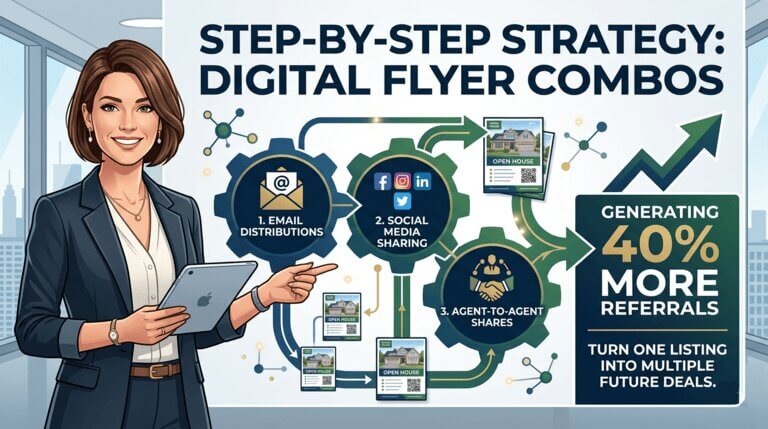
The solution is not complicated, but it does require a system. You need to combine three powerful channels: targeted email distribution to other agents, social media amplification, and deliberate agent-to-agent networking. When these three work together, they create a multiplier effect that single-channel marketing simply cannot achieve. This guide walks you through exactly how to build that system, step by step, using digital flyer technology that makes execution practical even for busy solo agents.
Understanding the Digital Flyer Combo Approach
A digital flyer combo is not just a pretty email. It is a multi-purpose marketing asset designed to work across three distinct channels simultaneously. The same flyer you email to agents can be shared on social media, forwarded to their clients, and embedded in your website. Each channel serves a different purpose and reaches a different audience, but they all point back to the same listing and ultimately the same goal: generating referrals that turn into closed deals.
The key difference between traditional marketing and the digital flyer combo approach is integration. Most agents treat email, social media, and agent networking as separate activities. They send an email blast, maybe post once on Instagram, and hope for the best. This fragmented approach wastes resources and makes tracking impossible. The combo approach treats all three channels as parts of one coherent strategy, with each element designed to support the others.
When you send a digital flyer by email to agents in your target area, those agents see your listing and can immediately forward it to their buyers. Many email platforms now offer an unbranded version that the receiving agent can customize with their own contact information before forwarding. Research shows that this simple feature increases forwarding by 35%, nearly doubling your lead generation from agent networks. The same flyer, when posted to your social media profiles, reaches your personal network and their networks through shares. And the agent-to-agent connection creates the foundation for future referral relationships that extend far beyond a single listing.
This approach works because it aligns with how real estate professionals actually make decisions. Agents respond to straightforward information about properties, not emotional appeals or lengthy credential statements. They want to know if there is news about a property that makes it worth showing their clients. The digital flyer delivers exactly that, in a format that is easy to scan, easy to forward, and easy to act on.
The Three-Channel Strategy Explained
Channel One: Targeted Agent Email Distribution
Email remains the highest-return marketing channel in real estate, generating an average of $36 to $42 for every dollar spent. For agent-to-agent campaigns specifically, open rates regularly exceed 45%, compared to the 21% average for general marketing emails. But these numbers only tell part of the story. The real power of targeted email distribution lies in precision.
When you send a digital flyer to agents based on zip code targeting, you are reaching professionals who already work in the neighborhoods where your listing is located. They know the market, they have active buyers looking in that area, and they are more likely to respond to a relevant listing than agents across town who have no connection to the neighborhood. This is why tools that let you select a radius on an interactive map and show you active agents in that zone deliver such dramatically better results than broad email blasts.
The workflow is straightforward. You create a digital flyer for your listing, choose your target area on a map, and the system sends to agents in that zone. Each flyer also becomes its own web page, which search engines can index, providing additional visibility beyond the email blast itself. This combination of email reach and search engine discovery is unique to digital flyer platforms and provides value that printed flyers or generic email campaigns simply cannot match.
Your email should be designed for agents, which means keeping it information-dense and action-oriented. Lead with the most important details: price, beds, baths, neighborhood, and one signature feature that makes the property stand out. Include clear showing instructions and a simple call to action. Agents are busy. They scan their emails quickly and delete anything that feels like a waste of time. Your flyer needs to respect that by delivering everything they need in a skimmable format.
Channel Two: Social Media Amplification
Your social media presence extends the reach of your listing far beyond your immediate email list. When you post your digital flyer to Facebook, Instagram, LinkedIn, or local community groups, you are reaching not just potential buyers but other agents who may have clients looking for properties like yours. The key is to post strategically, not just once and forget.
The most effective approach uses the same digital flyer across platforms but adapts the presentation. Your flyer likely works well as a landscape image for email, but social media often performs better with vertical or square formats. Many digital flyer platforms now generate multiple versions of each flyer automatically, optimized for different platforms and contexts. You can take a single property and create a carousel for Instagram, a post image for Facebook, a story slide for Instagram Stories, and a professional update for LinkedIn.
Social posting should complement your email campaign, not duplicate it. If you send your email blast on Tuesday, post to social media on Wednesday or Thursday. This staggered approach keeps your listing in front of different audiences at different times, increasing the total number of touchpoints without overwhelming any single channel. It also gives you an opportunity to test different messaging. Your social post can emphasize a different feature or use a different call to action than your email, helping you learn what resonates with different audience segments.
The tracking aspect of digital flyers matters especially on social media. When your flyer includes a unique landing page link, you can track exactly how many people clicked through from each social platform. This data tells you which platforms are driving the most interest from your listing, helping you allocate your marketing time more effectively in the future.
Channel Three: Agent-to-Agent Networking
The third channel is the one most agents neglect, and it is also the most valuable for long-term referral generation. When you send your digital flyer to other agents, you are not just marketing a listing. You are building a relationship. The agents who receive your flyer and forward it to their buyers are potential referral partners for every future listing you take.
This is why the forwarding feature matters so much. When an agent can forward an unbranded version of your flyer to their clients with their own contact information, they are more likely to do so. They are not working for free. They are building their own client relationships while helping you expose your listing. This creates a genuine two-way value exchange that forms the foundation of a sustainable referral network.
The follow-up is where many agents drop the ball. After sending your flyer, follow up with the agents who opened it or engaged with it. A simple message acknowledging that you noticed their interest, offering to provide additional information or schedule a private showing, begins a conversation that can lead to future referrals in both directions. This is not a sales call. It is a professional courtesy that positions you as someone other agents want to work with.
Over time, agents who consistently send valuable listing information to their peers build reputations as generous professionals who play fair. When those agents have a client looking in your area, or when they encounter a seller who needs your expertise, you are the first person they call. This is how referral networks are built, one flyer at a time.
Building Your Digital Flyer: What Actually Works
Creating a digital flyer that performs well across all three channels starts with understanding what each channel needs. The flyer must work as an email attachment, a social post, and a shareable document that other agents can forward to their clients. This means designing with multiple use cases in mind from the beginning.
The structure that works best includes several key elements. At the top, you need the most important information in the easiest-to-scan format: price, bedroom count, bathroom count, square footage, and neighborhood name. Below that, include three to five bullet points highlighting the property is best features. The features should speak to buyer motivations, not just property specifications. Instead of listing hardwood floors, mention the updated kitchen with quartz countertops and stainless appliances that todays buyers expect.
The hero image is critical. This is the first thing people see, and in digital formats, it often determines whether someone continues looking or moves on. Use your highest-quality professional photograph, preferably taken with wide-angle lenses that show the space at its best. The image should be well-lit, properly composed, and representative of how the home actually looks, not an artificially brightened version that sets unrealistic expectations.
Every flyer needs a clear call to action. What do you want the reader to do? Schedule a showing? Request more information? View additional photos? Whatever it is, make it simple and direct. Avoid multiple calls to action that confuse the reader. One clear action is more effective than three vague options.
The contact information block should include your name, phone number, email address, and brokerage. If you are using a platform that generates a landing page, include the link. This landing page serves as the central hub where interested parties can see all property details, view additional photos, watch video tours, and get in touch. It also provides the click-through data that tells you how many people are engaging with your listing beyond the email open.
One feature that many agents overlook is the forward-ready block. This is a short section, usually two to three lines, that summarizes the property in a format that another agent can easily copy and paste when forwarding to their own clients. It includes the property address, key highlights, and a call to action. When you make it easy for other agents to represent your listing to their buyers, they are far more likely to do so.
Step-by-Step Implementation Workflow
Now that you understand the strategy, here is the exact workflow to implement it for every listing you take. This system is designed to be repeatable, scalable, and trackable, so you can continuously improve your results over time.
Step One: Create Your Digital Flyer Before Listing Day
The best time to create your digital flyer is before the property goes live on the MLS. You likely have the listing appointment, take photographs during the listing presentation, and finalize the details. As soon as you have the price, photos, and property description, build your digital flyer. Having it ready to go the moment the listing goes live gives you a head start on marketing.
Use a platform that generates multiple formats automatically, so you have versions ready for email, social media, and web distribution. Check that the flyer includes your branding, contact information, and all required MLS disclosures. Confirm that the landing page link is working and properly formatted.
Step Two: Send Your Agent Email Blast Within 48 Hours
Timing matters. Research shows that email campaigns sent within the first 48 hours of a listing going live generate significantly more response than those sent later. The urgency of a new listing motivates agents to act. If your listing has been on the market for two weeks before you send your first flyer, you have lost the momentum advantage.
Send to agents in your target radius, which should be the immediate neighborhood and surrounding areas where buyers for your property type would likely search. For a single-family home in a suburban neighborhood, a three to five mile radius is usually appropriate. For a condo in an urban area, a one to two mile radius may be more targeted. Most digital flyer platforms let you adjust this based on the property type and location.
Step Three: Amplify on Social Media
Within 24 to 48 hours of your email blast, post to your social media channels. Use platform-specific formatting and include a call to action relevant to each platform. On Facebook, consider posting to local community groups where your target buyers might be looking. On Instagram, use Stories to create urgency and a feed post for permanence. On LinkedIn, focus on market insights and professional positioning.
Do not simply copy and paste your email content. Adapt it for each platform. A Facebook post might emphasize the neighborhood and local amenities. An Instagram Story might highlight a specific feature with a visual focus. The core information stays consistent, but the presentation changes to fit the platform.
Step Four: Follow Up With Engaged Agents
After your email has been open for a few days, check your tracking data to see which agents opened and clicked. Send a personalized follow-up to those agents. A simple message works: I noticed you viewed my listing at [address]. Happy to provide additional details or schedule a private showing for your clients. Let me know how I can help.
This follow-up accomplishes several things. It shows you are responsive and professional. It opens a dialogue that can lead to co-selling opportunities. It plants the seed for future referral relationships. Even if the agent does not have a ready buyer today, they remember the agent who followed up professionally when a future opportunity arises.
Step Five: Track and Optimize
Every digital flyer platform provides tracking data. Pay attention to open rates, click-through rates, and landing page visits. Compare these metrics across your listings to identify patterns. Which price ranges generate the most interest? Which neighborhoods respond best? Which flyer designs or messaging approaches outperform others?
Tracking Every Interaction: The Data That Matters
The ability to track your marketing efforts is what separates digital flyer combos from traditional marketing methods. With printed flyers or generic email campaigns, you have no way to know who saw your marketing, who was interested, and what actions they took. With digital flyers, you have detailed insight into every stage of the customer journey.
Start with email metrics. Open rate tells you how many agents opened your flyer. Click-through rate tells you how many took action by visiting your landing page. Forward rate, if your platform tracks it, tells you how many agents forwarded your flyer to their clients. These three metrics together give you a clear picture of your email campaign performance.
Landing page analytics tell you what happens after the click. How many people viewed the full property details? How many viewed the photo gallery? How many watched any video content? How many contacted you for more information? This data tells you which elements of your flyer are working and where potential customers are dropping off.
Social media metrics complete the picture. Track reach, engagement, and click-throughs from each platform. If Facebook is driving three times as many landing page visits as Instagram, you know where to focus your social posting energy. If a particular type of post generates more shares, you can create more of that content.
The goal is not just to collect data but to use it. Set up a simple spreadsheet or dashboard to track these metrics for each listing. Over time, you will see patterns emerge that inform your strategy. You will learn which properties appeal to which audiences, which messaging resonates, and which channels deliver the best return on your time.
Turning One Listing Into Multiple Future Deals
The ultimate goal of the digital flyer combo strategy is not just to sell the listing in front of you. It is to build a referral pipeline that generates deals for years to come. Every agent you reach with your flyer is a potential future referral partner. Every buyer who sees your listing through an agent forward is a potential future client, if you maintain the relationship properly.
The key is to think beyond the immediate transaction. When you send a flyer to an agent and they forward it to their buyer, you have added value to their business. That agent now owes you a favor in the form of future referrals. When you follow up professionally after they show interest, you reinforce that positive impression. When you send them information on future listings that might fit their clients, you continue providing value without asking for anything in return.
This long-term approach is what separates agents who generate a steady stream of referral business from those who depend entirely on leads they generate themselves. The agents who consistently send valuable information to their peers build networks that compound over time. One listing becomes a referral to another agent for their buyer. That agent remembers you when they have a seller. That seller refers their friends. The cycle continues, growing stronger with each iteration.
To accelerate this cycle, make it easy for agents to send referrals your way. When you receive a referral from another agent, acknowledge it promptly, close the deal professionally, and pay the referral fee promptly and fairly. Word spreads quickly among agents about which professionals are reliable, responsive, and fair. Be the agent that other agents want to refer their clients to, and your pipeline will grow naturally.
Common Mistakes to Avoid
Even with a solid strategy, certain common mistakes can undermine your results. Being aware of these pitfalls helps you avoid them.
The first mistake is sending too few flyers.
One email blast is not a campaign. The most effective approach sends an initial blast, follows up with a second message a few days later highlighting new information like a price adjustment or additional photos, and continues periodic outreach throughout the listing period. Many agents report that the follow-up generates nearly as much interest as the initial blast.
The second mistake is poor flyer design.
A flyer that is too text-heavy, uses low-quality images, or lacks clear calls to action will underperform regardless of how well you execute the distribution strategy. Invest the time to create a professional flyer that respects the reader attention and makes it easy to take action.
The third mistake is neglecting the follow-up.
Sending the flyer and waiting is not a strategy. The agents who respond to your flyers are the ones who see them as valuable, relevant, and easy to share with their own clients. Your follow-up makes the difference between a one-time interaction and the beginning of a referral relationship.
The fourth mistake is inconsistent execution.
The power of this strategy comes from repetition and accumulation. One listing with a well-executed digital flyer combo is valuable. A systematic approach across every listing builds momentum over time. Set up the workflow, execute it consistently, and track your results. The data will show you where to improve.
Measuring Your Success: The 40% Benchmark
Generating 40% more referrals is an ambitious but achievable goal. To know whether you are on track, you need to measure your results against a baseline and track progress over time.
Start by calculating your current referral percentage. What percentage of your closed transactions came from referrals versus other lead sources? If you do not know this, now is the time to start tracking. Your CRM should be able to tell you, or you can review your transaction log and categorize each lead source. Once you have your baseline, you can set a goal to increase it by a specific amount.
The digital flyer combo strategy contributes to referral growth in two ways. First, it directly generates referrals by connecting you with agents who have buyers. Second, it builds your network of professional relationships that generate referrals over time. Both effects compound, so your results will likely accelerate as you continue using the strategy.
Track these specific metrics to measure progress. Number of referral leads per month. Conversion rate of referral leads to closed deals. Number of active referral partners in your network. Total referral fee income if you pay or receive referral fees. Over time, these metrics should all trend upward as your strategy matures.
The Technology That Makes It Practical
Executing this strategy manually would be time-prohibitive for most agents. Fortunately, technology platforms have emerged that automate the hard parts while leaving you in control of the strategy. Tools like Blastrow let you create digital flyers with a few clicks, target agents by zip code using an interactive map, and track every interaction in real time.
These platforms solve several problems simultaneously. They provide verified agent contact databases so you do not have to build your own list. They handle the email delivery and formatting to ensure your flyers land in inboxes rather than spam folders. They generate the tracking data you need to measure performance. And they create the web pages that extend your reach beyond email into search engine results.
The key is choosing a platform that is built specifically for real estate agent-to-agent marketing. General email platforms like Mailchimp or HubSpot can handle basic campaigns, but they do not provide the agent database, the zip code targeting, or the integration with digital flyer creation that makes this strategy efficient. Platforms designed for real estate handle these specifics automatically, letting you focus on the relationship-building that actually generates referrals.
Conclusion: Your Action Plan
The digital flyer combo strategy is not a theoretical concept. It is a practical system you can implement starting with your next listing. Here is your action plan to get started.
First, choose a digital flyer platform designed for real estate agent marketing.
Look for one that provides targeted agent distribution, tracking data, and the ability to create shareable landing pages. Platforms like Blastrow are purpose-built for this workflow.
Second, create your first digital flyer using your next listing.
Include high-quality images, clear property details, a strong call to action, and your contact information. Make sure it works in both email and social media formats.
Third, send your agent email blast within 48 hours of the listing going live.
Target the surrounding zip codes where agents are most likely to have interested buyers. Follow up with agents who engaged with your flyer.
Fourth, amplify on social media within 24 to 48 hours of your email.
Post to your profiles, your local groups, and relevant communities. Track which platforms drive the most interest.
Fifth, track your results.
Measure open rates, click-throughs, and conversions. Note what works and what does not. Use this data to improve your next campaign.
Sixth, build the relationship.
Follow up professionally with agents who showed interest. Provide value without asking for returns. Over time, these relationships become your referral network.
The agents who generate 40% or more of their business from referrals are not working harder than you. They are working smarter, using systems that multiply the impact of every listing. The digital flyer combo strategy is one of those systems. Start implementing it today, and watch your referral pipeline grow.
Frequently Asked Questions

Blastrow
Listing Promotions