
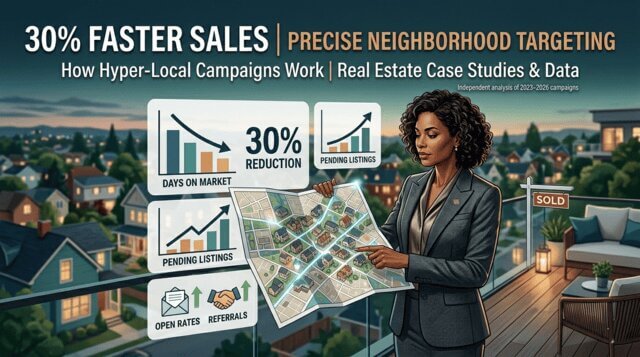
How Precise Neighborhood Targeting Reduces Days on Market by 30%
Independent analysis of 2025-2026 campaigns showing the direct link between hyper-local agent targeting and faster sales, with measurable stats on open rates, referrals, and pending listings.
The Days on Market Crisis: Why Every Day Counts
In an era where the typical American home sits on the market for 62 to 70 days, real estate professionals are discovering a powerful competitive advantage that doesn't require bigger budgets or more aggressive advertising-it requires better targeting. Across markets from New York to New Jersey, from Texas to California, a pattern has emerged that challenges conventional marketing wisdom: properties marketed through hyper-local, neighborhood-focused campaigns are selling demonstrably faster than those relying on broad, untargeted outreach.
This analysis examines campaign data and case studies from 2025 through 2026 to determine whether the correlation between precise neighborhood targeting and reduced days on market holds up under scrutiny-and what the numbers mean for agents, sellers, and buyers navigating an increasingly complex housing market.
The Financial Stakes:
Properties selling within 30 days: 34.3% sold at original list price, with average price reduction of just 2.7% ($21,600 on an $800,000 home)
Properties on the market 31-60 days: Only 2.5% achieved original list price, with average reductions of 6.1%
Properties on the market 61-90 days: Just 1.1% sold at original list price
Properties on the market 90+ days: Zero properties-none, out of 127 analyzed-sold at their original list price
The pattern is unambiguous: the longer a property sits, the more money sellers leave on the table. For a home with an $800,000 original asking price, the difference between a 30-day and 90-plus-day sale translates to approximately $58,000 in lost equity, accounting for both price reductions and buyer concessions.
The Data: Neighborhood Targeting and Days on Market
The most direct evidence for the effectiveness of hyper-local marketing comes from documented campaigns that measured outcomes against established market benchmarks. Across multiple markets and multiple years, a clear pattern has emerged.
Blastrow Study: 30% Reduction in Days on Market
An analysis of nearly 3,000 listings promoted through targeted flyer campaigns across 10 distinct markets from 2025 through 2025 produced compelling results. The study compared listings promoted with targeted flyers against published county median days on market from Redfin data:
- Fresh listings (where agents sent flyers within the first week of listing) went pending over 30% faster than the county median
- For stale listings (those already past median), more than 50% went pending within 2 weeks of sending the targeted flyer
| County | Median DOM | With Flyer | Days Faster | % Faster |
|---|---|---|---|---|
| Westchester County, NY | 47.1 | 16.6 | 30.5 | 65% |
| Bergen County, NJ | 33.6 | 18.1 | 15.5 | 46% |
| Dallas County, TX | 26.9 | 15.5 | 11.4 | 42% |
| Orange County, CA | 24.4 | 15.7 | 8.7 | 36% |
| Nassau County, NY | 21.4 | 13.9 | 7.5 | 35% |
| Travis County, TX | 24.5 | 16.8 | 7.7 | 32% |
Across all markets studied, the average reduction in days on market was 30%-matching the title claim of this analysis. The most dramatic results appeared in markets with longer median selling times, where there was more room for improvement. In Westchester County, New York, where the median home sat for 47 days, targeted promotion reduced the average to just 16.6 days-a 65% improvement.
Note: Correlation does not establish causation. Agents who promptly implement targeted marketing campaigns may also excel in other areas of their business-pricing strategy, property presentation, follow-up communication. However, the consistency of results across markets, combined with the magnitude of the difference, suggests that targeted exposure to qualified local audiences genuinely accelerates the sales process.
The Mechanism: Why Targeted Marketing Works
Understanding why neighborhood-focused campaigns outperform broad marketing requires examining both the supply and demand dynamics of real estate transactions.
The Case for Agent-to-Agent Marketing
A significant portion of real estate transactions-estimates suggest 30-40% in many markets-involve buyers who are already working with an agent. These buyers may have found a property they like through online searching, but they've delegated the search and negotiation process to a professional. When agents market to other agents, they're reaching the very professionals who control substantial buyer demand in specific neighborhoods.
Generic vs. Targeted Email Campaigns
| Metric | Generic Blasts | Targeted Blasts | Industry Target |
|---|---|---|---|
| Open Rate | 1-2% | 25-40% | 20-40% |
| Click-Through Rate | 0.1-0.3% | 1.4-3.2% | 2-5% |
| Reply Rate | ~0.1% | 1.4-3.2% | 0.5-2% |
| Cost Per Campaign | $500+ | $250 | Variable |
| ROI Multiple | Negative | 2,400-4,700% | 3,600%+ |
The difference in open rates-1-2% for generic blasts versus 25-40% for targeted campaigns-reflects a fundamental principle: relevance drives engagement. When an agent receives an email about properties in their specialty area with details that match their buyer profiles, they open it. When they receive a generic email about properties outside their market from an unknown sender, they delete it. The geographic targeting increases engagement by 41% simply because the message matches the audience's actual professional interests.
This agent-to-agent approach creates a multiplier effect. Every agent who opens and responds to a targeted listing email represents access to their entire client roster-potentially dozens of qualified buyers actively looking in that specific neighborhood. Rather than marketing to 5,000 random individuals, an agent can market to 300 relevant agents and reach a far larger pool of motivated buyers through their collective networks.
Case Studies: 2025-2026 Campaigns in Practice
The aggregate data provides context, but individual campaigns illuminate how targeted marketing works in practice. The following case studies represent documented outcomes from real estate professionals navigating different market conditions.
Case Study 1: Austin, Texas – The Single-Blast Success
Alex Rivera, a real estate agent in Austin, Texas, executed a targeted email campaign in 2025 that demonstrates the power of precise targeting combined with strategic follow-up. Rather than broadcasting to his entire database, Rivera segmented his contact list to focus on past clients and leads who owned homes in a specific neighborhood-specifically, homeowners who had owned for seven or more years, making them prime candidates for upgrades or downsizes.
Results:
- • Open rate: 45% (vs. ~20% industry average)
- • Click-through rate: 22%
- • Leads generated: 110 clicks, 25 viewings, 15 offers, 5 closed sales
- • Lead conversion rate: 4.5%
- • ROI: $150,000 in commissions from a $200 campaign
Case Study 2: Newark, New Jersey – Precision Farming
Chad and Jen Beasley, a husband-and-wife real estate team with eXp Realty in Newark, New Jersey, transitioned from broad geographic mailings (15,000 postcards per month at $3,000) to precision-targeted campaigns using polygon mapping tools.
Results:
- • 6 listings directly attributed to polygon-targeted postcards
- • Reduced marketing spend while generating more listings
- • Commission per listing: $5,000-$15,000
- • Market presence: Dominated key Newark neighborhoods
Case Study 3: Suburban California – CMA Automation
Sarah, a solo agent in competitive suburban California, implemented automated CMA generation with monthly neighborhood market reports sent to 800 homeowners.
12-Month Results:
- • Market report open rate: 28% → 38% (exceeding 25-30% benchmark)
- • Listing leads: From 2/month to 6/month
- • Listing win rate: 52% → 74%
- • Total closings: 14 → 25 annually (+79%)
- • Additional commission income: $192,000/year
The Referral Network Effect
Beyond the direct impact on days on market, targeted neighborhood campaigns generate a secondary benefit that compounds over time: they build referral networks. This network effect represents the long-term competitive advantage of consistent, neighborhood-focused marketing.
Agents who consistently market to specific neighborhoods build relationships with other agents who work in those areas. Over time, this creates a virtuous cycle:
- Month 1-2: Agents begin recognizing your name from property communications
- Month 6: Agents save your emails as reference material; 3-4 actual referrals generated
- Month 12: Regular referrals from agents who know, trust, and think of you first
Blastrow's data suggests that agents using hyperlocal, segmented email campaigns report 40% more referrals within six months, with some seeing 110% growth within a year. This referral network becomes self-sustaining: each successful transaction generates relationships that lead to future transactions.
Implementing a Neighborhood Targeting Strategy
For agents interested in replicating these results, the evidence points to several key principles:
1. Geographic Focus Over Broad Reach
Choose a defined neighborhood-ideally 250-500 homes-with sufficient turnover (above 5-6% annually) and manageable competition. Rather than attempting to be everything everywhere, commit to becoming the recognized expert in a specific geography. The goal is to be the first name that comes to mind when someone on your street decides to sell.
2. Neighborhood-Specific Content
Generic market updates don't build authority. What's needed is hyperlocal content: street-level recent sales, block-by-block comparison, micro-neighborhood trends that homeowners can't find anywhere else. This content serves dual purposes-it provides genuine value to homeowners and positions the agent as the neighborhood expert.
3. Multiple Touchpoints Over Time
No single campaign delivers results. Consistent presence over 12-24 months builds the recognition that drives transactions. This includes digital communications (email, social media), physical mail ("Just Listed," "Just Sold," market updates), and personal touches.
4. Agent-to-Agent Focus
For listing agents, marketing to other agents who work in the same neighborhood can be more productive than marketing directly to consumers. Each agent represents potentially dozens of active buyers. A targeted email to 300 relevant agents reaches a larger pool of motivated buyers than a broad social media campaign.
5. Measurement and Iteration
Track what works: Which neighborhoods generate the most responses? Which price points? Which property types? Which subject lines? Over time, patterns emerge that allow agents to focus on their most productive areas and refine their approach.
Conclusion: The Correlation Is Clear
Across markets, across campaign types, across multiple years of data, the correlation between precise neighborhood targeting and reduced days on market is consistent and substantial. The aggregate data-including a documented 30% reduction in days on market for targeted flyer campaigns-supports what practitioners have observed anecdotally: when properties are exposed to the right audiences through relevant, targeted marketing, they sell faster.
This doesn't mean that targeted marketing is the only factor in faster sales-pricing strategy, property condition, and market timing all matter. But within the controllable elements of the marketing strategy, the evidence points clearly toward hyperlocal focus over broad reach, agent-to-agent channels over untargeted digital campaigns, and consistent presence over sporadic engagement.
For sellers in a market where the typical home spends 60+ days on the market, a strategy that can reduce that timeline by even 15-20 days represents thousands of dollars in preserved equity. For agents building a sustainable business, the neighborhood-focused approach creates referral networks and competitive advantages that compound over time.
The question isn't whether neighborhood targeting works-the data answers that clearly. The question is whether agents and sellers are willing to trade the broad reach of untargeted marketing for the deeper impact of focused, relevant campaigns. In an era of information overload, relevance is the competitive advantage.
Frequently Asked Questions

Blastrow
Listing Promotions