
2026-2027 Marketing Channel Mix: Where Agents Get Results
 Mark Newman14 min readAugust 16, 2026
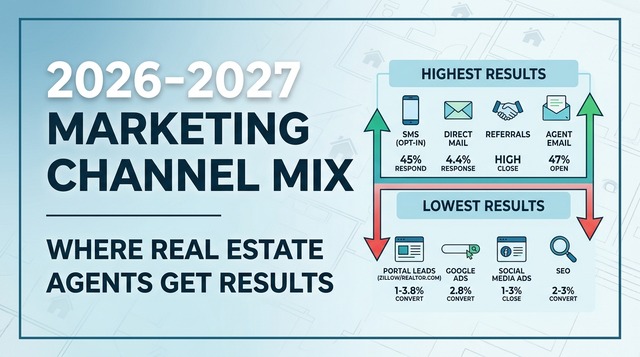
Real estate agents get their best results in 2026 from two places: targeted email outreach to other agents who hold active buyer relationships, and short-form video distributed through social channels. Targeted agent-to-agent email delivers the highest conversion economics in the industry, while video is the fastest-growing source of buyer attention. This guide benchmarks every channel an agent can spend money or time on - email, social, paid ads, portals, SMS, search, direct mail, open houses, and signs - and projects which ones gain share in 2027.
Key Takeaways
On this page
The 2026 Channel Map: Where the Money Actually Goes
The best starting point for a channel mix discussion is cash flow. Industry surveys consistently show that just over half of an average agent's total marketing budget goes to digital channels. NAR survey data pegs the digital share at about 54%, with projections suggesting it climbs toward 58 to 60 % as traditional advertising continues to retreat.
The absolute numbers are small compared to other industries, which is exactly why channel selection matters so much. The median agent spends roughly $1,850 per year on marketing, according to NAR member research. Top producers routinely spend $10,000 or more. A common rule of thumb across coaching programs is to reinvest 7 to 12% of gross commission income into marketing. An agent earning $250,000 in GCI should budget roughly $17,500 to $30,000 per year.
Where that money goes has shifted hard. Print marketing now accounts for a small slice of agent budgets. The US Postal Service reports marketing mail volume fell about 40% between 2008 and 2023, from roughly 99 billion pieces to about 59 billion, and held at around 56.8 billion pieces in fiscal 2025. The notable exception to the pure-digital narrative is the yard sign, which remains the highest-visibility piece of offline marketing an agent owns. NAR data shows 48% of buyers use yard signs as an information source during their search, and they cost almost nothing to deploy.
The market conditions behind the mix
Existing-home sales have hovered just above 4 million units annually, the slowest pace since 1995. NAR membership stands at roughly 1.44 million, down from the 1.6 million peak. Median gross income for agents is about $59,200, but agents with 16-plus years of experience earn a median of $88,500, and the gap is explained largely by repeat business and referrals. Agents with deep past-client pools are outperforming new entrants precisely because relationship channels cost less and convert better.
In a market with fewer transactions and more agents chasing them, the channels that put an agent in front of a motivated buyer or a referral-minded past client win. Channels that generate mass impressions without a clear follow-up path lose.
How Every Channel Compares: ROI, Cost per Lead, and Speed to Deal
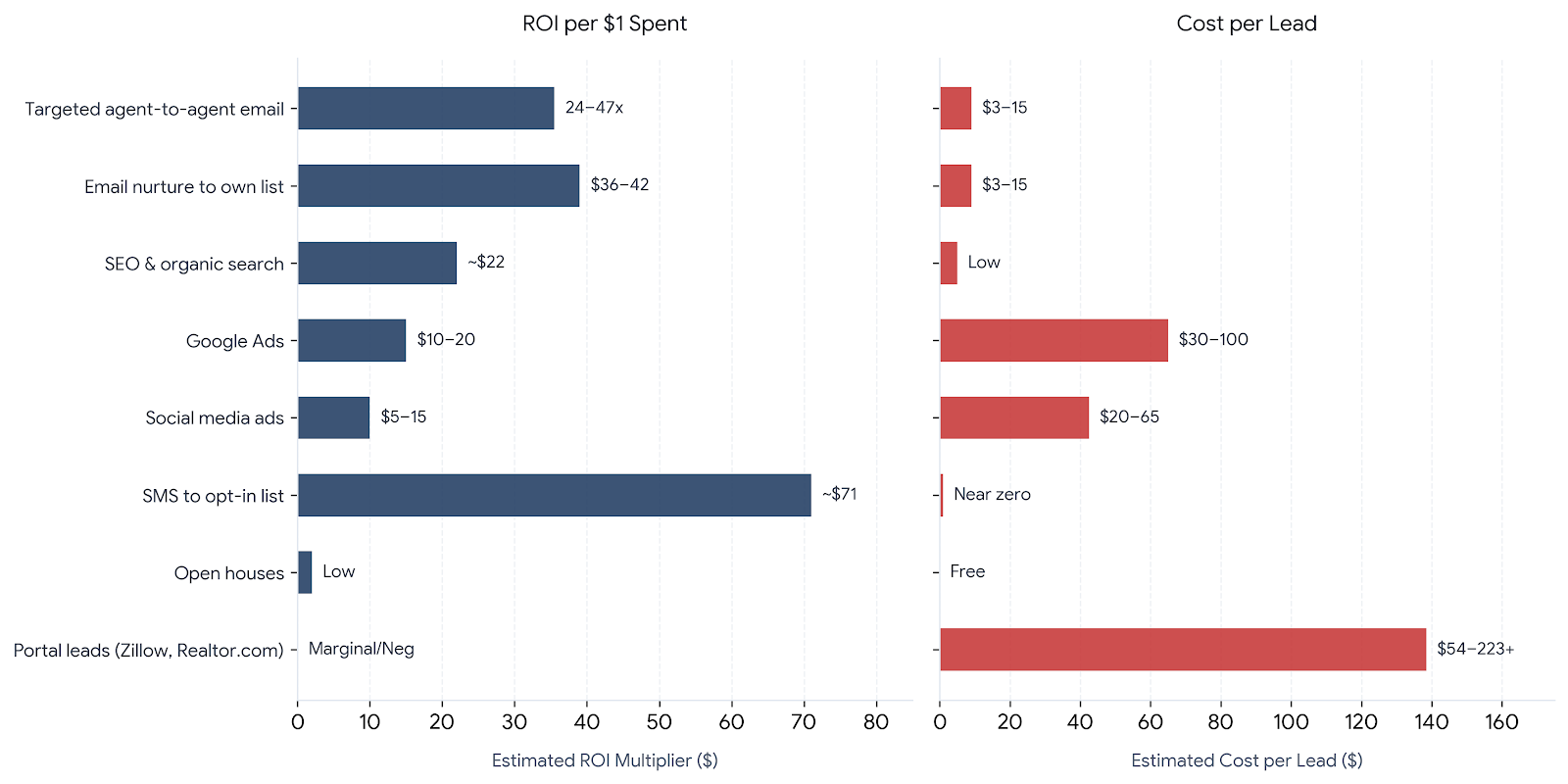
Channel comparisons in real estate marketing are full of variance, because results depend on list quality, targeting precision, and follow-up speed. But the ranges across credible industry sources are consistent enough to build a workable comparison table. The table below combines data from NAR research, DMA and ANA response rate reports, WordStream, and published platform benchmarks.
| Channel | ROI per $1 | Cost per Lead | Response or Conversion | Time to Deal |
|---|---|---|---|---|
| Targeted agent-to-agent email | 24-47x | $3-15 | 36-47% open, 1.4-3.2% reply | 1-4 weeks |
| Email nurture to own list | $36-42 | $3-15 | 20-35% open, 1-3% convert | 1-6 months |
| SEO and organic search | ~$22 | Low, long lead time | 2-3% convert | 3-12 months |
| Google Ads | $10-20 | $30-100 | 2.8% ad click conversion | Days to weeks |
| Social media ads | $5-15 | $20-65 | 1-3% of leads close | Days to weeks |
| Portal leads (Zillow, Realtor.com) | Marginal to negative | $54-223+ | 1-3.8% convert | Weeks to months |
| SMS to opt-in list | ~$71 | Near zero | 98% open, 45% respond | Hours to days |
| Direct mail | $8-15 | $30-80 | 2.7-4.4% response | 3-8 weeks |
| Open houses | Low cash cost | Free beyond time | 4-5% of buyers meet agent there | Variable |
| Referrals and sphere of influence | Near infinite | ~$0 | 14-17% convert | 1-3 months |
Three patterns jump out. First, the channels with the highest return are the ones the agent already owns: their CRM contacts, their past clients, and the lists of other agents in their market. Nothing beats a referral in conversion or a targeted agent email in cost efficiency. Second, paid channels cluster in the middle: they produce leads quickly, but close rates are low, and true acquisition economics are far less attractive than click-through narratives suggest. Third, speed is a channel in itself. SMS and agent-to-agent email compress the distance between promotion and reply to minutes and days rather than months, and in a market where the first agent to respond wins, channels that shorten response time are worth more than their raw ROI suggests.
Agent-to-Agent Email: The Highest-Leverage Channel in the Industry
The single most underused channel in real estate marketing is email sent from one agent to other agents. It works because the recipient base is professionally motivated. Listing agents send their listings to buyer-focused agents who hold active client relationships and are always hunting for the next property. When the match is right, the buying agent's first reaction is not to ask for more photos but to ask for showings and tour schedules.
The performance gap between targeted outreach and a generic mass blast is the largest spread in all of real estate marketing. Generic email blasts to broad, purchased lists produce open rates of 1 to 2% and click rates under 0.3 %. Targeted digital flyer campaigns sent to a curated set of local agents, selected by geography, recent transaction activity, and buyer profile, produce open rates of 36 to 47%, reply rates of 1.4 to 3.2%, and conversion to meetings or referrals of 2 to 4%. That is a 20 to 30 times improvement on the same channel with different targeting.
The reply rate deserves emphasis because it is the metric that matters most in agent-to-agent email. A reply means the receiving agent recognizes the opportunity, and replies in this channel routinely convert into buyer showings, co-listing conversations, and referrals. Blastrow's platform data shows this pattern clearly: agents using its digital flyer and hyperlocal targeting system see average open rates of 35 to 47% on campaigns to agents who recently closed deals in the target area, with reply rates between 1.4 and 3.2%. A single successful referral, worth $3,000 to $12,000 or more, pays for 6 to 12 months of campaigns at typical campaign prices.
Why does the economics work so well? First, the total cost is tiny: a targeted campaign to 1,000 relevant agents can be executed for roughly $250, and per-thousand costs fall toward $15 on self-serve platforms. Compare that to $1,500 to $3,000 for a comparable direct mail piece, $42 per lead for Google Ads, or $139 to $223 per portal lead. Second, the conversion base rate is higher because the audience is professional: a home buyer who inquires on a portal is shopping, while an agent who replies to a listing promotion is working. Third, the channel compounds: every successful referral creates a reciprocal relationship, and the agent who sends a qualified buyer to a listing agent today becomes the first person that agent calls when a matching listing appears.
The most important comparison is against the alternative way listing agents reach buyers. A listing promoted only to the general public waits for buyers to find it. The same listing promoted to 500 buyer-side agents reaches 500 professionals whose job is to match clients to properties. In a market where inventory is limited and buyer agents are hungry for fresh listings, that distribution advantage is decisive.
Watch Out for Open-Rate Inflation
The mechanics that make agent-to-agent email perform
Beyond targeting, execution details separate campaigns that get replies from campaigns that get deleted. Subject lines decide the open: agent inboxes sit at saturation, and lines built around the receiving agent's incentives - price, condition, cooperative commission - outperform branding-focused lines. Recognition beats novelty: a repeat sender who has already forwarded a good match earns opens on the next campaign without trying, which argues for a cadence of one relevant flyer per month to the same curated 500-agent list.
Segmentation is the biggest lever inside the channel. Email campaigns segmented by audience behavior lift click-through rates by roughly 76% compared with unsegmented sends and generate roughly 760% more revenue. Agent-to-agent segmentation runs on three fields: geography, buyer type, and recency. Automated sequences multiply the value of the initial open: following up with an unopened flyer after 48 hours and with an opened-but-unreplied flyer after another 72 hours recovers a meaningful share of conversations, and automated campaigns across industries produce about 320% more revenue than one-off sends.
Mobile formatting is non-negotiable for agent recipients: the majority of email is read on phones, and about 70% of recipients delete a non-responsive email immediately. Professional flyers render as clean single-column layouts with a visible price, fast-loading photos, and one obvious call to action - reply for tour details. Deliverability is the quiet filter: SPF, DKIM, and DMARC alignment decide inbox placement, and delivery rates of 95 to 98% are the healthy standard. Purchased or scrapped lists fail in this channel before message quality is ever tested.
The cadence ceiling is one to two campaigns per agent list per week, with monthly as the retention floor, and every campaign should carry a property the recipient's buyers could plausibly buy. For 2027, every projection points up for agent-to-agent email: portal costs continue climbing as agents bid against each other, buyer agents keep consolidating around a smaller number of trusted listing partners as inventory tightens, and the channel remains the rare case where the highest-ROI activity is also the one with the least competitive noise.
Why Referrals and Sphere of Influence Dominate the Conversion Table
Agent-to-agent email is the mechanism, but referrals are the underlying engine. The NAR 2025 Profile of Home Buyers and Sellers could not be clearer about how clients actually select agents. About 43% of buyers found their agent through a referral from a friend, neighbor, or relative, and 37% of sellers did the same. Another 29% of sellers returned to an agent they had used before. Combined, referrals and prior working relationships account for about 66% of all seller-agent connections.
The agent-to-agent slice is smaller but strategically important. About 7% of buyers found their agent through a referral from another real estate professional, and about 4% of sellers connected that way. Those %ages look modest until weighted by conversion: referral leads convert at 14 to 17%, versus 1 to 3% for paid leads and 0.4 to 1.2 % for raw internet leads. A referral is worth roughly 10 times as much per lead as a paid inquiry, at essentially zero acquisition cost.
The aggregate math is staggering. Industry analysis consistently attributes about 82% of real estate transactions to referrals and repeat business. NAR's 2025 Member Profile shows the median agent earns about 20% of business from repeat clients and another 21% from past-client referrals - meaning roughly 41% of an average agent's gross commission income is sphere-driven before any cold lead source receives a dollar.
The practical conclusion for the channel mix is that list-building beats lead-buying. Every dollar that strengthens past-client relationships - moving programs, market updates, annual check-ins - buys the highest-converting lead source in existence. Agent-to-agent email is the fastest way to build that list from the professional side, because every referring agent is also a potential recipient of future referrals. Recognize that flip: the listing agent who distributes a great flyer to collaborators is simultaneously feeding a referral economy that returns to them.
Video on Social: Why It Wins Attention and Where It Sits in the Mix
Video is the strongest attention-format in the 2026 channel mix. Listings promoted with video generate 403% more inquiries and 1,200% more social shares than text-and-photo-only listings. The mechanism is straightforward: social algorithms reward video dwell time, and buyers who watch a property move are substantially more likely to inquire than buyers who only scan photos.
The nuance is that attention and deal flow are not the same thing. Direct lead-to-close conversion for social video traffic stays low, in the 1 to 3% range, similar to social ads. But video multiplies every channel it feeds: video listing content improves listing engagement on portals, feeds the agent-to-agent email flyer with something worth opening, and gives referral conversations a tangible asset to share. Agents who film every listing and reuse the footage across email, social, and open house promotion are running video as an amplifier, not as a lead source.
Benchmarks that hold up across sources
| Format | Benchmark | Why It Matters |
|---|---|---|
| Video listing posts | 403% more inquiries, 1,200% more shares | The strongest single multiplier in property marketing |
| Live video | Demand up ~340% year over year | Cheap, authentic, and indexed by search engines |
| Short-form social video | Highest reach-to-cost ratio on every platform | Reels, Shorts, and TikTok dominate brand discovery |
| Interactive video | Share of video spend growing toward 50% | Quizzes and tours convert curiosity into contact |
The video pipeline that converts
Winning agents run a simple three-stage pipeline. First, produce: one day of filming per listing, broken into a 30-second hero clip, a 60-second walkthrough, and a neighborhood snippet. Second, distribute: the hero clip goes to social feeds, the walkthrough goes to email campaigns and the listing page, and the neighborhood snippet becomes the open house teaser. Third, capture: every video ends with one call to action - DM for details, tap to book a tour, or scan to view - and every responder enters the SMS and email follow-up sequence within 24 hours.
The trap is treating video as a vanity channel. A 3-minute cinematic tour that no one can reply to is less valuable than a 30-second clip with a clear next step. Video earns its place in the mix only when every view has a path to a conversation.
Which Social Platforms Actually Matter for Agents
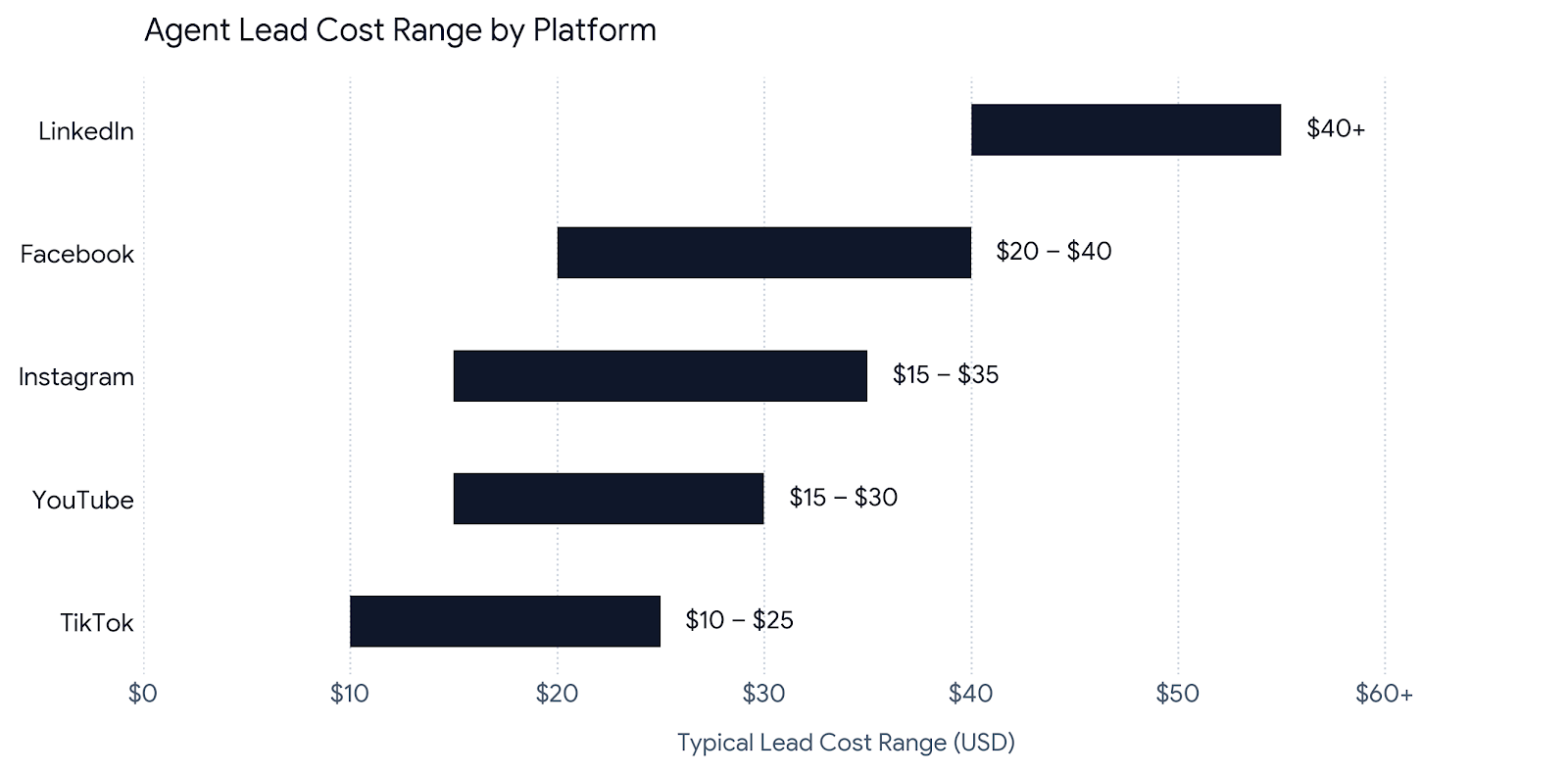
About 4 in 10 agents use social media for business, and Facebook remains the most common choice. The mistake is trying to be everywhere. Platform economics differ sharply for real estate content, and the platforms with the largest audiences are not always the platforms with the best lead paths.
Platform roles and lead costs
| Platform | Role for Agents | Typical Lead Cost Range |
|---|---|---|
| Broadest reach; listing boosts and open house events | $20-40 | |
| Reels and story reach for neighborhood lifestyle | $15-35 | |
| YouTube | Long-tail search asset; tours rank for years | $15-30 |
| Agent-to-agent referral building and COI outreach | $40+ (but referral quality is high) | |
| TikTok | Discovery for younger buyers and future movers | $10-25 |
The pattern is clear: every platform converts poorly as a direct lead channel, but Facebook and LinkedIn matter specifically for their community and referral mechanics. Facebook groups and local community pages are where neighborhood chatter happens, and LinkedIn is where agents and mortgage professionals build the reciprocal referral networks that feed the 82% of transactions that come from relationships.
A practical allocation: post daily short-form video to the two platforms where the agent's past clients already live, run a weekly listing post on Facebook, and reserve LinkedIn for referral relationship content once per week. Everything else is discovery-only, measured by reach, not by lead count.
Paid Search and Paid Social: The Honest ROI Picture
Paid channels deliver speed and scale that owned channels cannot match, but for real estate the headline ROI numbers do not survive contact with conversion rates. Google Ads for real estate carries an average cost per lead of $30 to $100, with some markets pushing past $42, and an industry-standard click-to-lead conversion of about 2.8%. Social media ads run $20 to $65 per lead, with only 1 to 3% of those leads closing.
The per-closing math is forbidding. At $42 per lead and a 3% close rate, an agent needs roughly 33 leads to produce one sale - about $1,400 in lead costs before anything else. At the top of the range, $100 per lead at a 3 % close rate crosses $3,300 per closing. Paid channels still work, but they work best when every lead is pushed into the same fast SMS follow-up and listing-email machinery that makes organic channels convert.
Where paid dollars actually land well
Three paid placements survive the ROI math in 2026. First, brand-protection search ads: bidding on the agent's own name and local market phrases is cheap, conversion is high, and it keeps competitors off branded queries. Second, retargeting: roughly 97 % of website visitors leave without converting, and retargeting campaigns recapture that warm traffic at half the cost of cold prospecting. Third, hyperlocal social ads with geofencing and listing-level sets, which put an active listing in front of the right zip code for a few dollars a day. Broad-market paid prospecting, by contrast, is where most agents burn budget in the first 90 days.
The sustainable play is a cap: keep paid search and paid social combined at or under about 20 to 25% of monthly marketing spend, measure cost per lead per zip code weekly, and cut any geography that misses the target twice in a row. Paid channels fund the top of the funnel; owned channels close the bottom.
Portal Leads: The $4,200 Question
Zillow and Realtor.com leads are the best-known lead source in the industry and the most variable in outcome. The economics depend entirely on response speed and follow-up infrastructure. Portals sell shared leads - the same inquiry is routed to multiple agents in competing teams - and shared leads convert at only 1 to 3% on average. Costs run $54 to $223 per lead depending on market and timing, which means the true cost per closed deal frequently exceeds $4,200 for agents who treat portal leads like a subscription rather than a fully-worked pipeline.
The leaders tell a different story. Top teams convert portal leads at 7 to 9% by running sub-5-minute response times with a structured 12-plus-touch cadence - SMS immediately, a call within minutes, a listing email within the hour, and consistent follow-up for weeks. At 8% conversion, the same $150 average cost per lead drops to about $1,875 per closing, which pencils out profitably for teams with a strong closing operation.
The $4,200 per closing math
The strategic question for the 2027 mix is not whether portals work but whether they are the best use of the same budget. The dollars an agent spends on portal subscriptions buy inquiries that must be re-converted through speed and cadence. The same budget spent on agent-to-agent email buys conversations with professionals who already hold ready buyers. For teams without a rigorous follow-up machine, owned and agent-targeted channels deliver more conversations per dollar; for teams with the machine, portals remain a defensible top-of-funnel layer.
SMS: The Speed Channel Hiding in Plain Sight
SMS is the fastest conversation channel available, and it is the closest thing to a free channel in the mix. Text messages post average open rates of about 98%, typically read within three minutes, and drive response rates reported near 45%. Industry analyses put SMS ROI in the range of $71 per dollar spent, because the marginal cost of a text is effectively zero once recipients have opted in.
The leverage comes from combining SMS with other channels. A portal lead that receives an immediate text has the fastest possible route to a showing. A past client who gets a quarterly market snapshot by text re-engages far more often than one who gets it by email. An agent list receives a listing alert by text with a one-tap tour-booking link, and the reply rate dwarfs email response.
The discipline is opt-in. Cold text blasting violates TCPA rules, damages sender reputation, and destroys the exact trust the channel depends on. Compose every text with a single goal - book the tour, confirm the update, or reply with a question - and let the full listing detail live in the accompanying email or landing page. SMS earns its place in the 2027 mix not as a destination but as the switchboard that routes every other channel's interest into a live conversation.
SEO Under AI Search: Shrinking Room, Rising Value for Survivors
Traditional SEO is the slowest channel in the mix, and AI search compresses it further. Generative answers in Google's AI Overviews, ChatGPT, and Perplexity increasingly respond to local queries without any click-through, shrinking the top-of-funnel room that blog posts and listing pages used to own. The residual niches are getting narrower and more valuable: "agents near me" queries, neighborhood deep-dives, and specific answer-style searches that AI assistants pull from authoritative sources.
The playbook that survives has three layers. First, own the local pack: a complete and reviewed Google Business Profile is the highest-risk single asset, because AI assistants cite local business data directly from it. Second, publish hyperlocal content - neighborhood guides, school zone analysis, commute data - that AI answers can cite and users can trust. Third, shift effort toward video search, where YouTube results retain click-through because the answer is the viewing experience itself.
Realistic expectations matter. The median agent's blog post will not rank under AI search; the agent's neighborhood page with genuinely local data might. Budget SEO as a 10 to 15% share of the mix, maintain it monthly, and never let it crowd out channels that produce conversations this quarter.
Speed to Lead: The Invisible Channel That Determines Everything
Every channel above produces the same raw material - an inquiry - and almost every channel's performance is decided in the minutes after that inquiry arrives. Agents who respond to a new lead within 5 minutes are 21 times more likely to qualify it than agents who respond after 30 minutes. Response within 15 minutes keeps an agent about 4 times more likely to win the conversation. After two hours, the advantage collapses toward baseline.
| Response Time | Qualification Odds vs 30 Minutes | What Top Agents Run |
|---|---|---|
| Under 5 minutes | 21x | Instant SMS auto-reply, live call within minutes |
| 5-15 minutes | ~4x | Automated text with tour-book link, callback queued |
| Under 2 hours | Baseline to slightly negative | Portals routed to VA-verified response systems |
| Same day or later | Below baseline | Lead is cold; needs re-touch sequence |
Speed is the cheapest infrastructure an agent can build: an SMS template, a call script, and a rule that every lead gets touched within five minutes of arrival. It also explains why portal leads disappoint for slow agents - not because the inquiries were bad, but because by the time most agents called back, a faster team had already booked the showing. In the 2027 mix, speed to lead is the channel that multiplies the ROI of every other channel you buy.
Traditional Channels: Direct Mail, Open Houses, and Yard Signs
Traditional channels have not died; they have become supporting players with specific jobs. Direct mail still earns 2.7 to 4.4% response rates on well-targeted lists and a reported 161% ROI in postal-industry studies, but marketing mail volume has fallen roughly 40% since 2008, feedback takes three to eight weeks, and a meaningful campaign costs $1,500 to $3,000. The channel works best as a farm-area brand layer: fewer, better shots, each carrying a QR code that routes the recipient to a trackable digital page.
Open houses remain the cheapest event channel in the industry. About 4 to 5% of buyers meet their agent at an open house, and the cash cost is near zero beyond time. The conversion lever is the registry: every guest checked in with name, phone, and email becomes a nurtured contact, and open house guests paired with a same-evening SMS follow-up convert into clients at rates that justify the whole ritual.
Yard signs are the quiet giants of local visibility: 48% of buyers use signs as an information source, and in neighborhoods where an agent holds multiple nearby listings, signs compound into share-of-mind for every future listing on the block. The modern upgrade is the sign-facing landing page - a short URL and QR on the sign that captures interest from drive-bys who normally vanish.
All three traditional channels share one trait: they work hardest in combination. A direct mail piece announcing an open house, a sign beyond the open house pointing traffic in, and a QR code capturing every drop-in creates a closed loop that none of the three produces alone.
2027 Projections and Your Channel Mix
Looking into 2027, the channel mix shifts along four lines: attention consolidates around short-form video, digital budgets keep growing as traditional advertising shrinks, AI search redirects a share of search traffic, and the cost of every paid lead source keeps climbing while targeting precision keeps rising.
| Channel | 2026 Direction | 2027 Projection |
|---|---|---|
| Agent-to-agent email | Rising adoption | Share gains from portals and paid |
| Referrals and SOI | Dominant, stable | Holds ~80%+ of transactions |
| Short-form video | Fastest-growing attention format | Continues to absorb social share |
| Portal leads | High CPL, growing | Flat to declining share for independent agents |
| Paid search | Stable CPL creep | Consolidated to brand and local defense |
| SEO and local content | Narrowing under AI search | Residual niche, cited by AI answers |
| Traditional advertising | Shrinking | Continues slow decline |
| SMS and automation | Emerging standard | Becomes table stakes for response |
The practical 2027 allocation
The channel-mix stack that compounds
The channels above are only as good as the infrastructure that joins them. The stack that moves the needle in 2027 has four parts: a CRM that records every inquiry and touch across channels; an agent-to-agent email tool with hyperlocal targeting and real-time reply tracking; an SMS layer wired for instant response and tour booking; and a video workflow that turns every listing into reusable footage. Teams that run all four report that their channel mix becomes a compounding system - every channel feeding the next, with cost per closing falling quarter over quarter.
None of this requires a bigger budget. It requires reallocating the budget toward the channels that build owned relationships - agent lists, past clients, and response speed - and away from the channels that rent attention at ever-rising prices. In a market of 4+ million annual transactions and 1.44 million agents, the winners will not be the agents who spent the most; they will be the agents who spent the most efficiently, one targeted flyer and one five-minute response at a time.
Ready to Put Agent-to-Agent Email at the Center of Your Channel Mix?
Blastrow lets you create a professional digital flyer from any listing, target the hyperlocal agents who actually work the neighborhood, and track opens, replies, and referrals in real time. The first 50 agents are free - no subscription, no commitment.
Try Blastrow FreeFrequently Asked Questions
What is the highest-ROI marketing channel for real estate agents in 2026 and 2027?
Are agent-to-agent email blasts worth it for listing agents?
How many leads do real estate agents actually get from social media video?
Is direct mail dead for real estate advertising?
Do portal leads like Zillow still make sense in the 2027 channel mix?
How should an agent split their marketing budget for 2027?
Blastrow
Listing Promotions