
Email Deliverability for Real Estate Pros: 2026 + 2027 Guide
 Mark Newman19 min readAugust 18, 2026
2025-2026 inbox placement data, real estate email benchmarks, spam rate limits, and the 2027 Gmail, Yahoo, DMARC, and AI inbox survival checklist - every number sourced, named, and ready to benchmark your own campaigns against.
Key Takeaways
On this page
What Does Inbox Placement Rate Actually Measure?
Inbox placement is the single most important email number for real estate pros right now: Validity's 2026 Email Deliverability Benchmark Report puts the global inbox placement rate at 87.2% for 2025, which means roughly 1 in 8 marketing emails never reaches the inbox, and real estate programs that keep lists clean, authenticate properly, and send targeted messages regularly hit 90% or better.
This guide is built for real estate agents, brokers, and marketers who send email to two very different audiences: consumer leads and past clients on one side, and other agents on the other side. Those two audiences behave differently, get filtered differently, and need different benchmarks. Every figure below comes from a named study or provider report, so you can verify them and use them with confidence when you benchmark your own campaigns.
Here is what you will find: what inbox placement actually measures, the 2025 and 2026 global deliverability results from Validity, inbox placement rates by mailbox provider, real estate open rates and engagement benchmarks compared with other industries, open rates by send day and time, list hygiene thresholds that keep you out of the spam folder, why agent-to-agent email is different from consumer email, and a full 2027 survival guide covering Gmail and Yahoo bulk sender rules, Apple Mail Privacy Protection, AI inbox filtering, DMARC enforcement, and privacy laws.
Before looking at the numbers, it helps to be precise about what "deliverability" means, because agents often confuse three different metrics.
- Delivery rate is the share of emails the receiving server accepts. Legitimate senders usually see 95% to 99% delivery rates, but a delivered email can still land in spam, in the Promotions tab, or in an "Other" folder where nobody looks. Delivery tells you nothing about whether the recipient saw your flyer.
- Inbox placement rate (IPR) is the share of sent email that lands in the recipient's primary inbox rather than the spam folder, Promotions tab, or Other folder. Validity, the company behind the most widely cited deliverability benchmark reports, defines IPR as the most accurate way to measure deliverability because it directly measures how many emails reach the inbox.
- Spam placement rate and missing rate cover the rest. Spam placement is mail the provider deliberately filters into the spam or junk folder. Missing rate is mail that never shows up at all, usually because of provider filtering that drops it silently or because of technical rejection.
The practical rule for real estate
A campaign can report a 98% delivery rate and still have a 60% inbox placement rate. If you only look at the delivery rate in your email platform, you may think your flyers are going out fine while most of them quietly disappear into spam folders. That is why every serious sender tracks inbox placement with seed testing through tools like Validity Everest, GlockApps, or similar mailbox monitoring services.
Global Deliverability Results: 2024 vs 2025
Validity publishes an annual Email Deliverability Benchmark Report based on seed data sent to hundreds of mailbox providers around the world, aggregated into its Everest Mailbox Provider Community reporting suite. The 2025 edition covered 2024 performance. The 2026 edition covered 2025 performance. Together they give the clearest two-year picture of how hard it has become to reach a real estate contact's inbox.
Here are the global numbers from both reports:
| Metric | 2024 (Validity 2025 report) | 2025 (Validity 2026 report) | Change |
|---|---|---|---|
| Global inbox placement rate | 83.5% | 87.2% | +3.7 points |
| Spam placement rate | 6.7% | Not published at global level | - |
| Missing rate | 9.8% | Not published at global level | - |
| Lowest quarterly IPR (Q4 2024 peak sale season) | 82.3% | - | - |
The 2025 report noted that global inbox placement had declined from 84.8% in the prior edition, with the dip driven heavily by Gmail's tightening and Microsoft's aggressive filtering. The 2026 report shows a rebound: global IPR rose to 87.2% in 2025, a 3.7 point improvement year over year. Validity credits the improvement to the new mailbox provider requirements and to senders improving their programs after the 2024 enforcement wave.
Two other findings from the 2026 report matter for real estate. First, global sending volume decreased year over year for the first time in the report's history, as marketers prioritized smaller, higher-value lists over giant blasts. Second, mailbox providers now weight recipient engagement as a primary trust signal. Both trends favor the way real estate agents already work: small, relevant, hyperlocal lists sent to people who actually want the message.
Validity also reports regional differences. Europe is the best-performing region with an average inbox placement rate of 91.1% in 2025. North America improved by roughly 1 point year over year and remains dominated by Gmail, Microsoft, and Yahoo, which together cover about 88% of North American mailboxes - a share expected to grow to nearly 92% following the merger of AT&T and Comcast email into Yahoo. Asia showed the biggest improvement at 86.4% average inbox placement, up 8.3 points, though that number masks big differences between countries.
The sector rankings are also worth a look. Transportation was the top-performing sector in 2025 at 97.2% average inbox placement, followed by Energy, Utilities, and Waste, and Telecommunications. Real estate does not get its own sector line in the Validity report, so the closest publicly available comparison comes from email platform benchmark studies, covered later in this guide.
Inbox Placement by Mailbox Provider: Where Your Flyers Actually Go
The provider breakdown matters more in real estate than in almost any other industry, because the people you email are split in a specific way: consumer leads and homeowners mostly use Gmail, Yahoo, and Apple, while agents and brokers very often use Microsoft 365 or Outlook through their brokerage. These two provider groups filter very differently.
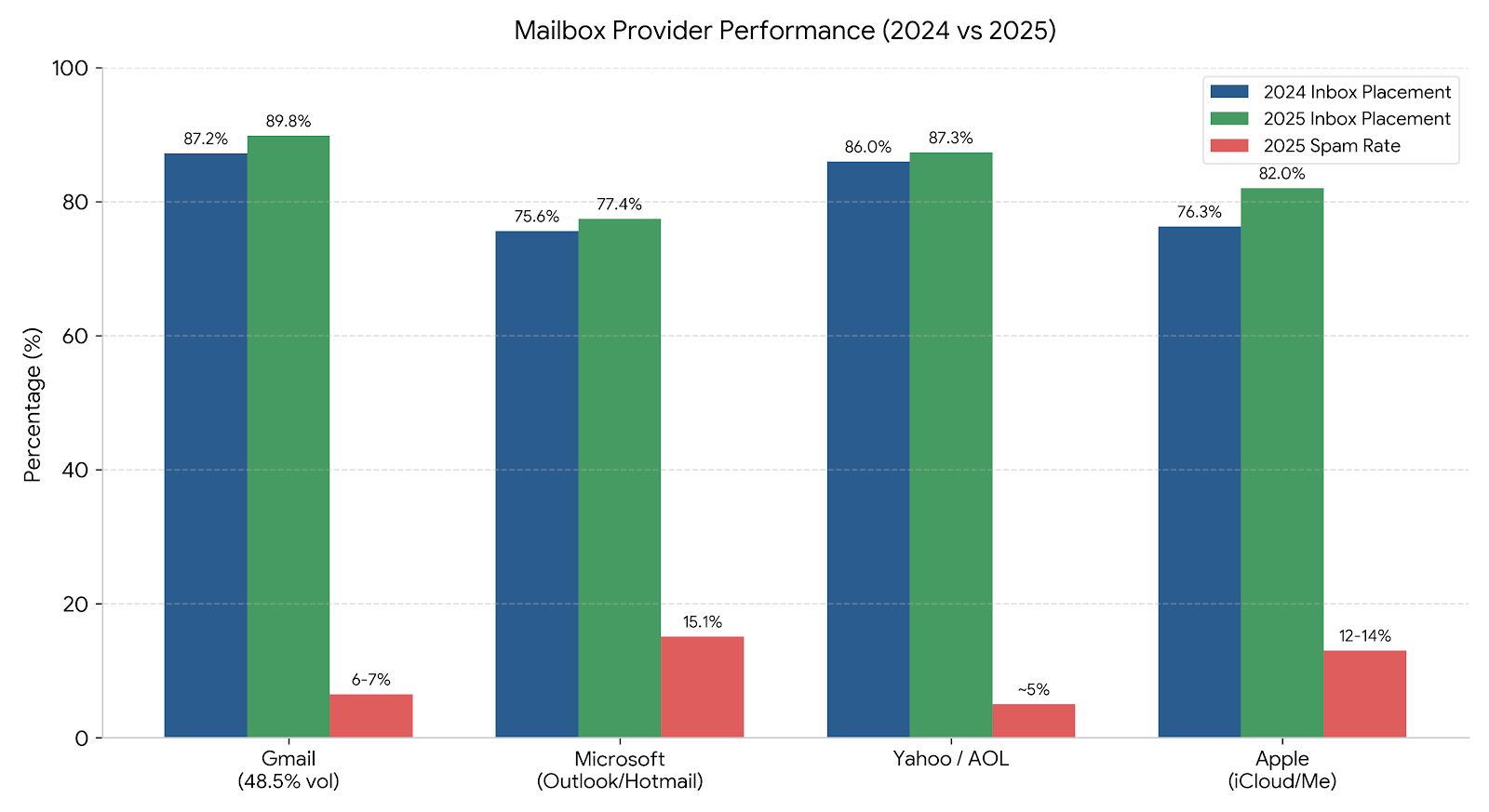
Validity's data for the MAGY providers (Microsoft, AOL, Gmail, Yahoo, with AOL merged into Yahoo and the "A" now standing for Apple) looks like this:
| Mailbox provider | 2024 inbox placement | 2025 inbox placement | 2025 spam rate |
|---|---|---|---|
| Gmail (roughly 48.5% of program volume) | 87.2% (averaged 89.8% early in 2024, fell to 84.2% by Q4) | 89.8% | About 6-7% |
| Microsoft (Outlook, Hotmail, Office 365) | 75.6% (worst of the major providers) | 77.4% | 15.1% |
| Yahoo / AOL | 86.0% | 87.3% | About 5% |
| Apple (icloud.com, me.com) | 76.3% | 82.0% | About 12-14% |
Gmail is the biggest single influence on deliverability because it serves over 2.5 billion accounts and receives nearly half of all marketing email. Gmail's inbox placement rate declined through 2024, from an average of 89.8% early in the year to 84.2% by Q4, after the new bulk sender requirements took effect in February 2024. In 2025 it recovered to 89.8% as senders cleaned up their authentication and list practices. If you email homeowner leads, Gmail is the provider that decides your fate most of the time.
Microsoft is the hardest provider to reach, and this is the one that matters for agent-to-agent email. Microsoft's average inbox placement rate was 75.6% in 2024 with spam rates above 14%, the highest of any major provider. It improved only modestly to 77.4% in 2025, with spam placement still at 15.1%. Microsoft's filtering weights user feedback heavily, including deleted-without-opening behavior, and its Focused Inbox and Sweep features route mail aggressively. The practical consequence: an agent sending a digital flyer to another agent at an Outlook.com or Office 365 address has a roughly 1 in 4 chance the flyer never reaches the main inbox. That is why it is essential to track placement separately by provider instead of looking at one blended number.
Yahoo and Apple are middle-of-the-road. Yahoo improved after adopting compliance standards similar to Gmail and opening its Sender Hub dashboard. Apple's inbox placement rose to 82% in 2025, up 5.7 points, but its strict filtering of unknown senders and its privacy protections still make it a tougher provider than Gmail for promotional mail.
What Is a Good Inbox Placement Rate for Real Estate Emails?
Industry-wide guidance is consistent across providers and tools. The global average inbox placement rate is about 83% to 87%, depending on the year, but the number to aim for is 90% or higher. Healthy senders at Gmail and Yahoo typically land 88% to 95% of their mail in the inbox. Microsoft is structurally lower, with anything above 75% considered reasonable because of its aggressive filtering. Below 80% inbox placement at any major provider is a warning sign that needs investigation.
For real estate specifically, the practical targets look like this:
| Audience | Realistic inbox placement target | Notes |
|---|---|---|
| Consumer leads and past clients via Gmail | 88-95% | Gmail is generally forgiving if authentication and complaints are clean |
| Consumer leads via Yahoo/AOL | 85-92% | Improved since Yahoo's 2024 compliance push |
| Agent and broker lists via Microsoft | 75-85% | Microsoft is the toughest provider; expect lower placement by design |
| Any provider after a bad hygiene event | Below 80% | Time to stop sending and fix the list |
There is also a useful relationship between bounce rates and placement. Validity found that senders who keep bounce rates under 1.5% see 10 to 12 points higher inbox placement than senders with worse bounce numbers. That single finding explains most of the difference between agents whose flyers get seen and agents whose flyers vanish.
The highest-leverage fix in this guide
Keep your bounce rate under 1.5% and you earn 10 to 12 percentage points of inbox placement over senders with worse bounce numbers. No other single change moves your deliverability that much - which is why list hygiene gets its own section below.
Real Estate Email Benchmarks: How Do Your Numbers Compare?
Now we move from placement to engagement. The best public data on real estate email engagement comes from the major email platforms, because they report industry averages from their own customer bases. We have pulled the real estate rows from the most recent studies so you can compare your own campaigns without digging through a dozen reports.
Consumer and Newsletter Lists: Open Rates
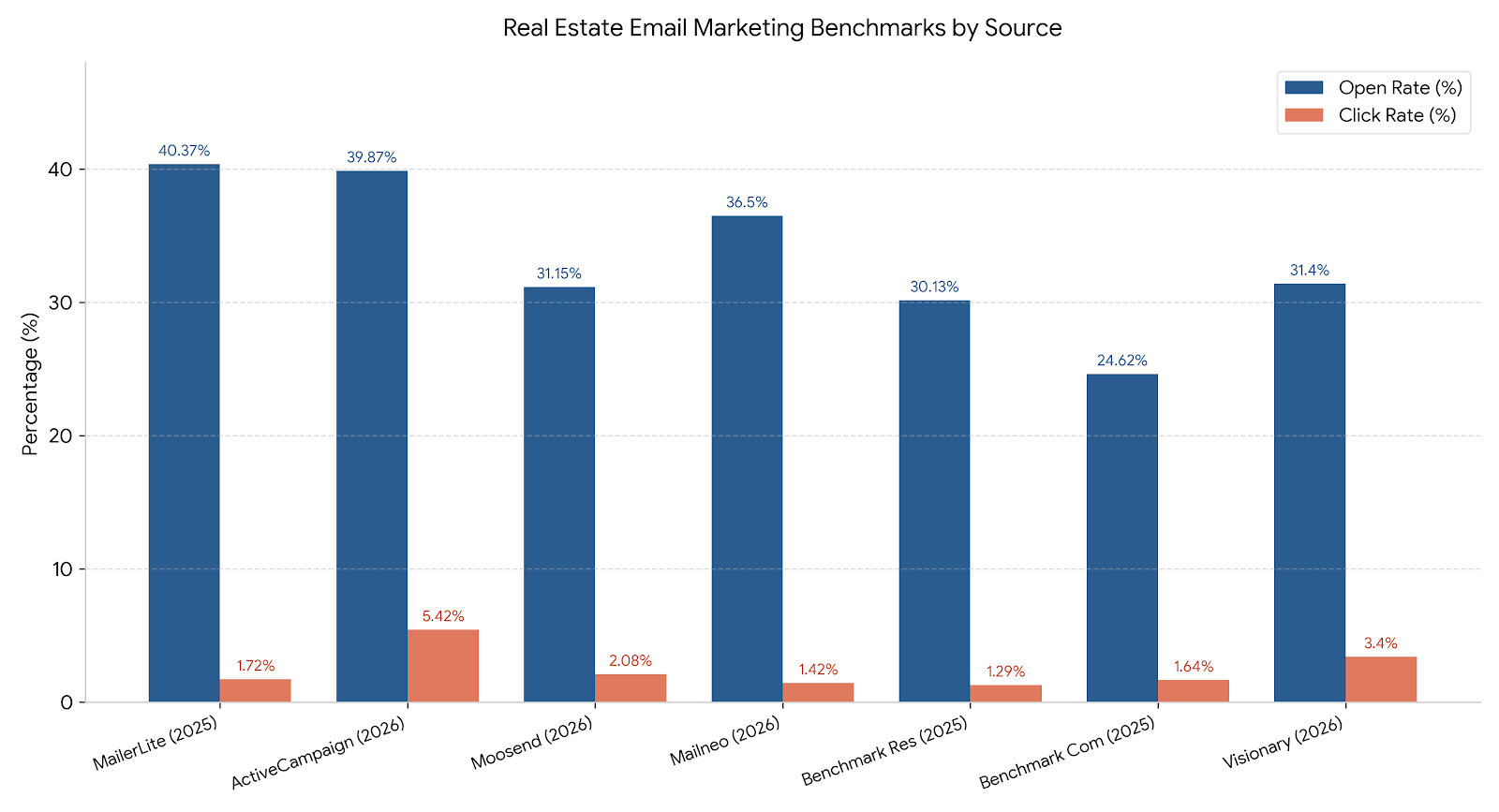
MailerLite's 2025 Benchmark Report, based on 3.6 million campaigns and 181,000 accounts, puts the real estate open rate at 40.37%, with a click rate of 1.72%, a click-to-open rate (CTOR) of 6.72%, and an unsubscribe rate of 0.16%. ActiveCampaign's 2026 benchmarks, based on 2025 campaign data, show real estate at 39.87% open rate and 5.42% click rate, close to the platform's overall average of 39.26% opens and 6.21% clicks. Moosend's 2026 data shows 31.15% open and 2.08% click for real estate, a lower figure that likely reflects a sample skewing toward larger brokerages with broader lists.
The Mailneo benchmark database, which merges platform reports from Klaviyo, MailerLite, ActiveCampaign, Omnisend, Campaign Monitor, HubSpot, GetResponse, and Mailchimp across 20.26 billion sends, reports real estate medians of 36.5% open rate, 1.42% click rate, 3.89% CTOR, 1.15% bounce rate, 0.19% unsubscribe rate, and 0.03% spam complaint rate. Benchmark Email's own user data shows residential real estate at 30.13% open rate and 1.29% click rate, and commercial real estate at 24.62% open and 1.64% click. The Visionary 2026 industry study, based on 32 million sends, shows residential real estate at 31.4% open, 3.4% click, 10.8% CTOR, 0.31% unsubscribe, 0.61% bounce, and 0.21% conversion, with revenue per email of $10.67.
Here is the full comparison table:
| Source (year published) | Real estate open rate | Real estate click rate | Notes |
|---|---|---|---|
| MailerLite 2025 Benchmark Report | 40.37% | 1.72% | CTOR 6.72%, unsub 0.16% |
| ActiveCampaign 2026 Benchmarks | 39.87% | 5.42% | Platform average: 39.26% open, 6.21% click |
| Moosend 2026 Benchmarks | 31.15% | 2.08% | Skews to larger brokerages |
| Mailneo 2026 database (blended) | 36.5% (median) | 1.42% | Bounce 1.15%, unsub 0.19%, spam complaints 0.03% |
| Benchmark Email 2025 (residential) | 30.13% | 1.29% | Unsub 0.14% |
| Benchmark Email 2025 (commercial) | 24.62% | 1.64% | Unsub 0.10% |
| Visionary 2026 | 31.4% | 3.4% | CTOR 10.8%, RPE $10.67 |
Two things stand out. First, real estate open rates are not weak. Across three major platforms, real estate sits at or slightly above the cross-industry average of roughly 22% to 39%, depending on the study. Second, real estate click rates are low relative to opens. That is normal for the industry: real estate email is a "passive engagement" category where subscribers open market updates out of curiosity but click only when they are actively in the market.
Where does real estate rank against other industries? ActiveCampaign's 2026 data puts real estate 7th of 15 industry categories by open rate, above software, e-commerce, and retail. Benchmark Email's data puts residential real estate near the top of its industry table at 30.13% opens, behind only law enforcement, fundraising, and public administration. Visionary's 2026 data shows real estate mid-table on opens and clicks, and near the very top on revenue per email at $10.67, which reflects the high value of a single closed transaction. The takeaway: real estate email performs respectably on opens, poorly on clicks, and outstandingly on revenue per send.
Agent-to-Agent Lists: A Completely Different Benchmark Set
The numbers above describe email to consumers, newsletter subscribers, and lead lists. Email to other agents behaves differently, and that is where real estate's real competitive edge lives.
Published cold email benchmarks give us the framework. Mailshake's tiers, based on its own campaign data, classify reply rates as below average under 1.5%, average from 1.5% to 3%, good from 3% to 5%, and top-decile at 5% or higher. RevenueFlow's 2026 real estate cold email benchmark, built from live outbound campaigns, puts real estate cold email averages at 35% to 45% open rates, 2.5% to 4.5% reply rates, and 1% to 2.5% meeting booking rates. The same study reports that independent agents and brokers are the most responsive segment in all of real estate, with 48% to 62% open rates and 5.5% to 9% reply rates, because they control their own decisions and monitor email constantly for client and lead messages. Institutional investors and REITs, by contrast, respond at 28% to 40% opens and 1.5% to 3.5% replies because corporate gatekeeping gets in the way.
Blastrow's own campaign data, published across its benchmark posts, shows what happens when agents target other agents with professionally designed digital flyers instead of sending generic blasts: open rates of 36% to 47% against 1% to 2% for generic blasts, reply rates of 1.4% to 3.2% against roughly 0.1%, and conversion to meetings or referrals of 2% to 4%. That 20x to 30x gap on opens is not a rounding difference. It is the difference between a deliverability-friendly, expected, relevant message and an unsolicited blast.
Here is how the two list types stack up:
| Metric | Consumer/newsletter lists | Agent-to-agent targeted lists |
|---|---|---|
| Typical open rate | 25-40% | 36-62% for well-targeted sends |
| Typical click rate | 1.4-3.4% | 1.4-5% |
| Typical reply rate | 0.5-2% | 1.4-9% |
| Unsubscribe rate | 0.15-0.31% | Lower, agents rarely unsubscribe from relevant peer mail |
| Spam complaint risk | Low if opt-in, high if purchased | Low when targeted, high when scraped broadly |
| Primary engagement signal | Clicks | Replies |
The agent-to-agent numbers are higher for a reason covered in detail later: other agents are business recipients who check email all day, they recognize peer outreach, and relevance (your listing, their zip code, their buyer profile) drives both opens and replies.
Open Rates by Send Day: Which Day Should Real Estate Agents Send?
Send timing is one of the most cited pieces of email advice, so here is the data behind it. The largest recent studies point in the same direction: midweek mornings win for business recipients, and weekends are the worst choice for most real estate sends.
Omnisend analyzed approximately 26 billion emails for its 2026 timing study. Tuesday produced the highest open rate of the week at 31.27% and the highest click-to-sent rate at 0.81%. Friday led on conversions at 0.081%. The spread between the best and worst day was only about 1.6 points, so day choice matters less than hour choice, but the pattern is consistent.
MailerLite's 2026 timing study, based on 2.1 million campaigns sent between December 2024 and November 2025, found Friday generated the highest average open rate at 49.72%, closely followed by Monday at 49.44%. Friday also generated the highest click rate at 8.09%, followed by Tuesday at 7.84%. MailerLite credits Friday's strength to end-of-week inbox clearing, and notes that Thursday at 9 AM delivers one of the highest open rates of the whole week at 49.6%.
The dedicated B2B cold email studies agree on the best midweek days. A 2026 WarmySender study of 75,000 cold B2B emails found Tuesday produced the highest reply rate at 4.8%, followed by Wednesday at 4.5% and Thursday at 4.3%, with Monday at 3.6% and Friday at 3.4%. Weekend reply rates averaged 1.6%, a 61% reduction versus the 4.1% weekday average. Belkins' analysis of 7.5 million cold emails found Wednesday and Thursday the leading reply days at 0.48% each, with Sunday appearing high only because of a small, unusual sample of deliberate Sunday-evening senders.
For real estate specifically, RevenueFlow's real estate cold email benchmark says Tuesday through Thursday consistently outperform other days, and recommends avoiding weekend sends because agents are often showing properties. This is the timing table agents should bookmark:
| Day | Consumer lists (open rate data) | B2B/agent cold email (reply rate data) | Verdict for real estate |
|---|---|---|---|
| Monday | 49.44% opens (MailerLite), 29.67% opens (Omnisend) | 3.6% replies (WarmySender) | Good for newsletters; inboxes are crowded after the weekend |
| Tuesday | 48.7% opens (MailerLite), 31.27% opens (Omnisend) | 4.8% replies (WarmySender), best day | Best all-around day for agent outreach |
| Wednesday | 48.5% opens (MailerLite), 30.27% opens (Omnisend) | 4.5% replies (WarmySender) | Strong second choice |
| Thursday | 49.2-49.6% opens (MailerLite), 30.42% opens (Omnisend) | 4.3% replies (WarmySender) | Strong for both audiences |
| Friday | 49.72% opens, best of week (MailerLite), best conversions (Omnisend) | 3.4% replies (WarmySender) | Great for consumer sends, weak for agent cold outreach |
| Saturday | 48.9% opens (MailerLite), 29.99% opens (Omnisend) | 1.7% replies (WarmySender) | Avoid for agent outreach |
| Sunday | 48.9% opens (MailerLite), 30.60% opens (Omnisend) | 1.5% replies (WarmySender) | Avoid for agent outreach |
Open Rates by Send Hour: What Time of Day Drives Opens, Clicks, and Replies?
The hour data has shifted in recent years. Open rates now peak in the morning, clicks peak in the late evening for consumer lists, and replies to business email peak mid-morning.
MailerLite's 2026 study found the highest open rates fall between 8 AM and 11 AM local time on most weekdays, while click rates peak much later, between 8 PM and 9 PM. Its single best sweet spot of the week is Friday at 6 PM, where opens and clicks align. Omnisend's study found the most reliable window for opens is 9 AM to 11 AM, with the strongest action for clicks at 7-8 AM and 4 PM, and the best conversion window at 7-8 AM, led by Friday at 7 AM at 0.138%.
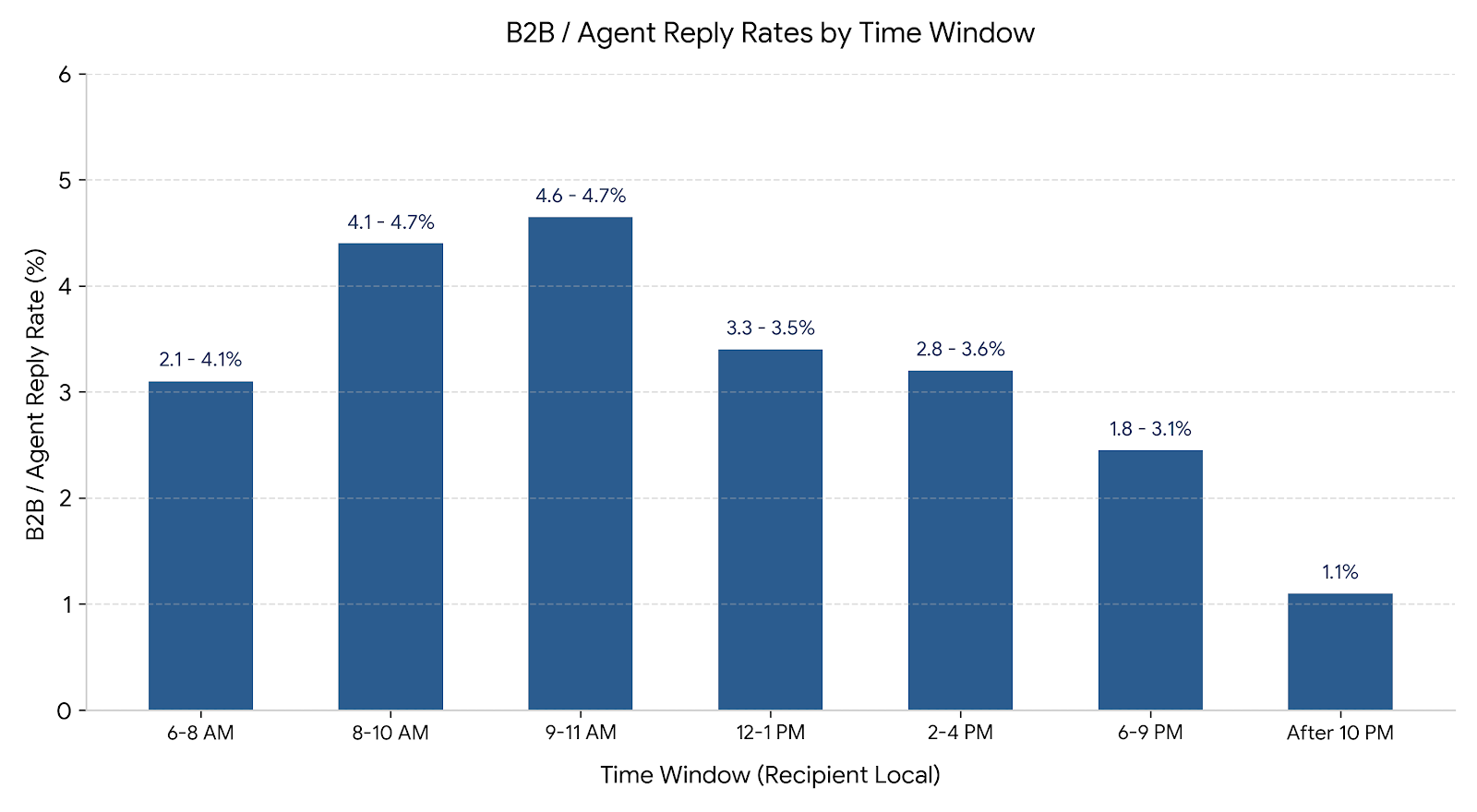
For cold outreach to agents and other professionals, the morning window is even more decisive. The WarmySender study of 75,000 cold B2B emails found the 9 AM to 11 AM window in the recipient's local time produced the highest reply rates at 4.6% to 4.7%, with open rates peaking at 8-10 AM. Belkins found morning sends (8 AM to 12 PM) had the highest reply rate at 0.54% and a meeting booking rate of 0.4%, four times higher than every other time window. Salesforce's general B2B guidance agrees: Tuesday to Thursday, 9 AM to 11 AM, with a secondary window at 12 PM to 1 PM.
One counterintuitive finding deserves a mention: Superhuman's analysis of 16.5 million B2B cold emails found evening sends between 8 PM and 11 PM achieved the highest reply rates at 6.52% for cold outreach specifically. That pattern applies to sales sequences, not to listing flyers, and most real estate experts still recommend morning sends because agents check email before showings start. RevenueFlow's real estate data recommends early morning sends (7-9 AM) before property showings begin, and evening sends (6-8 PM) after the day's activities end.
Here is the hour table:
| Time window (recipient local) | Consumer list opens | B2B/agent replies | Use for real estate |
|---|---|---|---|
| 6-8 AM | Rising, 31-40% opens (WarmySender) | 2.1-4.1% replies | Good for listing alerts before showings |
| 8-10 AM | Peak opens, 48-49% (MailerLite, WarmySender) | 4.1-4.7% replies | Best all-around window |
| 9-11 AM | Peak opens (Omnisend, Salesforce) | 4.6-4.7% replies (best of day) | Best window for agent outreach |
| 12-1 PM | Post-lunch dip | 3.3-3.5% replies, brief recovery | Fine for newsletters |
| 2-4 PM | Secondary open peak 3-3:30 PM (Brevo) | 2.8-3.6% replies | Acceptable, secondary window |
| 6-9 PM | Click peak 8-9 PM (MailerLite) | Evening sends 1.8-3.1% replies | Good for consumer emails, weak for agents (except tech) |
| After 10 PM | Lowest engagement | 1.1% replies | Avoid |
The practical guidance for real estate
Send flyers and outreach to other agents Tuesday through Thursday between 8 AM and 11 AM in the recipient's time zone. Send consumer newsletters and market updates Tuesday through Friday, with Friday morning a proven winner, and put high-value listings in front of buyers in the 7-9 AM window. What you should not do is blast the whole list at 2 PM on a Saturday and expect placement or opens to save you.
List Hygiene: The Thresholds That Keep You Out of the Spam Folder
Deliverability is decided by reputation, and reputation is decided by list hygiene. This section gives you the exact thresholds that mailbox providers and email platforms use, so you can check your own numbers against them.
Hard Bounce Rates
A hard bounce is a permanent delivery failure, usually because the address does not exist. Amazon SES guidance says to keep the hard bounce rate below 5%, while its complaint guidance targets 0.1%. Most modern deliverability practitioners set far tighter internal targets. Sender.net's 2026 reputation guide classifies hard bounce rates below 0.5% as healthy, 0.5% to 2% as needing work, and above 2% as critical. The Instantly.ai domain health guide recommends keeping hard bounces under 1% as the practical operational target, noting that campaigns crossing 2% put the domain at risk of throttling and that rates above 5% trigger stricter filtering for all mail from the domain, including mail to valid addresses.
Warm-up studies add a timing dimension: a bounce rate above 2% during warm-up should stop volume increases, and anything above 3% should pause sending entirely. A single bad send to a dirty list can set a new domain's reputation back by two weeks.
The reproducible rule: hard bounces belong under 1%, ideally under 0.5%. Every hard bounce address must be suppressed immediately. Soft bounces (full inbox, server timeout) can be retried a few times, but an address that soft bounces repeatedly should be treated like a hard bounce after roughly five attempts.
Spam Complaint Rates
The spam complaint rate is the share of delivered mail that recipients mark as spam. It is the single most damaging signal a sender can generate. Google's official guidance for Gmail is explicit: keep the spam rate reported in Postmaster Tools below 0.10% and avoid ever reaching 0.30% or higher. Yahoo publishes the same 0.3% ceiling. Gmail's enforcement escalates in stages: above 0.3%, senders become ineligible for delivery mitigation, and recovery requires seven consecutive days below 0.3%.
The real estate reality
0.1% means one complaint per 1,000 delivered emails, or ten complaints on a list of 10,000. A purchased or scraped list will blow through that in a single campaign, because the recipients have no relationship with you. Benchmark Email's platform data shows the typical abuse rate across its user base sitting at 0.04% to 0.14%, and Mailneo's real estate data shows spam complaint rates around 0.03% for well-run real estate programs. Those are the numbers to measure yourself against.
The Full Hygiene Scorecard
Here is the complete threshold table, compiled from Validity, Gmail, Yahoo, Amazon SES, and the sender reputation guides published in 2025 and 2026:
| Metric | Excellent | Acceptable | Warning | Critical |
|---|---|---|---|---|
| Hard bounce rate | Below 0.5% | 0.5-2% | 2-3% | Above 3% (pause sending) |
| Spam complaint rate | Below 0.05% | 0.05-0.1% | 0.1-0.3% | Above 0.3% (Gmail ineligible for mitigation) |
| Unsubscribe rate | Below 0.2% | 0.2-0.5% | 0.5-1% | Above 1% |
| Inbox placement rate | 90%+ | 85-90% | 80-85% | Below 80% (investigate) |
| Open rate (post-MPP, directional) | 35%+ | 25-35% | 15-25% | Below 15% |
| Sender score (if you use one) | 80-100 | 70-79 | Below 70 | Below 70 with declining trend |
A useful cross-check: Validity found senders with bounce rates under 1.5% see 10 to 12 points higher inbox placement than senders above the threshold. That one number explains most of the gap between agents whose flyers land and agents whose flyers vanish. List hygiene is not a compliance chore. It is the highest-leverage deliverability fix you can make.
How Does List Hygiene Damage Sender Reputation, and How Long Does Recovery Take?
Bad hygiene degrades reputation through documented mechanisms. High hard bounce rates signal to providers that you do not know your recipients, which Amazon SES notes directly in its guidance. Spam complaints are weighted even more heavily, and Gmail's AI filtering now feeds complaint data into its placement decisions in near real time. Spam traps make it worse: bought and scraped lists contain honeypot addresses planted by ISPs and blocklist operators, and hitting a pristine trap can trigger immediate blacklisting. Instantly.ai's 2026 guide notes that purchased or scraped lists frequently contain spam traps that can get your domain blacklisted immediately.
Recovery is slow
Warm-up studies from 2026 report that a single campaign to a dirty list can drop a Google Postmaster Tools domain reputation from "High" to "Low" in one send, and recovery takes two to four weeks of warm-up-only sending. Proactive monitoring cuts recovery time from an average of 34 days for reactive approaches to 12 days for teams that catch problems early. Reputation is built slowly and lost quickly.
The components of reputation scoring are worth knowing by name: IP reputation (history of the server that sends your mail), domain reputation (the sending domain, which Gmail and Yahoo now weight more heavily than IP), content signals (spammy copy, mismatched links), and engagement signals (opens, replies, forwards, moves from spam to inbox, and deletion speed). A clean IP gets you in the door, but domain reputation and engagement decide where your flyer lands.
Engagement-Based Sending and Re-Engagement: The New Rules
Mailbox providers now treat recipient engagement as a primary trust signal, and Gmail's AI filtering evaluates every message for relevance before a human sees it. Practically, that means two things for real estate.
First, segment by engagement and stop mailing people who stopped caring. Providers track opens, clicks, scroll depth, replies, deletion speed, and folder moves. Subscribers who have not engaged in six months generate negative signals (fast deletes, no opens), and those signals can quietly push your placement down for the entire list, including your active clients. The industry-standard practice, confirmed across the 2025 and 2026 deliverability literature, is to move non-openers out of regular sends after 90 to 180 days and to run a defined re-engagement campaign before you drop them.
Second, replies are the strongest positive signal available. Emails that generate replies, forwards, or manual moves into the primary inbox train the provider to surface your future mail. This is one of the structural advantages of agent-to-agent flyers: a targeted flyer to a peer agent that asks a simple question ("buyers for this area?") produces replies that a consumer newsletter will never generate. Over time, reply-positive sending patterns improve placement for the entire domain.
For re-engagement specifically, the rule set is simple. Send one re-engagement email with a clear value proposition and a simple ask, typically 15% to 25% open rates for real estate. If the contact still does not engage, suppress them from regular sends and keep them only on occasional, low-frequency mailings. Continuing to email unresponsive contacts is the single fastest way to accumulate negative signals, and it is entirely avoidable.
Agent-to-Agent Lists vs Consumer Lists: Why the Rules Are Different
Real estate is unusual in that its practitioners email two audiences with opposite deliverability profiles. Here is the full comparison:
| Factor | Consumer lists (leads, past clients, newsletter subscribers) | Agent-to-agent lists (other agents, brokers) |
|---|---|---|
| Typical recipient mailbox | Gmail, Yahoo, Apple Mail | Microsoft 365, Outlook, Gmail for Business |
| Opt-in status | Usually opted in, or legally gray if purchased | Usually not opted in; professional relevance is the justification |
| Spam complaint risk | Low if opt-in; high if purchased | Low if targeted and relevant; high if scraped broadly |
| Engagement pattern | Passive reading; clicks are the action signal | Active checking; replies are the action signal |
| Data decay | Moderate | High; agents change brokerages and roles constantly |
| Best send window | Tue-Fri mornings, also evening click window | Tue-Thu, 8-11 AM recipient local time |
| Biggest deliverability threat | Apple MPP distortion of opens | Microsoft's aggressive filtering |
| Typical open rate | 25-40% | 36-62% when well targeted |
The deliverability challenges of scraping and farming agent emails deserve a hard look, because they are the most common source of deliverability disasters in real estate.
Why Scraped and Purchased Agent Lists Fail
The evidence against bought and scraped lists is consistent across every study that has measured them. A 2026 WarmySender comparison of purchased versus self-built lists found purchased lists produce 30% to 50% bounce rates against 1% to 3% for self-built lists, 2% to 5% spam trap rates, spam complaint rates of 0.3% to 1.5% (5 to 15 times worse), open rates of 8% to 15%, and reply rates of 0.1% to 0.5%. The same report estimates a $500 purchased list can cost $5,000 to $10,000 in domain reputation damage, blacklist removal, and lost deliverability across all future campaigns.
For agent lists specifically, the decay problem compounds. B2B email addresses decay at 25% to 30% per year as people change employers, and real estate contact data decays faster than most verticals because agents move between brokerages constantly. A list scraped from the MLS 12 months ago has already lost a quarter of its addresses, and role-based addresses like info@, leasing@, and property@ that dominate scraped lists convert far below named-individual addresses while generating spam complaints at higher rates.
There is also a legal layer that keeps getting stricter. CAN-SPAM penalties in the US can reach $51,744 per individual email, and Canadian CASL fines run up to $10 million for businesses and $1 million for individuals. Most major platforms (Mailchimp, ActiveCampaign, Klaviyo, Constant Contact) prohibit imported purchased lists in their terms of service, and accounts that breach the complaint thresholds get suspended. The practical warning for agents: one campaign to a scraped list can destroy the deliverability of the domain you use for your real clients.
Why Targeted Agent-to-Agent Email Behaves Differently
When agent-to-agent email works, it works because it is the opposite of scraping. A targeted flyer sent to a specific set of agents in a specific zip code, referencing specific listings and buyer profiles, is relevant professional correspondence. It generates replies and conversations rather than complaints, and those positive engagement signals feed the sender's reputation over time.
This is the model behind platforms like Blastrow, which lets agents create digital flyers and distribute them to targeted other agents by email. The deliverability logic is straightforward: smaller, relevant lists of professional recipients who reply beat giant scraped lists of strangers who complain. The 20x to 30x gap between targeted agent flyer open rates (36% to 47%) and generic blasts (1% to 2%) is deliverability working as designed: relevant, expected mail gets placed and opened; irrelevant mail gets filtered, deleted, or reported.
| Metric | Generic email blast | Targeted agent flyer | Improvement |
|---|---|---|---|
| Open Rate | 1-2% | 36-47% | 20-30x |
| Reply Rate | ~0.1% | 1.4-3.2% | 14-32x |
| Conversion to Meetings or Referrals | Near zero | 2-4% | 2-4% of recipients |
The other structural advantage of agent-to-agent mail: agents read email constantly. RevenueFlow's real estate data shows independent agents respond to cold email at 5.5% to 9% reply rates, higher than almost any other B2B segment. Subject lines that promise something directly useful (more listings, more leads, a specific buyer) achieve 3 to 4 times the open rate of generic subject lines, and personalization referencing a specific market or property roughly doubles reply rates. When you add compliance basics (SPF, DKIM, DMARC, one-click unsubscribe, complaint rates under 0.1%), agent-to-agent email is one of the most deliverability-friendly channels in real estate.
Gmail and Yahoo Bulk Sender Rules: What Agents Must Know for 2026 and 2027
The February 2024 enforcement wave changed email permanently. Here is the summary of the rules, what changed through 2025 and 2026, and what is coming in 2027.
The Baseline Rules
Since February 1, 2024, every sender to personal Gmail accounts must keep spam rates reported in Postmaster Tools below 0.3%, use TLS, maintain valid forward and reverse DNS, and avoid impersonating Gmail From headers. Bulk senders, defined as domains sending close to 5,000 or more messages per day to Gmail accounts, must additionally set up SPF and DKIM, publish a DMARC record with at least p=none, align the From domain with SPF or DKIM, and support one-click unsubscribe (RFC 8058 List-Unsubscribe headers) on all marketing mail, honoring requests within 48 hours.
Yahoo runs parallel requirements with the same 0.3% spam ceiling, publishing a DMARC record, and honoring unsubscribes within two days. Yahoo does not publish a hard volume threshold but treats "significant volume" as bulk. Microsoft joined in April 2025 with its own restrictions for senders of 5,000 or more messages per day to Outlook.com, Hotmail, and Live.com, requiring SPF and DKIM, a DMARC record, a valid From address, an unsubscribe link, and proper bounce management.
The enforcement timeline that followed is crucial context:
| Date | What changed |
|---|---|
| February 1, 2024 | Gmail and Yahoo enforcement begins; authentication, spam rate, and DNS requirements in force |
| June 1, 2024 | One-click unsubscribe enforcement begins; spam rates above 0.3% lose mitigation eligibility |
| April 2025 | Microsoft applies equivalent bulk sender rules to Outlook.com domains |
| November 2025 | Google escalates from temporary deferrals to permanent rejections for continued non-compliance |
| May 2026 | DMARC moves to IETF Standards Track as RFC 9989, replacing the 2015 RFC 7489 |
The Thresholds Explained
The 0.3% spam rate ceiling, with 0.1% as the working target, is now the single most important compliance number in email marketing. It is calculated daily, not averaged. Ten complaints on a 10,000-recipient send puts you at 0.1%, which Google considers the edge of acceptable. Thirty complaints puts you over the limit. Recovery from crossing 0.3% requires seven consecutive days under the ceiling, and one bad day resets the clock.
Two cautions for solo agents
For a solo agent sending 100 to 500 flyers a week to other agents, the bulk sender threshold of 5,000 messages per day to Gmail seems distant, but two cautions apply. First, the count is per domain across everything you send, and once you cross it, the rules apply permanently even if volume drops. Second, the direction of travel is clear: thresholds will drift downward, DMARC policy will move from p=none toward enforced quarantine or reject, and full alignment of DMARC to both SPF and DKIM is expected to become mandatory. Designing your sending setup for the bulk sender standard even when you are below it is future-proofing, not overkill.
What the 2027 Predictions Look Like
The trends visible in the data point to five 2027 realities:
- More mailbox providers will enforce the same template; Apple iCloud Mail and regional providers increasingly evaluate the same signals as Google, Yahoo, and Microsoft.
- DMARC enforcement expectations will rise; publish a proper record with a reporting address (rua), read the reports, and plan to move from p=none toward p=quarantine or p=reject.
- The spam complaint threshold remains the binding constraint, and AI-trained filters will compound the consequences of complaints faster than traditional filters ever did.
- One-click unsubscribe will be treated as a hard requirement everywhere, not just at Gmail and Yahoo.
- AI summaries and AI inbox views will change how engagement is measured, which we cover next.
Apple Mail Privacy Protection: Open Rates Are Distorted, and Here Is the Data
Apple's Mail Privacy Protection (MPP) launched with iOS 15 in September 2021 and changed open rate measurement permanently. MPP pre-loads email content and images on Apple's servers, generating a "machine open" for every message regardless of whether a human ever looks at it. Roughly 95% of Apple Mail users keep the protection enabled once they see the prompt.
The scale of the distortion is documented. Litmus's email client market share data shows Apple accounted for 49.29% of email opens in January 2025, and its May 2025 data shows more than 50% of all opens happen on devices with MPP activated. The PMA's 2026 analysis puts Apple Mail at 51.52% of opens in Q1 2025, making it the largest email client in the world. Omeda's controlled before-and-after study found open rates nearly doubled after MPP rollout, from a 22.6% total open rate to 40.5%.
The practical consequence for real estate benchmarks: a quarter to a half of your "opens" may be Apple bots, not humans. Industry estimates put the MPP share of reported opens at 45% to 65% for consumer-skewing lists, and even conservative estimates run at 25% to 35% inflation. This is why every credible 2026 benchmark source, including the ones cited throughout this post, tells you to treat open rate as directional and to make click rate, click-to-open rate, reply rate, and conversion the metrics you actually manage.
Open rate still has one diagnostic use: a sudden large drop in opens usually means a deliverability problem, because MPP inflation is roughly constant over time. That makes open trends useful as a health check even when absolute numbers are meaningless.
AI Inbox Filtering: Gemini, Copilot, and Apple Intelligence Are Rewriting Your Emails
The biggest structural change heading into 2027 is the AI-mediated inbox. Gmail, Microsoft, Apple, and Yahoo have all shipped AI features that read, summarize, prioritize, and rewrite email content before recipients engage with it.
Google's January 2026 announcement, "Gmail is entering the Gemini era," introduced AI Overviews, Suggested Replies, and the AI Inbox, which filters out clutter, identifies VIPs, and surfaces to-dos rather than showing a chronological message list. The AI Inbox is rolling out to Google AI Pro and Ultra subscribers in the US, and Gmail Live lets users ask questions about their inbox and extract information without opening messages. InboxAlly's 2026 analysis reports Gmail's AI now deprioritizes up to 40% of emails that technically reach the inbox: delivered is no longer the same as seen.
Apple Intelligence, in broad deployment since late 2024, provides both pre-open summaries (which replace your preheader text in the inbox overview) and post-open summaries. The pre-open summary is enabled by default and cannot be suppressed by senders. Microsoft's Copilot offers post-open summaries in Outlook, including for free Outlook.com accounts, and Yahoo has its own "Catch Up" feature.
The research on how AI summaries behave is specific and actionable. Response Labs found all three major AI summarizers pull most of their content from the first 150 to 200 characters of an email. The BuzzStream and Aira analysis of 628 emails across the three platforms found: AI summaries pull 82% to 87% of their content from the first half of the email (Gemini 87.1%, Apple 82.5%, Copilot 65.4%); bullet points influence summaries at least 64% of the time; Copilot produces the longest summaries (156.5 words on average) while Gemini produces the shortest (28.8 words); and AI summaries misrepresented the original content in about one in three emails, with Apple at 33%, Microsoft at 30%, and Google at 11%.
The engagement impact is already measurable. Omeda's analysis of billions of emails after AI summaries launched found open rates rose to 45.6% while click-through rates dropped from 4.35% to 3.93%: subscribers read the summary and never click. Salesforce's guidance for 2026 states plainly that open rates will decline industry-wide as subscribers adapt to summarized inboxes, and that click-through and conversion must become the primary tracking signals.
For real estate flyers and listings
Put the essential facts in the first 150 to 200 characters of live text: price, beds, baths, zip code, and your ask. Use bullet points. Never make your flyer a single image, because Apple Intelligence only scans live text and will summarize the footer instead of your listing. Write subject lines that state the value directly, because they now feed AI ranking. And expect that some agents will get your listing summary without ever opening your flyer, which means the CTA has to work inside the summary itself.
US Privacy Laws, CAN-SPAM, and DMARC: The Compliance Stack for 2027
Three compliance layers matter for real estate email in 2027.
CAN-SPAM remains the baseline US federal law: truthful subject lines, honest From and reply-to headers, a physical postal address, and a working opt-out mechanism honored within 10 business days. Penalties for violations can reach $51,744 per individual email, and while enforcement typically targets large-scale violators, the deliverability consequences of non-compliance apply to everyone.
US state privacy laws continue to multiply. California's CCPA and the wave of state consumer privacy laws that followed give consumers rights over their personal data, and the trend is toward more states adding email and marketing data requirements. Delaware's data broker law took effect in 2025, and more state laws are scheduled to take effect through 2026 and 2027. The practical effect for agents is indirect but real: bought and shared lists carry new compliance risk, while lists you built with consent are the safest asset you have.
DMARC moved to the IETF Standards Track in May 2026 (RFC 9989, replacing the 2015 RFC 7489), with two deprecations that affect technical setups: the pct= (percentage) and ri= (reporting interval) tags were deprecated in favor of the new t= (test mode) parameter, and two new parameters arrived (np= for non-existent subdomain policy and psd= for public suffix domains). The bigger trend is enforcement: providers now expect a published DMARC record with a reporting address on every sending domain, alignment between the From domain and SPF/DKIM, and eventual movement from p=none to enforced policies. Gmail's documentation already says full alignment of DMARC to both SPF and DKIM is likely to become a sender requirement.
The 2027 Survival Checklist for Real Estate Agents
Here is the complete checklist, compiled from the deliverability guidance published by Gmail, Yahoo, Microsoft, Validity, and the major sender reputation guides:
| Check | Target | Why it matters |
|---|---|---|
| SPF record | Published, within lookup limits, includes every sending tool | Unauthenticated mail gets rejected or spammed |
| DKIM | Signed on every send | Digital signature proving the message is really from you |
| DMARC | Published with rua reporting, policy at least p=none, moving toward p=quarantine | Required by Gmail and Yahoo bulk senders; blocks spoofing |
| From domain alignment | From header aligns with SPF or DKIM domain | DMARC fails silently without alignment |
| TLS and reverse DNS | Enabled on sending infrastructure | Baseline requirement at Gmail; PTR required |
| One-click unsubscribe | RFC 8058 List-Unsubscribe headers on all marketing mail | Required since June 2024; honored within 48 hours |
| Spam complaint rate | Below 0.1%, never reaching 0.3% | The binding constraint on inbox placement |
| Hard bounce rate | Below 1%, ideally below 0.5% | High bounces signal purchased or stale lists |
| List verification | Verify before send; re-verify quarterly | Agent data decays 25-30% per year |
| Suppression list | Unsubscribes, bounces, complaints removed forever | Failure to suppress is the slowest-burning reputation killer |
| Engagement segmentation | Non-openers removed from regular sends after 90-180 days | Providers weight engagement as the primary trust signal |
| Re-engagement campaign | One targeted win-back send before suppression | Recovers contacts without accumulating negative signals |
| Send timing | Tue-Thu, 8-11 AM recipient local time for agent outreach | Best reply windows documented across multiple studies |
| Live text first | Key facts in the first 150-200 characters, bullets used | AI summaries pull from the top of the email |
| No image-only emails | Real text, real bullets, single clear CTA | Apple Intelligence cannot summarize images |
| Track placements | Seed tests at Gmail, Microsoft, Yahoo, Apple | Blended numbers hide provider-specific failures |
| Monitor Postmaster Tools | Weekly review of spam rate and domain reputation | Free visibility into how Gmail judges you |
Putting It Together: What This Means for Your Next Campaign
The 2026 data tells one coherent story. Inbox placement has recovered to 87.2% globally, but only because senders cleaned up their authentication and their lists. Real estate open rates are healthy at 30% to 40% for consumer lists and higher for agent lists, but clicks are the metric that matters, and replies are the strongest signal you can generate. Send times have settled: Tuesday through Thursday mornings for agents, Friday morning for consumers, no weekend blasts. List hygiene is the difference between a 90% placement rate and a 60% placement rate, and the thresholds are published: bounces under 1%, complaints under 0.1%, suppression always.
Looking at 2027, the direction is unmistakable. AI summarizes and prioritizes your email before agents ever see it, so the first 200 characters of your flyer are now your headline. Apple distorts open rates, so manage clicks and replies. Gmail, Yahoo, and Microsoft enforce authentication, so SPF, DKIM, and DMARC are non-negotiable. And spam complaints remain the single number that can sink a domain, which is why sending relevant, targeted, expected mail is no longer just good marketing. It is the only sending strategy that survives contact with the modern inbox.
The agents who do well in 2027 will not be the ones with the biggest lists. They will be the ones whose emails land in the inbox, get summarized favorably, and produce replies. For agent-to-agent flyer distribution, that means tight targeting, professional design, and a platform built for professional recipients rather than scraped data. When your flyers are expected, relevant, and reply-worthy, the deliverability math takes care of itself. The data in this guide gives you the numbers to check yourself against, and the checklist to keep your domain healthy through the changes ahead.
Start with the scorecard
Run your own numbers against the hygiene scorecard before your next send: bounce rate, spam complaint rate, and inbox placement by provider.
Then schedule agent flyers for Tuesday through Thursday at 8-11 AM, put the facts in the first 200 characters, and watch what replies do for your placement over the next 90 days.
Send Flyers That Actually Land in the Inbox
Stop gambling on scraped lists and spam folders. Create professional agent-to-agent digital flyers on Blastrow and send them to targeted agents who reply instead of complain. The first 50 agents are free.
Try Blastrow FreeFrequently Asked Questions
What is a good inbox placement rate for real estate emails in 2026?
What spam complaint rate should a real estate agent stay under?
Do Gmail and Yahoo bulk sender rules apply to agents sending fewer than 5,000 emails a day?
What is the best day and time to send real estate emails to other agents?
Is it safe to email a list of agent emails scraped from the MLS or bought from a vendor?
How will AI email summaries change real estate email marketing in 2027?

Blastrow
Listing Promotions