
Short-Form Video + AI Listing Content in 2026-2027: What Actually Converts (and What Needs Disclosure)
 Mark Newman16 min readSeptember 3, 2026
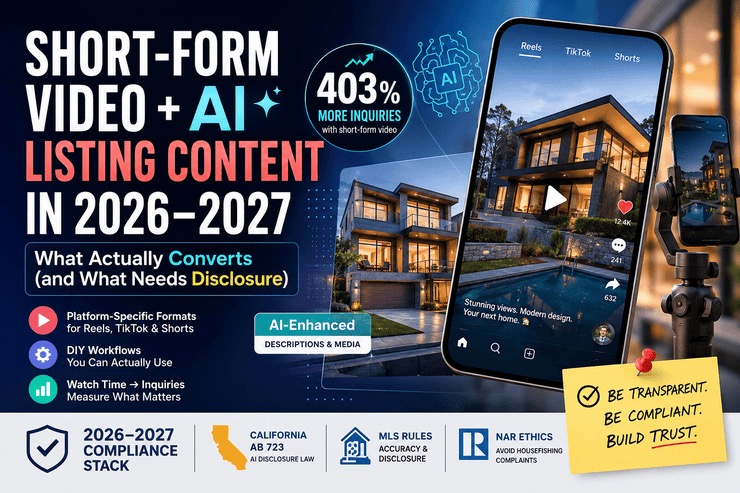
In 2026, video listings drive 403% more inquiries and sell ~32% faster - but every AI edit that changes what the property looks like now needs a label and the original on file. This is the platform-by-platform playbook for Reels, TikTok, and Shorts that actually converts watch time into showings, plus the disclosure workflow under California AB 723, MLS rules, and NAR ethics that keeps you out of "housefishing" complaints.
Key Takeaways
On this page
Why Video Still Wins Inquiries in 2026-2027
Short-form video is no longer optional. By 2026 it is the baseline buyers expect: 58% of buyers expect video tours when browsing listings, 51% use YouTube as a primary research platform, and listings with embedded video generate 403% more inquiries and 1,200% more social shares than text-and-photo-only listings. In a market where the average listing still sits ~32 days (Toronto, July 2026, avg sale ~$1M), video compresses the distance between discovery and first showing.
The compounding effect matters more than any single view count. Sellers report being 73% more likely to list with an agent who uses video, so a video pipeline wins the next appointment before it is even pitched. Short-form vertical clips under 90 seconds drive about 2x the engagement of long-form on every major platform except YouTube, and real estate Reels average 0.52% engagement vs 0.37% for static posts, with 3.2x more saves and shares than carousels.
Speed is where the ROI shows. Analyzed across campaigns, video listings sell roughly 32% faster. At $1M+ inventory, a single week of carrying-cost or avoided price reduction pays for months of video production - even when that production is a phone on a gimbal and 30 minutes of editing.
The one-sentence case for video
| Signal | Benchmark (2026) | Source context |
|---|---|---|
| Inquiries vs photo-only | +403% | Resimpli / Peachgum aggregate |
| Shares vs photo carousel | 12x | Toronto Reels analysis, Aug 2026 |
| Saves + shares vs static | 3.2x | Sprout / Hootsuite trend reports |
| Days on market | ~32% faster | Cross-market listing comparison |
| TikTok engagement | 4.10% | Cufinder / Sprout 2026 |
The DIY Production Stack Agents Actually Use
The agents posting consistently in 2026 are not running a studio. They run a repeatable phone workflow that takes 2-3 hours per week and produces multiple posts from one shoot.
Shoot kit (under $300 total)
- Phone set to 1080×1920 vertical (9:16), 30fps, stabilization on
- Small gimbal or two-handed grip; no drone needed for walkthroughs
- Natural light: shoot 10am-2pm, all lights on, blinds open
- 6-10 clips: front, living, kitchen, primary suite, best feature, street/neighborhood
- One take per room, 8-12 seconds each - cut later, do not re-shoot for perfection
Edit kit (free)
- CapCut, InShot, or YouTube Create for cuts, captions, and audio
- Auto-captions on by default - ~85% watch muted
- Template: hook (2s) → 3 feature beats (4s each) → CTA (3s)
- Export master at 1080×1920 MP4, then re-export platform copies
- Keep one clean master without watermark for cross-posting
Batch, do not binge. Film 10-12 videos in one morning, edit from templates, schedule for two weeks. A steady three-per-week cadence for eight weeks beats a daily burst followed by silence - the algorithm rewards consistency over spikes on every platform.
What to film if you only have 10 minutes at the listing
Where AI Helps vs Where It Misleads
AI in 2026 earns its keep in two workflows agents can run themselves: photo-to-video (animate stills into cinematic pans with beat-synced transitions) and talking-head / explainer clips (script → captioned video without a studio). Both cut production from days to minutes and make it realistic to create video for every listing, not just luxury.
The useful middle path
Feed 10-15 listing stills into a photo-to-video tool for a 30-60 second vertical tour. Use AI for: smooth camera motion over stills, auto-captions, transcription for accessibility, background cleanup that does not alter the property, and beat-matched cuts to trending audio. For talking-head, record once, let AI add captions, trim silence, and reframe to 9:16.
The line AI must not cross without disclosure
AI that re-renders geometry from scratch (text-to-room generators) or that adds, removes, or swaps permanent elements - furniture that implies included items, changed flooring or paint, added pool or lawn, removed stains, power lines, or clutter that hides condition, swapped skies that change light truth - moves from production aid to representation. That triggers disclosure duties (see Sections 12-14). Prefer tools that edit the input photo and preserve the original file, not tools that invent a new room you cannot prove.
| AI use | Risk | Rule |
|---|---|---|
| Pan/zoom over a real photo + captions | Low | No disclosure needed if property unchanged |
| Virtual staging (add furniture to vacant room) | Disclose | Label + original required |
| Remove clutter, hide damage, erase power lines | High / do not do | Disclosure does not cure deception |
| Change wall color, flooring, sky | High | Label + original; many MLSs restrict |
| Brightness / white balance / cropping only | Low | Not considered digitally altered |
Reels vs TikTok vs Shorts: Different Algorithms, Different Cuts
Posting one cut identically everywhere is the most common reason reach collapses. Same format (9:16), different behavior.
| Spec | Instagram Reels | TikTok | YouTube Shorts |
|---|---|---|---|
| Aspect + resolution | 9:16 vertical, 1080×1920 minimum, MP4/MOV | ||
| Max duration | 90s | 10 min (60s recommended) | 60s |
| Ideal for listings | 15-45s discovery | 30-60s | 40-58s |
| Cadence that holds traction | 4-5 Reels/week + daily Stories | 3-4/week floor, 5-7 for growth | 2-3/week (evergreen) |
| Discovery window | 24-48 hrs peak | Days to weeks (batch tests) | Months via Search |
| Hashtags | 5-10 specific | 5-7 (broad + location + niche) | 3-5 (search terms) |
| Strongest signal | Watch-through >80% | Shares > comments > completion | Watch-through + search clicks |
| Safe zone for text | Top 15% / bottom 20% obscured | Top 10% / bottom 25% obscured | Top 10% / bottom 20% obscured |
Cross-post the clean master, not a watermarked download. Re-upload natively to each app, then rewrite captions and hashtags for that audience. TikTok watermarks get suppressed on Instagram; Instagram audio trends do not translate to TikTok search.
Instagram Reels: 15-45 Seconds That Earn Discovery
Instagram is where homeowners already follow local businesses, and Reels are the only format Meta still pushes to non-followers by default. A 500-follower account can reach 10,000 people if watch-through holds. For agents, that maps cleanly to seller-lead discovery.
Formats that perform on Reels
- 30-second cinematic highlight with trending audio - the Explore-tab staple.
- Before/after staging reveals - show empty → staged → original again (disclosed).
- Neighborhood micro-spots (coffee, park, school walk) - signals local authority and gets saves.
- Client reaction moments (with permission) - highest share rate in the listing lifecycle.
Discovery Reels (cold audience) should stay 15-45s and hold ≥80% watch-through; a tight 30s beats a loose 60s. For warm followers you can run to 90s. Post 4-5 Reels/week and keep daily Stories live - the algorithm reads Stories health as account health and rewards Reels reach.
Hashtags on Reels in 2026
#[city]realtor → #[city]realestate → property tags (#firsttimehomebuyer, #luxuryhomes). Thirty generic tags dilutes signal. Lead with location.TikTok: 30-60 Seconds for First-Time Buyers
TikTok's audience has aged into the 28-35 core first-time buyer bracket - the fastest-growing segment on the platform - and its algorithm is the most aggressive at pushing content to new local viewers. One well-crafted video can reach 50,000+ people in your metro within 48 hours with zero followers, because TikTok tests each post in expanding batches (initial → 1k-5k → 10k-50k).
What wins on TikTok for listings
- "What $X buys you in [City]" comparisons - curiosity + tag-a-friend shares.
- Day-in-the-life neighborhood walks on Saturday morning - sells place, not just zip code.
- Before/after and time-lapse prep - watching a listing come together in 45s consistently outperforms standard tours.
- Myth-busters ("Your lender won't tell you this") - comment velocity that the algorithm rewards.
Keep listing tours to 30-60s, 8-10 rooms - leave viewers wanting more with "Comment TOUR for full walkthrough." Videos under 15s only work with an extraordinary hook; over 90s drops steeply unless serialized. Use the three-layer tag system: one broad (#realestate), one location (#[city]realestate), one niche (#homewalkthrough), 5-7 total.
YouTube Shorts: 40-58 Seconds + the SEO Dividend
Most agents underuse Shorts, which is exactly why it is an opportunity. Shorts surface in Google Search results - the only short-form platform with direct SEO value - and keep earning views for months rather than 24-72 hours. Real estate Shorts under 60s get 3x more impressions than long-form on new channels.
How to use Shorts as a pipeline
- 10-second hooks that link to a full tour - "Here's the kitchen. Wait until you see the backyard."
- Weekly 45-second market takes - "What the [city] market did this week" - consistently reshared.
- Neighborhood tours and "what does $X buy" - aligns with the searches buyers type into YouTube/Google.
- End every Short with links to consultation and listing pages; track via UTM.
Internal data shows 40-58s outperforms shorter cuts on Shorts because the platform trains viewers to watch longer. Two to three Shorts/week is enough to hold presence; unlike TikTok, YouTube does not penalize a sprint-then-maintenance rhythm. Use 3-5 hashtags, led by location and search terms (#homeforsale, #househunting).
One Shoot, Three Videos, Two Weeks of Posts
Sustainability beats virality. The agents still holding an audience in 12 months are not editing daily - they run this loop:
1) Produce (one visit)
30s hero (Reels) + 60s walkthrough (TikTok) + neighborhood snippet (Shorts). 6-10 clips, strongest selling points first.
2) Distribute (natively)
Hero → Reels + Stories; walkthrough → TikTok; snippet → Shorts with link to full tour. Re-write captions per platform.
3) Capture (same CTA)
Every video ends with one CTA: DM TOUR, tap to book, or scan QR to listing. Responder → SMS + email within 24 hrs.
| Lifecycle beat | Video | Post as |
|---|---|---|
| Just listed | 30s hero | Reels + TikTok + Shorts |
| Feature spotlight | 15s detail (kitchen/best feature) | Reels + Stories |
| Neighborhood | 30s walk | TikTok + Shorts |
| Open house | 15s teaser + invite | Reels + TikTok |
| Under contract | Time-lapse or reaction | All platforms |
Industry posting math for a working agent is realistic: roughly 3 Reels + 2 TikToks + 4 statics/carousels + 1 YouTube video (or Shorts stack) per week. One well-planned shoot covers it.
Hooks, Captions, Hashtags That Hold Watch Time
You have ~1.5 seconds before a viewer decides to stay or scroll. Most skip decisions happen before the 2-second mark, so the hook is not creative decoration - it is distribution math.
Hook formulas that work in 2026
Front-load the first 150-200 characters of caption and on-screen text - AI inbox and search summaries pull 82-87% of content from the first half, and misrepresent roughly one in three if you bury the lead. Keep text inside safe zones, use auto-captions for sound-off, and end with one CTA. Low-commitment ("Save for later") on 60% of posts, medium ("Comment TOUR") on 30%, high ("DM to schedule") on 10%.
Caption trap that kills completion
Measurement: Watch Time → Inquiries → Offers
Vanity metrics feel good; funnel metrics pay the mortgage. Run three layers and connect them with trackable links:
| Funnel layer | Metrics | Target / why it matters |
|---|---|---|
| Top: Attention | Views, average watch time, completion rate, CTR to listing | >60% good, >80% excellent; 30% = hook or length problem |
| Mid: Intent | Saves, shares, profile visits, link clicks (UTM), DMs | 1 share > 10 likes on TikTok; saves predict future inquiries |
| Bottom: Business | Inquiries, showings, offers, days on market vs 90-day baseline | Prove ROI by comparing video vs photo-only comps |
A simple ROI check per listing
Track per listing: production cost + time, days on market, showings, offers, price changes. Compare against 3-5 photo-only comps at similar price/location over 90 days. Multiply days saved by the seller's weekly carrying cost and add any avoided price reduction - if that total exceeds video cost, production is ROI-positive before long-term brand benefit (200-300% website traffic lift for video users).
Implementation: create trackable links per platform with UTMs (e.g., ?utm_source=tiktok&utm_campaign=123-main-hero), route DMs and bio-link clicks into your CRM, and review weekly which format drove saves/shares - then produce more of that type.
Vanity vs Conversion: What to Actually Optimize
Three numbers predict inquiries; everything else is noise in 2026:
Watch-through rate
The primary algorithmic signal. 80% on a 20s video outranks 30% on a 90s video, even if the longer video is "better."
Saves & shares
Saved 200 times reaches more qualified buyers than 50k empty views. Shares put your listing in front of a partner, parent, or agent.
DMs & profile visits
Highest-intent signals. A DM from a Reel is warmer than any portal inquiry. Track follower-to-lead: ~1-2 consults per 500 new followers is healthy on Instagram.
Gen Z discovery skews TikTok (61%) + Instagram (48%); Millennials skew YouTube (54%) + Facebook (41%). That maps formats to buyers: TikTok for first-time buyer explainers and curiosity hooks, Reels for local seller reach, Shorts for long-tail search that still delivers views months after posting.
The Housefishing Line: What Crosses It
"Housefishing" - listing photos and videos altered to show something the property is not - now has measurable scale. A 2026 Coraly analysis of ~40,000 photos across Zillow, Redfin, Realtor.com, and Homes.com found nearly 11% showed signs of AI alteration. The Guardian, Business Insider, and The Atlantic have catalogued the tells: repainted walls, imaginary lawns, unnaturally smooth surfaces, erased power lines, and views through windows that do not match reality.
Buyer reaction is not "impressed." Agents interviewed by HousingWire and NAR report the same line: buyers resent feeling deceived and trust erodes at the door. One agent now systematically calls the listing agent before showing any AI-staged listing to confirm photos match reality. That is the compounding cost of a misleading edit - it taxes every future showing.
Edits that always need disclosure vs edits that do not
| Edit | Disclose? | Why |
|---|---|---|
| Virtual staging (add furniture/decor) | Yes | Changes perceived use and scale |
| Remove clutter, damage, objects, stains | Yes - and risky | Hides condition; does not cure with label |
| Sky / day-to-dusk, grass greening, add landscaping | Yes | Changes light, season, site |
| Change wall color, flooring, fixtures, façade | Yes - restricted in many MLSs | Alters permanent/semi-permanent elements |
| Remove power lines, streetlights, neighbor structures, views | Yes - often prohibited | Misrepresents surroundings |
| AI-generated room or image from prompt | Yes | Entirely synthetic |
| Brightness, exposure, white balance, color correction | No | Does not change property representation |
| Cropping, straightening, sharpening, lens correction | No | Standard photographic adjustment |
Labeling does not fix a material misrepresentation
The Disclosure Stack: State Law, MLS, and NAR Ethics
There is no single federal AI-photo rule. Obligations layer - state law, MLS rules, and NAR ethics - and you must satisfy every layer that applies where the listing is published. As of 2026, the map looks like this:
| Jurisdiction / source | What drives it | What it requires | Status |
|---|---|---|---|
| California - AB 723 | State law (sale) | Label on/beside image ("Virtually Staged" / "Digitally Altered") + link/QR to original; "digitally altered image" = added/removed/changed furniture, fixtures, flooring, walls, paint, hardscape/landscape, façade, floor plan, or outside elements visible from property | Effective Jan 1, 2026 |
| California - AB 2025 | State law (rent/lease) | Same disclosure + original access, extended to rentals | Committee-passed Apr 2026 |
| Wisconsin - Act 69 | State law | Disclose AI-altered photos for 1-4 unit residential; good-faith safe harbor | Effective Jan 1, 2027 |
| New York | DOS guidance + RPL 441-c | AI-altered photos that mislead can violate deceptive advertising; fines up to $2,000 | Advisory Nov 2025 |
| New Jersey - A4728 | Proposed statute | Bars fundamental AI alteration; allows furniture-only AI if disclosed + original on request; photos must be ≤5 years and reflect current state | Introduced Mar 2026 - $500 / $1,000 penalties |
| Texas - TRAIGA | AI governance act + TREC | No photo-label mandate; deceptive advertising enforced by TREC under License Act | Effective Jan 1, 2026 |
| CRMLS (110k+ members) | MLS Rule 11.5.2 | Label in photo description ("Photo Modified" / "Virtually Staged" / "Digitally Altered" / "AI Altered") + original immediately before/after altered image | Effective 2026 |
| Bright / Northstar / Stellar / SDMLS | MLS rules | Visible watermark + remarks disclosure; SDMLS: label alone insufficient, original must be viewable | Effective 2026 |
| NAR Code of Ethics | Arts. 2 & 12, SOP 12-10 | Present a true picture; do not manipulate listing content (including images) to produce a deceptive result | Applies nationally to all Realtors |
Two persistent myths to clear: the Colorado AI Act does not cover listing photos - it governs high-risk decision systems like hiring/lending - and a generic footer "images are illustrative" does not satisfy California or MLS rules, which require a clear label on or beside the specific image plus the original accessible.
Where the first complaint lands
Video carries the same duty
Synthetic listing video - AI-generated walkthroughs from stills, altered exteriors, or AI talking-head overlays that imply the property looks different - carries the same disclosure obligation as photos. If the video changes permanent elements, views, or condition, label it and keep the source clips available. Where California requires a link/QR to the original for photos, apply the same logic to video description and gallery placement.
A Compliant Workflow Checklist You Can Hand Your Photographer
Print this. Use it before any AI edit goes live - for photos, video, and syndicated copies.
- Preserve the untouched original - same camera position, same file, before any edit.
- Record exact changes - what was added, removed, or swapped, and why (e.g., "added right-sized furniture to vacant living room, no structural change").
- Ask: did property condition or features change? If yes, disclosure is triggered. If it hides a defect, stop.
- Check state law - CA AB 723 (and rent bill AB 2025), WI Act 69, NY DOS, NJ A4728, TX TREC.
- Check local MLS handbook - label wording, field placement, and photo order (CRMLS: original immediately before/after).
- Check brokerage policy - some brokers restrict flooring/paint/view edits even with a label.
- Add required label with the asset - burned-in "Virtually Staged" or "Digitally Altered" where your MLS requires a watermark, plus caption field.
- Provide original-image access - gallery adjacency, link, or QR that works without login and survives portal syndication.
- Mirror in remarks - secondary note: "Photos marked Virtually Staged have been digitally altered; originals available via link/QR."
- Review the consumer-facing syndicated result - MLS remarks do not always travel to portals or social crops; confirm the label travels.
- Retain files 3-4 years - original, staged, disclosure proof, seller sign-off, and approval record (matches typical consumer-fraud statutes).
- Apply to video reuse - check description labels and gallery order for every Short/Reel cut.
The conservative default that satisfies everyone
What to Expect in 2027
The map will keep shifting, but the direction is clear. California and Wisconsin are first movers, not outliers - MLS disclosure rules are spreading faster than statutes, and New York City's July 2026 Rental Ripoff proposal (23 initiatives from 2,400+ renter testimonies) would require landlords, brokers, and platforms to disclose AI-altered rental photos and video. Expect more states to carry furniture-only allowances with mandatory disclosure, five-year photo-age limits like New Jersey's draft, and portal-level enforcement (Zillow already labels virtual staging and pairs originals).
The other 2027 shift is algorithmic. AI inbox and AI search summaries already decide whether your listing gets opened: 82-87% of summary content comes from the first half of an email or description, and summaries misrepresent roughly one in three if the lead is buried. Front-load price, beds/baths, and the ask in live text (not image-only), and apply the same discipline to video descriptions and portal remarks.
The winning posture is small, testable, and boring - in the best way: shoot every listing for vertical, publish the three cuts that match platform behavior, measure saves/shares/DMs over views, and disclose every AI edit that changes the property while keeping the original within reach. That is the content system that converts watch time into showings in 2026 and stays compliant in 2027.
Start this week
- Film one listing with the 30-60-90 workflow and post the three native cuts.
- Set up UTMs and CRM tagging for Reels / TikTok / Shorts so every DM and link click ties to a video.
- Audit one recent listing gallery for any undisclosed AI edits and add labels + originals before syndication re-pushes it.
Informational overview, not legal advice. Confirm current requirements with your broker, MLS, and state regulator before publishing. Key sources: NAR 2026 Code of Ethics (Art. 2 & 12, SOP 12-10), California AB 723 (effective Jan 1, 2026) & AB 2025 analysis, Wisconsin Act 69 (2025 Wis. Act 69), NJ A4728 (Mar 2026), CRMLS Rule 11.5.2 FAQ (Feb 2026), and Coraly 2026 photo analysis.
Frequently Asked Questions
Do listings with short-form video actually get more inquiries?
What is the best length for Reels, TikTok, and YouTube Shorts for listings in 2026?
How do you measure whether short-form video is converting?
Which AI edits to listing photos require disclosure?
What does California AB 723 require for AI-altered listing images?
Do disclosure rules apply outside California?
Mark Newman16 min readSeptember 3, 2026
Blastrow
Listing Promotions