
Why Digital Brochures Beat Printed Flyers (+ How to Leverage Both for Real Estate Lead Generation)
Digital brochures outpace printed flyers on cost, speed, and tracking. Learn the data-driven comparison and hybrid strategies that maximize your real estate marketing ROI in 2026.
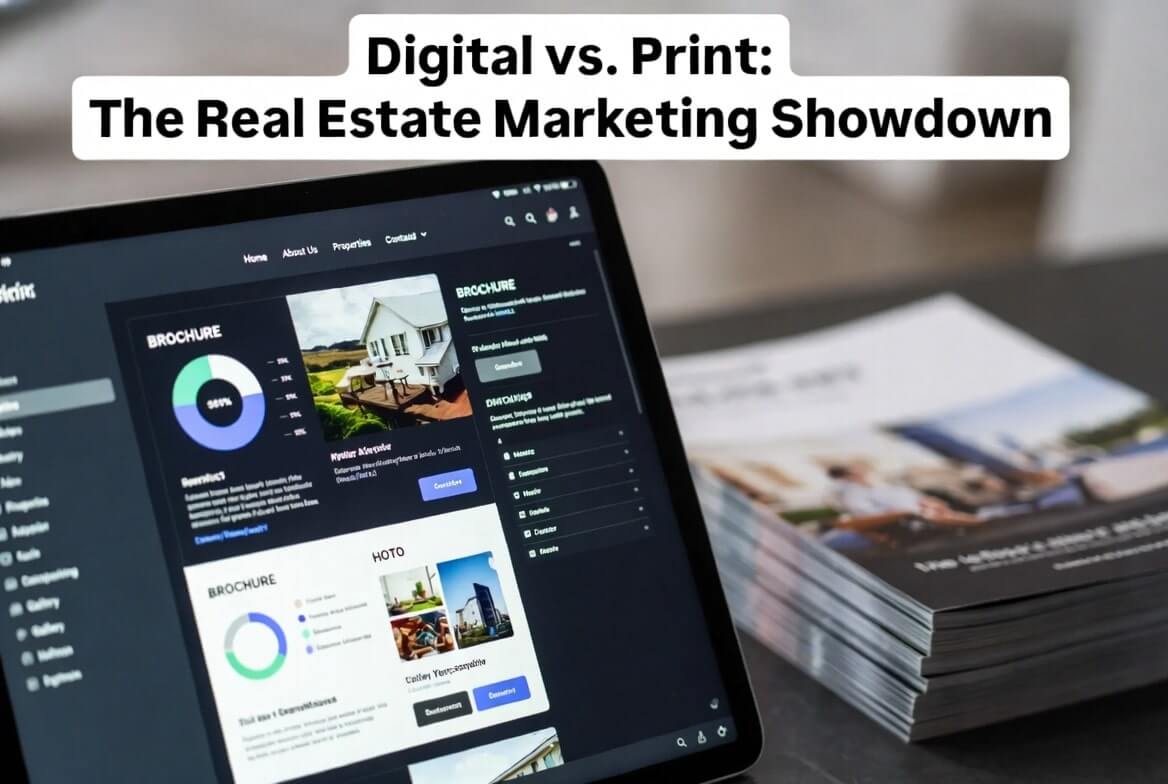
Digital Vs. Printed Real Estate Brochures: Which Actually Works Better?
You're standing in your office holding a stack of 500 freshly printed flyers. The design looks great. The photos pop. You spent time crafting the copy. But here's what you don't know: How many people will actually look at them? Where did they end up? Did anyone take action based on what they read? Will you know if one of those flyers resulted in a showing?
With printed flyers, the answer to all those questions is basically: you won't know.
With a digital brochure, you get answers in real time. You know exactly how many agents opened your email. Which ones clicked through. How long they spent looking at your listing. Whether they showed it to clients. You can even track if they called you based on the digital flyer.
This is the core difference between digital and printed brochures in real estate. It's not just about saving trees or feeling modern. It's about data, cost, speed, and actual measurable results.
This guide compares digital and printed brochures head-to-head across the metrics that matter most to your bottom line. Then we'll show you how the best agents aren't choosing between one or the other. They're using both strategically.
The Cost Comparison: What You Actually Spend
Let's start with the most concrete difference: what comes out of your pocket.
Printing and Distribution Costs
A standard printed real estate flyer costs anywhere from $0.05 to $0.75 per flyer depending on volume and print quality. But that's just printing. You also have to distribute them. If you're hand-delivering to neighboring offices or doing a neighborhood drop, distribution adds $0.70 to $1.50 per flyer. If you're using a service like EDDM (Every Door Direct Mail), you're looking at postage costs around $0.67 per piece, plus printing.
Here's what a modest 1,000-flyer campaign actually costs:
Printing: 1,000 flyers at $0.20 per flyer = $200
Distribution (hand-to-hand or door-to-door): 1,000 flyers at $0.70 per flyer = $700
Total cost: $900 for 1,000 flyers
That's $0.90 per flyer when you add everything together. For a single listing, if you print and distribute 500 flyers, you're looking at $450 out of pocket with no way to know the actual return.
Now compare that to digital. A digital brochure created on a platform like Blastrow typically costs nothing to produce once you have your photos and listing details. If you're using an email list or agent targeting service, you might pay $20 to $50 per month for the platform. But that fee covers unlimited listings. So spreading that across 4 to 12 listings per month brings the cost per listing down to just a few dollars, or essentially free if the platform is part of your existing subscription.
The cost advantage is immediate and significant. But the real difference isn't just what you spend upfront. It's what you can measure and improve.
Tracking and Testing Costs
With printed flyers, you have no way to track performance without paying for additional services. You could run split tests by sending two different designs to different neighborhoods and asking every caller how they heard about you, but this requires manual effort and guesswork.
With digital brochures, tracking is built in. You see open rates, click rates, view duration, and device types automatically. This data costs you nothing and enables continuous improvement.
The Data: What Gets Results
Here's where the numbers get interesting, because they reveal which approach actually generates leads and closes deals.
Response Rates and Engagement
Print marketing in real estate shows a 3.7% response rate when sent to targeted lists. That means 37 out of every 1,000 recipients respond. Direct mail with untargeted lists averages around 1 to 3% response.
Digital email marketing for real estate achieves a 20 to 40% open rate, depending on list quality and subject line effectiveness. Click-through rates typically range from 2 to 5%. Conversion rates, which represent people who actually take action (schedule a showing, fill out a form, etc.), range from 1 to 3%.
Wait. Those percentages seem lower than the print response rate. But here's the important part: those percentages are measuring different things.
Print response rate is measured by tracking coupon redemptions, phone calls, or forms filled out. It typically takes days for that response to arrive. Digital engagement is measured in minutes and hours. Opening an email is an engagement. Clicking to view the brochure is engagement. Both are measurable and happen fast.
More importantly, digital engagement creates opportunity for follow-up. When you see that an agent opened your email and clicked through to view the brochure, you can follow up immediately with a personalized message. Print never gives you that opportunity.
Real-World Timing
A printed flyer sent on Monday might arrive in a mailbox on Tuesday or Wednesday. An agent might glance at it, set it aside, or toss it. If they're interested, they might call or email later that week. By then, other offers might have come in or the agent's focus might have shifted.
A digital brochure sent at 10 AM reaches inboxes immediately. Agents see it that morning or afternoon. If they're interested, they can coordinate a showing that day or the next morning. The faster you move, the better your chances.
Properties marketed with digital flyers show faster days-to-close compared to those marketed with print alone. The speed of digital marketing directly impacts how quickly you move inventory.
The Search Engine Advantage: Playing the Long Game
Here's something printed flyers can never do: they don't rank in Google search results.
A digital brochure, when created on a platform with proper SEO infrastructure, lives on the web and can be indexed by Google. This means your listing brochure might show up when someone searches for properties in your neighborhood, properties with specific features, or open houses in your area.
Over 90 percent of homebuyers start their search on Google. When your digital brochure ranks in those search results, you're capturing interest that extends far beyond your initial email blast.
A single digital brochure can generate impressions and clicks for months or even years after you create it. That printed flyer is in a recycling bin after a week.
For SEO purposes, digital brochures should include:
- Clear, descriptive titles with location and key features
- Detailed property descriptions with relevant keywords
- High-quality images properly optimized
- Schema markup (structured data) that helps Google understand property details like price, bedrooms, location
- A clear call-to-action
When optimized this way, a digital brochure becomes an asset that keeps working long after you've moved on to your next listing.
Design and Presentation: Digital Wins on Flexibility
With a printed flyer, once it's printed, it's locked in. If the price drops, you can't update the flyer that's already in mailboxes. If you got new photos, too bad. If you want to add an open house date, you're starting over with a new print run.
Digital brochures update in seconds. Price change? Fixed immediately. New photos? Uploaded and live in minutes. Open house added? Updated and the new version is sent with your next email batch.
This flexibility also applies to testing and optimization. With digital, you can try different headlines, photo arrangements, or copy without reprinting anything. You can see what converts better and adjust. With print, you're committing to one version for thousands of copies.
The Reliability Factor: You Control the Message
With printed flyers, especially if you're using a distribution service, you don't always know where they end up or how they're handled. Some flyers get delivered. Some get lost. Some get handled roughly. Distribution quality varies.
With digital brochures, delivery is consistent. Once it reaches an agent's inbox, the quality and appearance are identical every time. The brochure looks the same on their phone as it does on their desktop.
You also control the exact message. With email, you write the subject line and the introduction. You determine timing. With print distribution services, your flyer is one of thousands in a batch, and the carrier has no incentive to handle yours carefully.
Here's the Thing About Open Rate Comparisons
You might have read that printed flyers have an 85% "open rate" compared to email's 20 to 40%. This statistic gets thrown around, but it's misleading.
An 85% open rate for printed flyers means 85% of people who receive a flyer will open and look at it at some point. That's the physical act of opening an envelope or picking up a flyer. But opening a printed piece doesn't tell you anything about engagement. Someone can open a flyer, skim it, and toss it without retaining any information.
Email open rates are tracked more rigorously and typically use pixel-based tracking (with some limitations from Apple's Mail Privacy Protection). An email that's opened is one that was actively retrieved from an inbox and viewed. These engagement levels aren't directly comparable because they measure different behaviors.
More importantly, the distinction matters less than this: with digital, you know who opened it. With print, you don't.
Return on Investment: The Money Speaks
Email marketing in real estate generates $36 in revenue for every $1 spent on average. That's a 3,600% ROI.
Direct mail marketing averages a 29% ROI for real estate applications.
Print outperforms email on engagement when measured as raw response rate percentage (3.7% vs. 0.62% for all digital channels combined). But when you calculate actual return on dollars spent, email wins decisively because the per-unit cost is so much lower.
Here's a concrete example:
Printed Flyer Campaign:
- 1,000 flyers printed and distributed: $900
- Expected response rate: 3.7% = 37 responses
- Cost per response: $24.32
Digital Brochure Campaign:
- 100 agents emailed through Blastrow or similar platform: $0 (platform fee spread across listings) or $10-50 if paying specifically for email list
- Expected click rate: 2.5% = 2.5 clicks
- Expected conversion rate: 1.5% of emails = 1.5 conversions
- Cost per conversion: $0-33
The digital approach reaches a much smaller segment (100 targeted agents vs. 1,000 random households) but does so at nearly zero cost and captures higher-quality leads because you're targeting agents who can bring qualified buyers.
The Hybrid Approach: Why Best Agents Use Both
The data makes the case clear: digital works better for speed, cost, tracking, and ROI. But here's what the best agents understand: printed flyers still have value in specific situations.
A high-end luxury property might warrant a beautiful printed brochure that buyers keep. A physical open house needs printed materials on site. Some neighborhoods are still heavily populated by older demographics less likely to engage with email.
The winning strategy isn't digital or print. It's both, used strategically.
When to Use Digital
Use digital brochures when you need speed and want to measure results. When you're reaching agents directly. When you want to update information frequently. When you need cost-effective distribution across multiple listings. When you want the listing to rank in search results over time. When you want real-time engagement data.
Basically, use digital as your primary marketing vehicle. Send every listing digitally.
When to Use Print
Use print for open house attendance. Print a limited quantity of high-quality brochures for people to take home from the open house. This serves a different purpose than your digital blast to agents.
Use print for follow-up materials. After an agent shows interest via email, send a printed brochure in the mail as a follow-up touch that reinforces your professionalism.
Use print in specific neighborhoods where the demographic skews older or less digital-savvy. Do your research on which areas this applies to.
Use print for luxury or high-value properties where the tangible, high-quality feel of print matters. A $3 million property warrants a $5 printed brochure.
The Hybrid Execution
Here's how this looks in practice:
- Week 1: Create a digital brochure. Send it via email to 80 nearby agents who've sold in the area or work with buyers in your price range.
- Days 2-3: Monitor open rates and clicks. Send a personalized follow-up email to agents who opened but didn't click.
- Week 2: Print 200 high-quality brochures for the open house. These sit on the dining room table for people to pick up.
- Week 2-3: For agents who've shown strong interest (multiple clicks, inquiries), mail a printed brochure as a professional follow-up. Your email said "let me know if interested," and a follow-up physical piece reinforces the message.
- Ongoing: The digital brochure keeps working. It ranks in search results. When agents search your area on Google, they might find it.
This approach leverages the strengths of both channels without overspending on print for every single listing.
Case Study: The Real Numbers
Let's look at a real-world example. Sarah, a listing agent, had two similar properties sell within the same month in the same neighborhood.
Property A - Printed Flyer Only:
- 2BR/2BA, priced at $385,000
- Printed 500 flyers, distributed to neighborhoods
- Cost: $425
- Days on market: 28 days
- Showings: 8 total
- Final price: $378,500 (sold slightly below asking)
Property B - Digital Brochure Plus Print (Hybrid):
- 2BR/2BA, priced at $389,000 (similar property)
- Digital brochure sent to 60 targeted agents via email
- Printed 150 brochures for open house
- Cost: $35 (email platform) + $120 (print) = $155 total
- Days on market: 12 days
- Showings: 14 total
- Final price: $391,500 (sold above asking)
Property B sold faster, attracted more showings, and sold for a higher price at less than one-third the marketing cost. The digital approach to targeting agents moved the property faster and generated more qualified interest than a general neighborhood flyer campaign.
This isn't an anomaly. This is the standard pattern agents see when they shift to digital-first strategies.
FAQ: Digital vs. Printed Real Estate Brochures
The Bottom Line
Digital brochures beat printed flyers on every metric that modern real estate marketing depends on: cost, speed, tracking, ROI, and long-term visibility.
Printed flyers still have a role when used strategically for open houses, luxury properties, or specific demographics.
But if you're still treating print and digital as equal options, the data shows you should be shifting your budget toward digital as your primary vehicle. Speed matters. Cost matters. Knowing whether someone actually looked at your listing matters.
The agents winning in 2026 aren't the ones who print the most flyers. They're the ones who send digital brochures that reach the right agents, provide measurable results, and create searchable assets that work for them indefinitely.
That's where the real advantage lies.

Blastrow
Listing Promotions